

6.3 Systems Analysis in Infrastructure Sectors
6.3.1 System Concepts
The word “system” arises from the Greek systema, itself stemming from syn
meaning together and histema meaning “to set”, giving literally “to set together”
for system. A complex arrangement of interrelated parts also defines a “system”. The
Oxford English Dictionary (1989, 2nd ed.) describes system as “a set or assemblage
of things connected, associated, or interdependent, so as to form a complex unity; a
whole composed of parts in orderly arrangement according to some scheme or plan”.
Using a very simple example, a finger can operate by itself, as well as all the fingers
on one hand. The hand, itself, is linked to the forearm and arm, not to say to other
parts of the human body. Thus, the hand can be seen as a system by itself, containing
or linked to many other interdependent components. As such, a system can comprise
sub-systems which, in turn, can consist of several sub-subsystems, etc. Conversely, a
system can form part of a bigger super-system, and so on.
Table 6.1 gives a list of definitions.
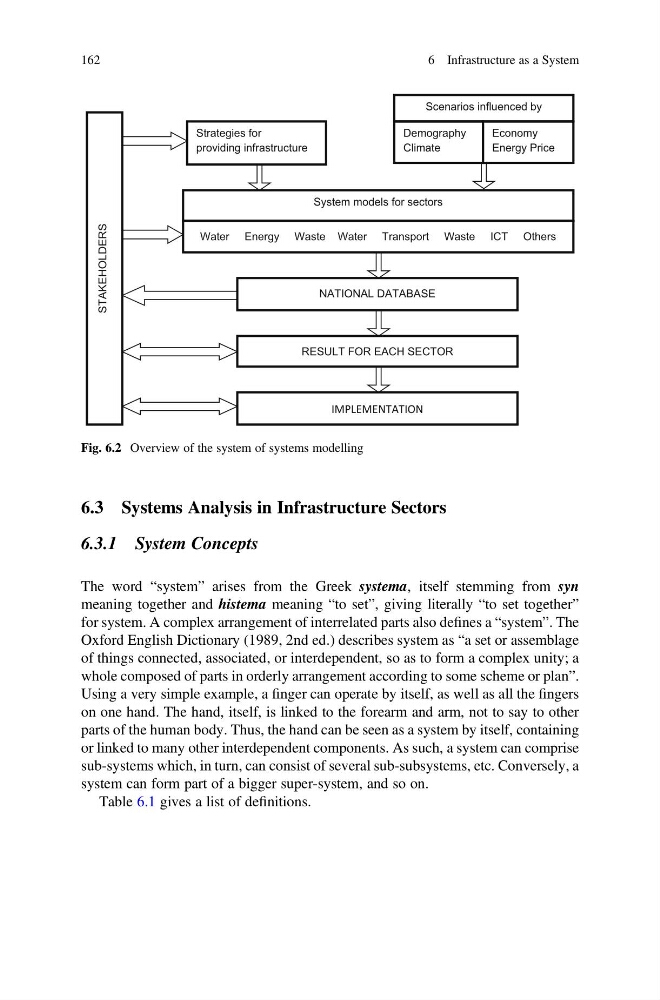
NATIONAL DATABASE
RESULT FOR EACH SECTOR
IMPLEMENTATION
Water Energy Waste Water Transport Waste ICT Others
System models for sectors
Strategies for
providing infrastructure
STAKEHOLDERS
Scenarios influenced by
Demography
Climate
Economy
Energy Price
Fig. 6.2 Overview of the system of systems modelling
162
6 Infrastructure as a System
6.3.1 System Concepts
The word “system” arises from the Greek systema, itself stemming from syn
meaning together and histema meaning “to set”, giving literally “to set together”
for system. A complex arrangement of interrelated parts also defines a “system”. The
Oxford English Dictionary (1989, 2nd ed.) describes system as “a set or assemblage
of things connected, associated, or interdependent, so as to form a complex unity; a
whole composed of parts in orderly arrangement according to some scheme or plan”.
Using a very simple example, a finger can operate by itself, as well as all the fingers
on one hand. The hand, itself, is linked to the forearm and arm, not to say to other
parts of the human body. Thus, the hand can be seen as a system by itself, containing
or linked to many other interdependent components. As such, a system can comprise
sub-systems which, in turn, can consist of several sub-subsystems, etc. Conversely, a
system can form part of a bigger super-system, and so on.
Table 6.1 gives a list of definitions.
NATIONAL DATABASE
RESULT FOR EACH SECTOR
IMPLEMENTATION
Water Energy Waste Water Transport Waste ICT Others
System models for sectors
Strategies for
providing infrastructure
STAKEHOLDERS
Scenarios influenced by
Demography
Climate
Economy
Energy Price
Fig. 6.2 Overview of the system of systems modelling
162
6 Infrastructure as a System