

5.2 Planning Investment in the Water Sector
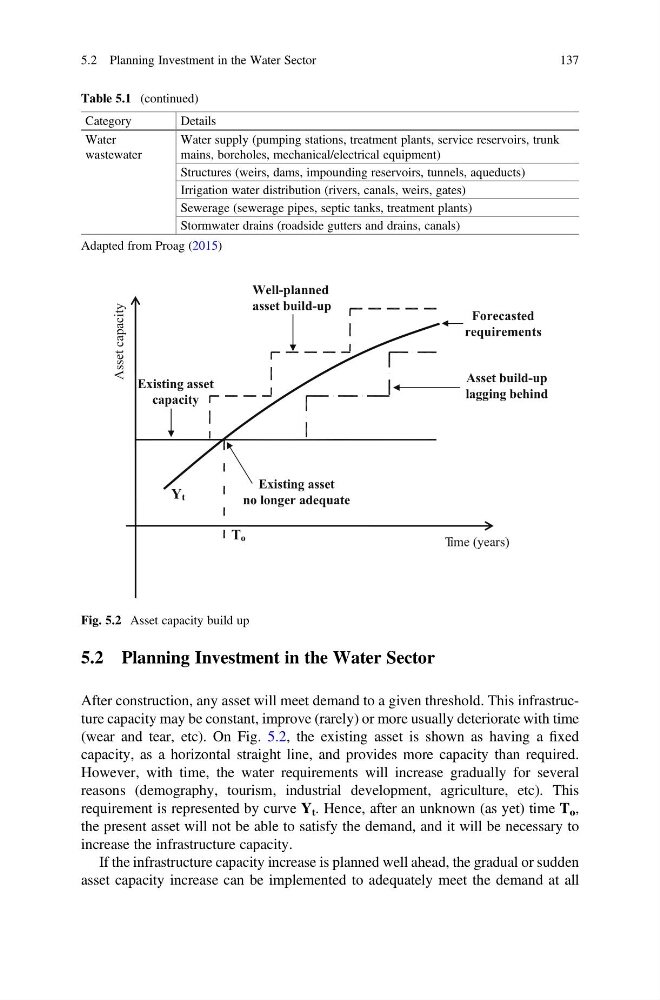
After construction, any asset will meet demand to a given threshold. This infrastructure capacity may be constant, improve (rarely) or more usually deteriorate with time
(wear and tear, etc). On Fig. 5.2, the existing asset is shown as having a fixed
capacity, as a horizontal straight line, and provides more capacity than required.
However, with time, the water requirements will increase gradually for several
reasons (demography, tourism, industrial development, agriculture, etc). This
requirement is represented by curve Y t . Hence, after an unknown (as yet) time T o ,
the present asset will not be able to satisfy the demand, and it will be necessary to
increase the infrastructure capacity.
If the infrastructure capacity increase is planned well ahead, the gradual or sudden
asset capacity increase can be implemented to adequately meet the demand at all
Table 5.1 (continued)
Category
Details
Water
wastewater
Water supply (pumping stations, treatment plants, service reservoirs, trunk
mains, boreholes, mechanical/electrical equipment)
Structures (weirs, dams, impounding reservoirs, tunnels, aqueducts)
Irrigation water distribution (rivers, canals, weirs, gates)
Sewerage (sewerage pipes, septic tanks, treatment plants)
Stormwater drains (roadside gutters and drains, canals)
Adapted from Proag (2015)
Well-planned
asset build-up
Forecasted
requirements
Existing asset
capacity
Asset build-up
lagging behind
Existing asset
no longer adequate
Time (years)
Asset capacity
Y t
T o
Fig. 5.2 Asset capacity build up
5.2 Planning Investment in the Water Sector
137
After construction, any asset will meet demand to a given threshold. This infrastructure capacity may be constant, improve (rarely) or more usually deteriorate with time
(wear and tear, etc). On Fig. 5.2, the existing asset is shown as having a fixed
capacity, as a horizontal straight line, and provides more capacity than required.
However, with time, the water requirements will increase gradually for several
reasons (demography, tourism, industrial development, agriculture, etc). This
requirement is represented by curve Y t . Hence, after an unknown (as yet) time T o ,
the present asset will not be able to satisfy the demand, and it will be necessary to
increase the infrastructure capacity.
If the infrastructure capacity increase is planned well ahead, the gradual or sudden
asset capacity increase can be implemented to adequately meet the demand at all
Table 5.1 (continued)
Category
Details
Water
wastewater
Water supply (pumping stations, treatment plants, service reservoirs, trunk
mains, boreholes, mechanical/electrical equipment)
Structures (weirs, dams, impounding reservoirs, tunnels, aqueducts)
Irrigation water distribution (rivers, canals, weirs, gates)
Sewerage (sewerage pipes, septic tanks, treatment plants)
Stormwater drains (roadside gutters and drains, canals)
Adapted from Proag (2015)
Well-planned
asset build-up
Forecasted
requirements
Existing asset
capacity
Asset build-up
lagging behind
Existing asset
no longer adequate
Time (years)
Asset capacity
Y t
T o
Fig. 5.2 Asset capacity build up
5.2 Planning Investment in the Water Sector
137