

are overtaken or surprised by the new possibilities or opportunities. Then there is a
gradual slowing down of the development rate, pending the next upsurge.
The following questions:
(1) How does development happen?
(2) What moves development forward?
(3) What slows it down or stops it?
(4) Why have some countries developed more than others?
(5) Can development occur continuously (indefinitely)? often raise heated debates.
Taking the expression “the engine of development”, let us use the analogy of the
engine (motor car) to obtain some clarifications.
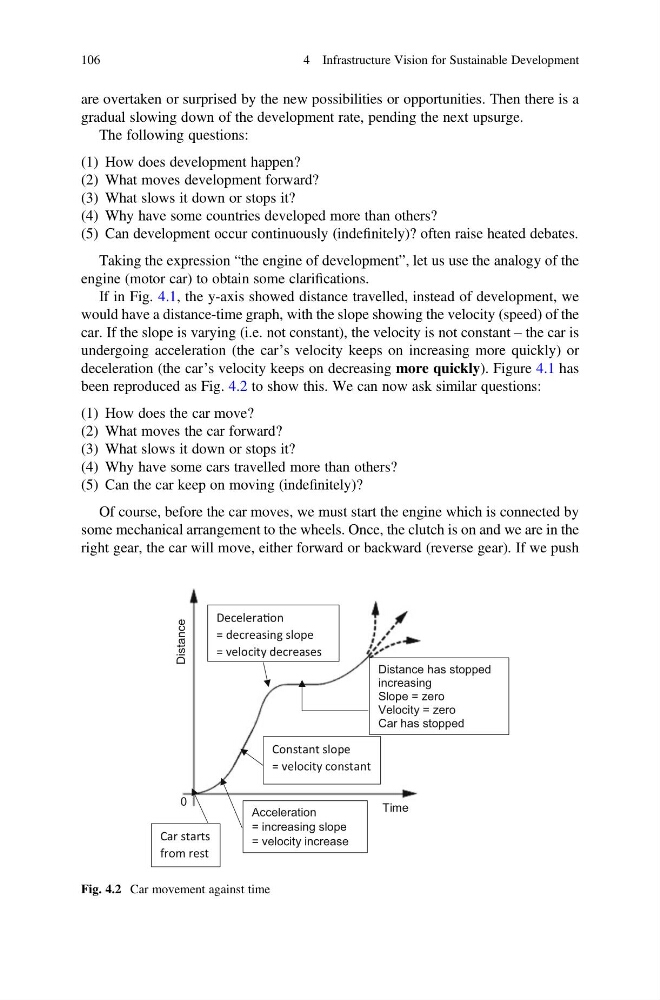
If in Fig. 4.1, the y-axis showed distance travelled, instead of development, we
would have a distance-time graph, with the slope showing the velocity (speed) of the
car. If the slope is varying (i.e. not constant), the velocity is not constant – the car is
undergoing acceleration (the car’s velocity keeps on increasing more quickly) or
deceleration (the car’s velocity keeps on decreasing more quickly). Figure 4.1 has
been reproduced as Fig. 4.2 to show this. We can now ask similar questions:
(1) How does the car move?
(2) What moves the car forward?
(3) What slows it down or stops it?
(4) Why have some cars travelled more than others?
(5) Can the car keep on moving (indefinitely)?
Of course, before the car moves, we must start the engine which is connected by
some mechanical arrangement to the wheels. Once, the clutch is on and we are in the
right gear, the car will move, either forward or backward (reverse gear). If we push
Distance has stopped
increasing
Slope = zero
Velocity = zero
Car has stopped
Acceleration
= increasing slope
= velocity increase
Time
Distance
DeceleraƟon
= decreasing slope
= velocity decreases
0
Car starts
from rest
Constant slope
= velocity constant
Fig. 4.2 Car movement against time
106
4 Infrastructure Vision for Sustainable Development
gradual slowing down of the development rate, pending the next upsurge.
The following questions:
(1) How does development happen?
(2) What moves development forward?
(3) What slows it down or stops it?
(4) Why have some countries developed more than others?
(5) Can development occur continuously (indefinitely)? often raise heated debates.
Taking the expression “the engine of development”, let us use the analogy of the
engine (motor car) to obtain some clarifications.
If in Fig. 4.1, the y-axis showed distance travelled, instead of development, we
would have a distance-time graph, with the slope showing the velocity (speed) of the
car. If the slope is varying (i.e. not constant), the velocity is not constant – the car is
undergoing acceleration (the car’s velocity keeps on increasing more quickly) or
deceleration (the car’s velocity keeps on decreasing more quickly). Figure 4.1 has
been reproduced as Fig. 4.2 to show this. We can now ask similar questions:
(1) How does the car move?
(2) What moves the car forward?
(3) What slows it down or stops it?
(4) Why have some cars travelled more than others?
(5) Can the car keep on moving (indefinitely)?
Of course, before the car moves, we must start the engine which is connected by
some mechanical arrangement to the wheels. Once, the clutch is on and we are in the
right gear, the car will move, either forward or backward (reverse gear). If we push
Distance has stopped
increasing
Slope = zero
Velocity = zero
Car has stopped
Acceleration
= increasing slope
= velocity increase
Time
Distance
DeceleraƟon
= decreasing slope
= velocity decreases
0
Car starts
from rest
Constant slope
= velocity constant
Fig. 4.2 Car movement against time
106
4 Infrastructure Vision for Sustainable Development