

4.1.2 Development in Practice
Table 4.1 shows what development might mean in practice.
There are, in fact, many countries, where at least one of these criteria has not been
fully met.
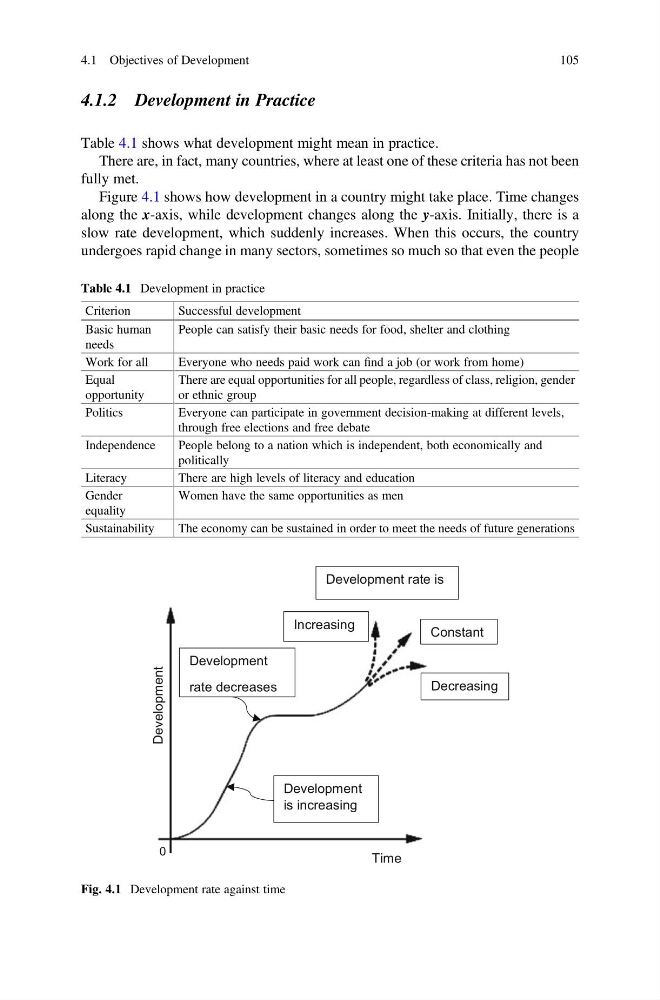
Figure 4.1 shows how development in a country might take place. Time changes
along the x-axis, while development changes along the y-axis. Initially, there is a
slow rate development, which suddenly increases. When this occurs, the country
undergoes rapid change in many sectors, sometimes so much so that even the people
Table 4.1 Development in practice
Criterion
Successful development
Basic human
needs
People can satisfy their basic needs for food, shelter and clothing
Work for all
Everyone who needs paid work can find a job (or work from home)
Equal
opportunity
There are equal opportunities for all people, regardless of class, religion, gender
or ethnic group
Politics
Everyone can participate in government decision-making at different levels,
through free elections and free debate
Independence
People belong to a nation which is independent, both economically and
politically
Literacy
There are high levels of literacy and education
Gender
equality
Women have the same opportunities as men
Sustainability
The economy can be sustained in order to meet the needs of future generations
Decreasing
Constant
Time
Increasing
Development rate is
Development
rate decreases
Development
is increasing
Development
0
Fig. 4.1 Development rate against time
4.1 Objectives of Development
105
Table 4.1 shows what development might mean in practice.
There are, in fact, many countries, where at least one of these criteria has not been
fully met.
Figure 4.1 shows how development in a country might take place. Time changes
along the x-axis, while development changes along the y-axis. Initially, there is a
slow rate development, which suddenly increases. When this occurs, the country
undergoes rapid change in many sectors, sometimes so much so that even the people
Table 4.1 Development in practice
Criterion
Successful development
Basic human
needs
People can satisfy their basic needs for food, shelter and clothing
Work for all
Everyone who needs paid work can find a job (or work from home)
Equal
opportunity
There are equal opportunities for all people, regardless of class, religion, gender
or ethnic group
Politics
Everyone can participate in government decision-making at different levels,
through free elections and free debate
Independence
People belong to a nation which is independent, both economically and
politically
Literacy
There are high levels of literacy and education
Gender
equality
Women have the same opportunities as men
Sustainability
The economy can be sustained in order to meet the needs of future generations
Decreasing
Constant
Time
Increasing
Development rate is
Development
rate decreases
Development
is increasing
Development
0
Fig. 4.1 Development rate against time
4.1 Objectives of Development
105