

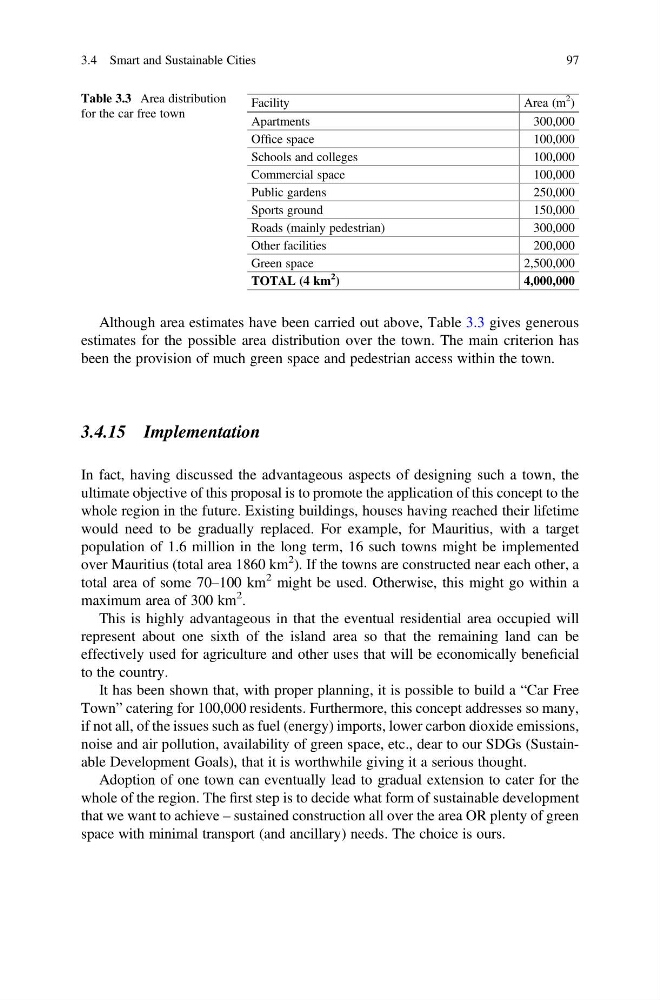
Although area estimates have been carried out above, Table 3.3 gives generous
estimates for the possible area distribution over the town. The main criterion has
been the provision of much green space and pedestrian access within the town.
3.4.15 Implementation
In fact, having discussed the advantageous aspects of designing such a town, the
ultimate objective of this proposal is to promote the application of this concept to the
whole region in the future. Existing buildings, houses having reached their lifetime
would need to be gradually replaced. For example, for Mauritius, with a target
population of 1.6 million in the long term, 16 such towns might be implemented
over Mauritius (total area 1860 km
2 ). If the towns are constructed near each other, a
total area of some 70–100 km
2 might be used. Otherwise, this might go within a
maximum area of 300 km
2 .
This is highly advantageous in that the eventual residential area occupied will
represent about one sixth of the island area so that the remaining land can be
effectively used for agriculture and other uses that will be economically beneficial
to the country.
It has been shown that, with proper planning, it is possible to build a “Car Free
Town” catering for 100,000 residents. Furthermore, this concept addresses so many,
if not all, of the issues such as fuel (energy) imports, lower carbon dioxide emissions,
noise and air pollution, availability of green space, etc., dear to our SDGs (Sustainable Development Goals), that it is worthwhile giving it a serious thought.
Adoption of one town can eventually lead to gradual extension to cater for the
whole of the region. The first step is to decide what form of sustainable development
that we want to achieve – sustained construction all over the area OR plenty of green
space with minimal transport (and ancillary) needs. The choice is ours.
Table 3.3 Area distribution
for the car free town
Facility
Area (m
2
)
Apartments
300,000
Office space
100,000
Schools and colleges
100,000
Commercial space
100,000
Public gardens
250,000
Sports ground
150,000
Roads (mainly pedestrian)
300,000
Other facilities
200,000
Green space
2,500,000
TOTAL (4 km
2
)
4,000,000
3.4 Smart and Sustainable Cities
97
estimates for the possible area distribution over the town. The main criterion has
been the provision of much green space and pedestrian access within the town.
3.4.15 Implementation
In fact, having discussed the advantageous aspects of designing such a town, the
ultimate objective of this proposal is to promote the application of this concept to the
whole region in the future. Existing buildings, houses having reached their lifetime
would need to be gradually replaced. For example, for Mauritius, with a target
population of 1.6 million in the long term, 16 such towns might be implemented
over Mauritius (total area 1860 km
2 ). If the towns are constructed near each other, a
total area of some 70–100 km
2 might be used. Otherwise, this might go within a
maximum area of 300 km
2 .
This is highly advantageous in that the eventual residential area occupied will
represent about one sixth of the island area so that the remaining land can be
effectively used for agriculture and other uses that will be economically beneficial
to the country.
It has been shown that, with proper planning, it is possible to build a “Car Free
Town” catering for 100,000 residents. Furthermore, this concept addresses so many,
if not all, of the issues such as fuel (energy) imports, lower carbon dioxide emissions,
noise and air pollution, availability of green space, etc., dear to our SDGs (Sustainable Development Goals), that it is worthwhile giving it a serious thought.
Adoption of one town can eventually lead to gradual extension to cater for the
whole of the region. The first step is to decide what form of sustainable development
that we want to achieve – sustained construction all over the area OR plenty of green
space with minimal transport (and ancillary) needs. The choice is ours.
Table 3.3 Area distribution
for the car free town
Facility
Area (m
2
)
Apartments
300,000
Office space
100,000
Schools and colleges
100,000
Commercial space
100,000
Public gardens
250,000
Sports ground
150,000
Roads (mainly pedestrian)
300,000
Other facilities
200,000
Green space
2,500,000
TOTAL (4 km
2
)
4,000,000
3.4 Smart and Sustainable Cities
97