

building. Thus, the persons living in a flat can move downstairs or to the adjacent
building to go to work and for shopping such that most of the inhabitants of the town
would rarely need to use vehicular transport. Hence, traffic flow in the town will be
largely reduced.
Given that the town is not completely self-sufficient, goods need to be transported
to the town. Examples of the goods that have to be transported include livestock,
fresh vegetables, clothes, etc. There will also be movement of those inhabitants
working in factories outside the town boundary every day in the morning and in the
afternoon. Traffic movements can also arise from movement of people from other
towns either to the particular town and vice versa.
3.4.3.2 Collector Roads
Although the above-mentioned movements in and out of the town are not very
significant, they are bound to cause traffic problems if the carriageways are not
properly designed. Thus a dual 4-lane carriageway is proposed to be used as the
collector roads.
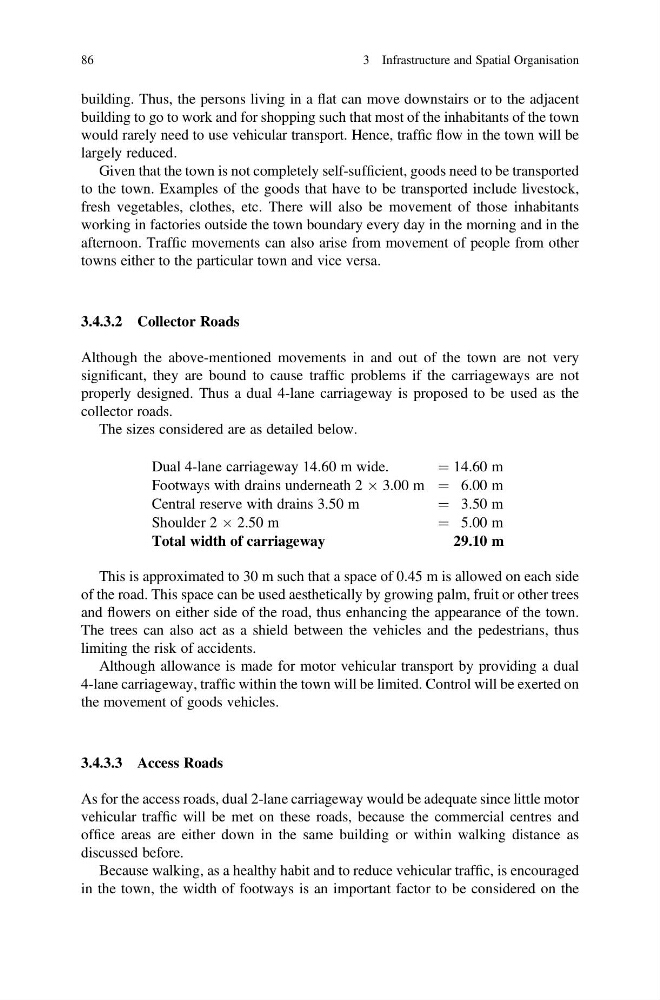
The sizes considered are as detailed below.
Dual 4-lane carriageway 14.60 m wide.
¼ 14.60 m
Footways with drains underneath 2 Â 3.00 m ¼ 6.00 m
Central reserve with drains 3.50 m
¼ 3.50 m
Shoulder 2 Â 2.50 m
¼ 5.00 m
Total width of carriageway
29.10 m
This is approximated to 30 m such that a space of 0.45 m is allowed on each side
of the road. This space can be used aesthetically by growing palm, fruit or other trees
and flowers on either side of the road, thus enhancing the appearance of the town.
The trees can also act as a shield between the vehicles and the pedestrians, thus
limiting the risk of accidents.
Although allowance is made for motor vehicular transport by providing a dual
4-lane carriageway, traffic within the town will be limited. Control will be exerted on
the movement of goods vehicles.
3.4.3.3 Access Roads
As for the access roads, dual 2-lane carriageway would be adequate since little motor
vehicular traffic will be met on these roads, because the commercial centres and
office areas are either down in the same building or within walking distance as
discussed before.
Because walking, as a healthy habit and to reduce vehicular traffic, is encouraged
in the town, the width of footways is an important factor to be considered on the
86
3 Infrastructure and Spatial Organisation
building to go to work and for shopping such that most of the inhabitants of the town
would rarely need to use vehicular transport. Hence, traffic flow in the town will be
largely reduced.
Given that the town is not completely self-sufficient, goods need to be transported
to the town. Examples of the goods that have to be transported include livestock,
fresh vegetables, clothes, etc. There will also be movement of those inhabitants
working in factories outside the town boundary every day in the morning and in the
afternoon. Traffic movements can also arise from movement of people from other
towns either to the particular town and vice versa.
3.4.3.2 Collector Roads
Although the above-mentioned movements in and out of the town are not very
significant, they are bound to cause traffic problems if the carriageways are not
properly designed. Thus a dual 4-lane carriageway is proposed to be used as the
collector roads.
The sizes considered are as detailed below.
Dual 4-lane carriageway 14.60 m wide.
¼ 14.60 m
Footways with drains underneath 2 Â 3.00 m ¼ 6.00 m
Central reserve with drains 3.50 m
¼ 3.50 m
Shoulder 2 Â 2.50 m
¼ 5.00 m
Total width of carriageway
29.10 m
This is approximated to 30 m such that a space of 0.45 m is allowed on each side
of the road. This space can be used aesthetically by growing palm, fruit or other trees
and flowers on either side of the road, thus enhancing the appearance of the town.
The trees can also act as a shield between the vehicles and the pedestrians, thus
limiting the risk of accidents.
Although allowance is made for motor vehicular transport by providing a dual
4-lane carriageway, traffic within the town will be limited. Control will be exerted on
the movement of goods vehicles.
3.4.3.3 Access Roads
As for the access roads, dual 2-lane carriageway would be adequate since little motor
vehicular traffic will be met on these roads, because the commercial centres and
office areas are either down in the same building or within walking distance as
discussed before.
Because walking, as a healthy habit and to reduce vehicular traffic, is encouraged
in the town, the width of footways is an important factor to be considered on the
86
3 Infrastructure and Spatial Organisation