

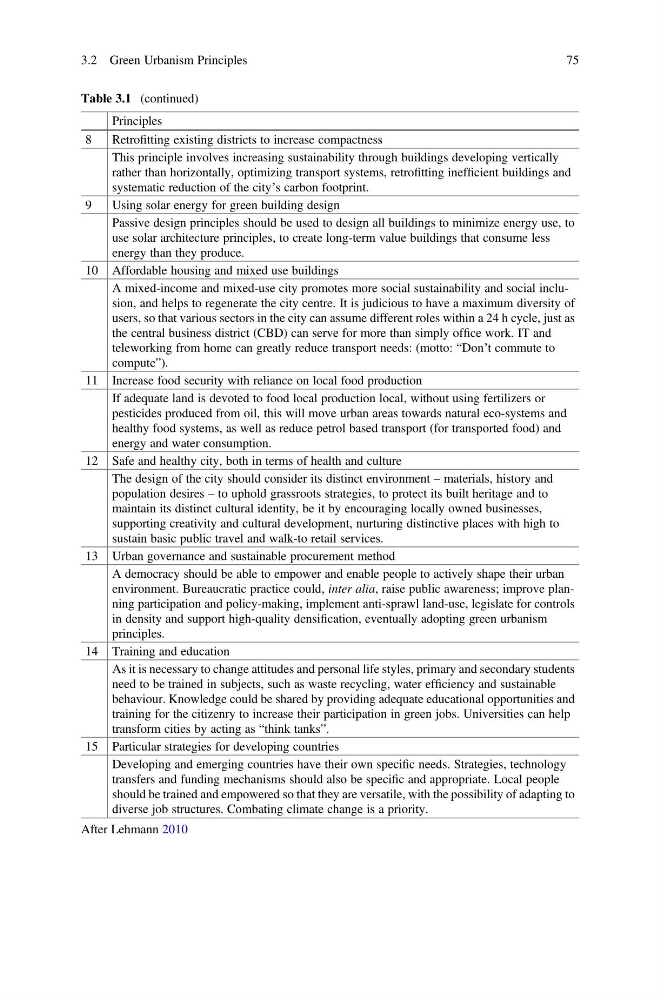
Table 3.1 (continued)
Principles
8
Retrofitting existing districts to increase compactness
This principle involves increasing sustainability through buildings developing vertically
rather than horizontally, optimizing transport systems, retrofitting inefficient buildings and
systematic reduction of the city’s carbon footprint.
9
Using solar energy for green building design
Passive design principles should be used to design all buildings to minimize energy use, to
use solar architecture principles, to create long-term value buildings that consume less
energy than they produce.
10 Affordable housing and mixed use buildings
A mixed-income and mixed-use city promotes more social sustainability and social inclusion, and helps to regenerate the city centre. It is judicious to have a maximum diversity of
users, so that various sectors in the city can assume different roles within a 24 h cycle, just as
the central business district (CBD) can serve for more than simply office work. IT and
teleworking from home can greatly reduce transport needs: (motto: “Don’t commute to
compute”).
11 Increase food security with reliance on local food production
If adequate land is devoted to food local production local, without using fertilizers or
pesticides produced from oil, this will move urban areas towards natural eco-systems and
healthy food systems, as well as reduce petrol based transport (for transported food) and
energy and water consumption.
12 Safe and healthy city, both in terms of health and culture
The design of the city should consider its distinct environment – materials, history and
population desires – to uphold grassroots strategies, to protect its built heritage and to
maintain its distinct cultural identity, be it by encouraging locally owned businesses,
supporting creativity and cultural development, nurturing distinctive places with high to
sustain basic public travel and walk-to retail services.
13 Urban governance and sustainable procurement method
A democracy should be able to empower and enable people to actively shape their urban
environment. Bureaucratic practice could, inter alia, raise public awareness; improve planning participation and policy-making, implement anti-sprawl land-use, legislate for controls
in density and support high-quality densification, eventually adopting green urbanism
principles.
14 Training and education
As it is necessary to change attitudes and personal life styles, primary and secondary students
need to be trained in subjects, such as waste recycling, water efficiency and sustainable
behaviour. Knowledge could be shared by providing adequate educational opportunities and
training for the citizenry to increase their participation in green jobs. Universities can help
transform cities by acting as “think tanks”.
15 Particular strategies for developing countries
Developing and emerging countries have their own specific needs. Strategies, technology
transfers and funding mechanisms should also be specific and appropriate. Local people
should be trained and empowered so that they are versatile, with the possibility of adapting to
diverse job structures. Combating climate change is a priority.
After Lehmann 2010
3.2 Green Urbanism Principles
75
Principles
8
Retrofitting existing districts to increase compactness
This principle involves increasing sustainability through buildings developing vertically
rather than horizontally, optimizing transport systems, retrofitting inefficient buildings and
systematic reduction of the city’s carbon footprint.
9
Using solar energy for green building design
Passive design principles should be used to design all buildings to minimize energy use, to
use solar architecture principles, to create long-term value buildings that consume less
energy than they produce.
10 Affordable housing and mixed use buildings
A mixed-income and mixed-use city promotes more social sustainability and social inclusion, and helps to regenerate the city centre. It is judicious to have a maximum diversity of
users, so that various sectors in the city can assume different roles within a 24 h cycle, just as
the central business district (CBD) can serve for more than simply office work. IT and
teleworking from home can greatly reduce transport needs: (motto: “Don’t commute to
compute”).
11 Increase food security with reliance on local food production
If adequate land is devoted to food local production local, without using fertilizers or
pesticides produced from oil, this will move urban areas towards natural eco-systems and
healthy food systems, as well as reduce petrol based transport (for transported food) and
energy and water consumption.
12 Safe and healthy city, both in terms of health and culture
The design of the city should consider its distinct environment – materials, history and
population desires – to uphold grassroots strategies, to protect its built heritage and to
maintain its distinct cultural identity, be it by encouraging locally owned businesses,
supporting creativity and cultural development, nurturing distinctive places with high to
sustain basic public travel and walk-to retail services.
13 Urban governance and sustainable procurement method
A democracy should be able to empower and enable people to actively shape their urban
environment. Bureaucratic practice could, inter alia, raise public awareness; improve planning participation and policy-making, implement anti-sprawl land-use, legislate for controls
in density and support high-quality densification, eventually adopting green urbanism
principles.
14 Training and education
As it is necessary to change attitudes and personal life styles, primary and secondary students
need to be trained in subjects, such as waste recycling, water efficiency and sustainable
behaviour. Knowledge could be shared by providing adequate educational opportunities and
training for the citizenry to increase their participation in green jobs. Universities can help
transform cities by acting as “think tanks”.
15 Particular strategies for developing countries
Developing and emerging countries have their own specific needs. Strategies, technology
transfers and funding mechanisms should also be specific and appropriate. Local people
should be trained and empowered so that they are versatile, with the possibility of adapting to
diverse job structures. Combating climate change is a priority.
After Lehmann 2010
3.2 Green Urbanism Principles
75