

4 Solar Cells: Optical and Recombination Losses
79
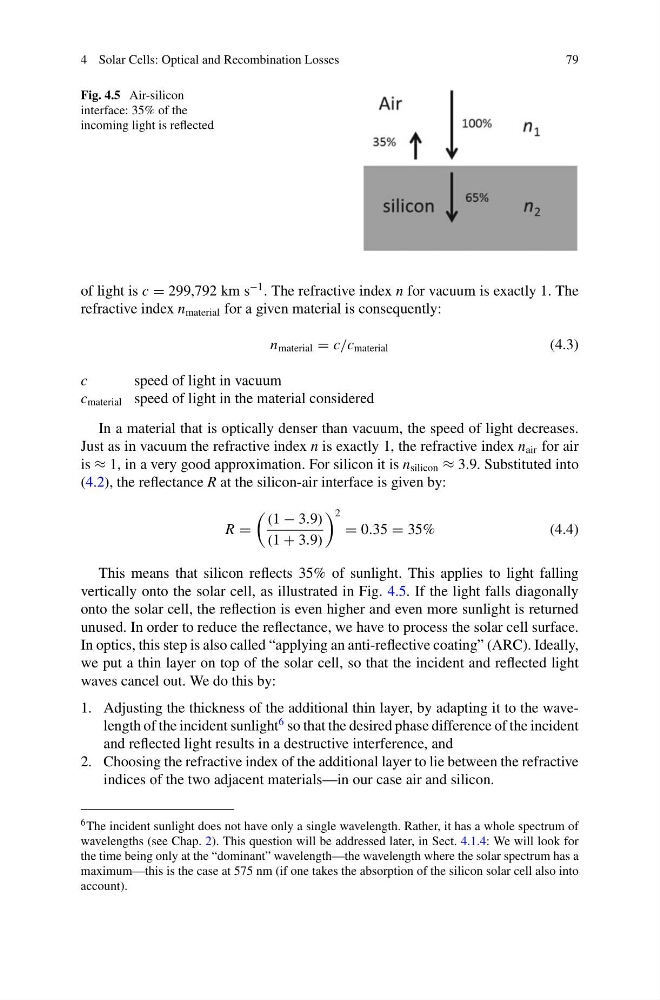
Fig. 4.5 Air-silicon
interface: 35% of the
incoming light is reflected
of light is c = 299,792 km s
−1 . The refractive index n for vacuum is exactly 1. The
refractive index n material for a given material is consequently:
n material = c/c material
(4.3)
c
speed of light in vacuum
c material speed of light in the material considered
In a material that is optically denser than vacuum, the speed of light decreases.
Just as in vacuum the refractive index n is exactly 1, the refractive index n air for air
is ≈ 1, in a very good approximation. For silicon it is n silicon ≈ 3.9. Substituted into
(4.2), the reflectance R at the silicon-air interface is given by:
R =
(1 − 3.9)
(1 + 3.9)
2
= 0.35 = 35%
(4.4)
This means that silicon reflects 35% of sunlight. This applies to light falling
vertically onto the solar cell, as illustrated in Fig. 4.5. If the light falls diagonally
onto the solar cell, the reflection is even higher and even more sunlight is returned
unused. In order to reduce the reflectance, we have to process the solar cell surface.
In optics, this step is also called “applying an anti-reflective coating” (ARC). Ideally,
we put a thin layer on top of the solar cell, so that the incident and reflected light
waves cancel out. We do this by:
1. Adjusting the thickness of the additional thin layer, by adapting it to the wavelength of the incident sunlight
6 so that the desired phase difference of the incident
and reflected light results in a destructive interference, and
2. Choosing the refractive index of the additional layer to lie between the refractive
indices of the two adjacent materials—in our case air and silicon.
6 The incident sunlight does not have only a single wavelength. Rather, it has a whole spectrum of
wavelengths (see Chap. 2). This question will be addressed later, in Sect. 4.1.4: We will look for
the time being only at the “dominant” wavelength—the wavelength where the solar spectrum has a
maximum—this is the case at 575 nm (if one takes the absorption of the silicon solar cell also into
account).
79
Fig. 4.5 Air-silicon
interface: 35% of the
incoming light is reflected
of light is c = 299,792 km s
−1 . The refractive index n for vacuum is exactly 1. The
refractive index n material for a given material is consequently:
n material = c/c material
(4.3)
c
speed of light in vacuum
c material speed of light in the material considered
In a material that is optically denser than vacuum, the speed of light decreases.
Just as in vacuum the refractive index n is exactly 1, the refractive index n air for air
is ≈ 1, in a very good approximation. For silicon it is n silicon ≈ 3.9. Substituted into
(4.2), the reflectance R at the silicon-air interface is given by:
R =
(1 − 3.9)
(1 + 3.9)
2
= 0.35 = 35%
(4.4)
This means that silicon reflects 35% of sunlight. This applies to light falling
vertically onto the solar cell, as illustrated in Fig. 4.5. If the light falls diagonally
onto the solar cell, the reflection is even higher and even more sunlight is returned
unused. In order to reduce the reflectance, we have to process the solar cell surface.
In optics, this step is also called “applying an anti-reflective coating” (ARC). Ideally,
we put a thin layer on top of the solar cell, so that the incident and reflected light
waves cancel out. We do this by:
1. Adjusting the thickness of the additional thin layer, by adapting it to the wavelength of the incident sunlight
6 so that the desired phase difference of the incident
and reflected light results in a destructive interference, and
2. Choosing the refractive index of the additional layer to lie between the refractive
indices of the two adjacent materials—in our case air and silicon.
6 The incident sunlight does not have only a single wavelength. Rather, it has a whole spectrum of
wavelengths (see Chap. 2). This question will be addressed later, in Sect. 4.1.4: We will look for
the time being only at the “dominant” wavelength—the wavelength where the solar spectrum has a
maximum—this is the case at 575 nm (if one takes the absorption of the silicon solar cell also into
account).