

4 Solar Cells: Optical and Recombination Losses
77
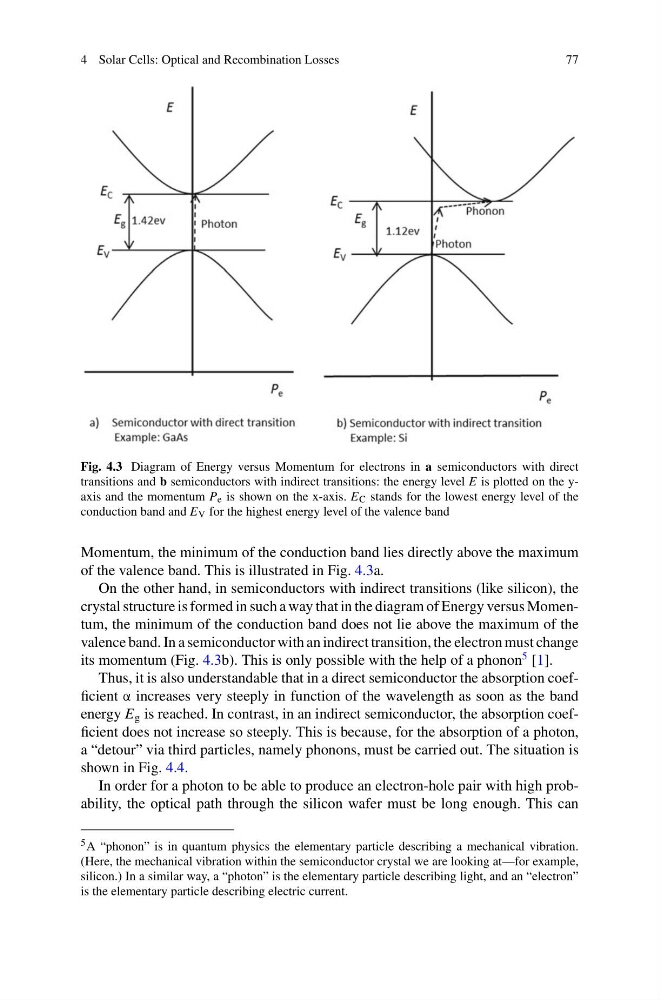
Fig. 4.3 Diagram of Energy versus Momentum for electrons in a semiconductors with direct
transitions and b semiconductors with indirect transitions: the energy level E is plotted on the yaxis and the momentum P e is shown on the x-axis. E C stands for the lowest energy level of the
conduction band and E V for the highest energy level of the valence band
Momentum, the minimum of the conduction band lies directly above the maximum
of the valence band. This is illustrated in Fig. 4.3a.
On the other hand, in semiconductors with indirect transitions (like silicon), the
crystal structure is formed in such a way that in the diagram of Energy versus Momentum, the minimum of the conduction band does not lie above the maximum of the
valence band. In a semiconductor with an indirect transition, the electron must change
its momentum (Fig. 4.3b). This is only possible with the help of a phonon
5 [1].
Thus, it is also understandable that in a direct semiconductor the absorption coefficient α increases very steeply in function of the wavelength as soon as the band
energy E g is reached. In contrast, in an indirect semiconductor, the absorption coefficient does not increase so steeply. This is because, for the absorption of a photon,
a “detour” via third particles, namely phonons, must be carried out. The situation is
shown in Fig. 4.4.
In order for a photon to be able to produce an electron-hole pair with high probability, the optical path through the silicon wafer must be long enough. This can
5 A “phonon” is in quantum physics the elementary particle describing a mechanical vibration.
(Here, the mechanical vibration within the semiconductor crystal we are looking at—for example,
silicon.) In a similar way, a “photon” is the elementary particle describing light, and an “electron”
is the elementary particle describing electric current.
77
Fig. 4.3 Diagram of Energy versus Momentum for electrons in a semiconductors with direct
transitions and b semiconductors with indirect transitions: the energy level E is plotted on the yaxis and the momentum P e is shown on the x-axis. E C stands for the lowest energy level of the
conduction band and E V for the highest energy level of the valence band
Momentum, the minimum of the conduction band lies directly above the maximum
of the valence band. This is illustrated in Fig. 4.3a.
On the other hand, in semiconductors with indirect transitions (like silicon), the
crystal structure is formed in such a way that in the diagram of Energy versus Momentum, the minimum of the conduction band does not lie above the maximum of the
valence band. In a semiconductor with an indirect transition, the electron must change
its momentum (Fig. 4.3b). This is only possible with the help of a phonon
5 [1].
Thus, it is also understandable that in a direct semiconductor the absorption coefficient α increases very steeply in function of the wavelength as soon as the band
energy E g is reached. In contrast, in an indirect semiconductor, the absorption coefficient does not increase so steeply. This is because, for the absorption of a photon,
a “detour” via third particles, namely phonons, must be carried out. The situation is
shown in Fig. 4.4.
In order for a photon to be able to produce an electron-hole pair with high probability, the optical path through the silicon wafer must be long enough. This can
5 A “phonon” is in quantum physics the elementary particle describing a mechanical vibration.
(Here, the mechanical vibration within the semiconductor crystal we are looking at—for example,
silicon.) In a similar way, a “photon” is the elementary particle describing light, and an “electron”
is the elementary particle describing electric current.