

70
A. Shah
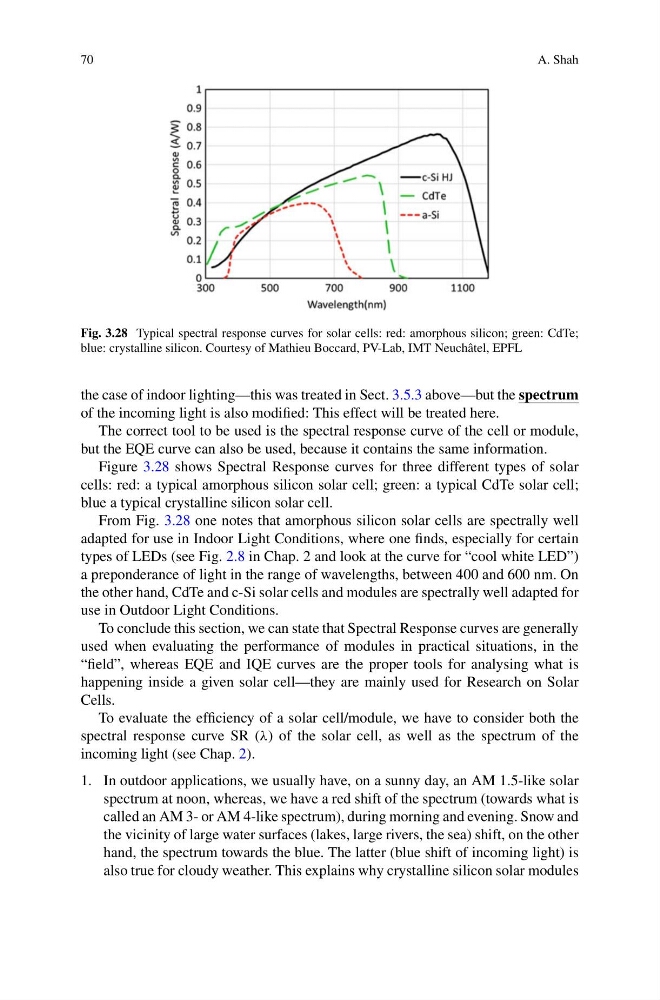
Fig. 3.28 Typical spectral response curves for solar cells: red: amorphous silicon; green: CdTe;
blue: crystalline silicon. Courtesy of Mathieu Boccard, PV-Lab, IMT Neuchâtel, EPFL
the case of indoor lighting—this was treated in Sect. 3.5.3 above—but the spectrum
of the incoming light is also modified: This effect will be treated here.
The correct tool to be used is the spectral response curve of the cell or module,
but the EQE curve can also be used, because it contains the same information.
Figure 3.28 shows Spectral Response curves for three different types of solar
cells: red: a typical amorphous silicon solar cell; green: a typical CdTe solar cell;
blue a typical crystalline silicon solar cell.
From Fig. 3.28 one notes that amorphous silicon solar cells are spectrally well
adapted for use in Indoor Light Conditions, where one finds, especially for certain
types of LEDs (see Fig. 2.8 in Chap. 2 and look at the curve for “cool white LED”)
a preponderance of light in the range of wavelengths, between 400 and 600 nm. On
the other hand, CdTe and c-Si solar cells and modules are spectrally well adapted for
use in Outdoor Light Conditions.
To conclude this section, we can state that Spectral Response curves are generally
used when evaluating the performance of modules in practical situations, in the
“field”, whereas EQE and IQE curves are the proper tools for analysing what is
happening inside a given solar cell—they are mainly used for Research on Solar
Cells.
To evaluate the efficiency of a solar cell/module, we have to consider both the
spectral response curve SR (λ) of the solar cell, as well as the spectrum of the
incoming light (see Chap. 2).
1. In outdoor applications, we usually have, on a sunny day, an AM 1.5-like solar
spectrum at noon, whereas, we have a red shift of the spectrum (towards what is
called an AM 3- or AM 4-like spectrum), during morning and evening. Snow and
the vicinity of large water surfaces (lakes, large rivers, the sea) shift, on the other
hand, the spectrum towards the blue. The latter (blue shift of incoming light) is
also true for cloudy weather. This explains why crystalline silicon solar modules
A. Shah
Fig. 3.28 Typical spectral response curves for solar cells: red: amorphous silicon; green: CdTe;
blue: crystalline silicon. Courtesy of Mathieu Boccard, PV-Lab, IMT Neuchâtel, EPFL
the case of indoor lighting—this was treated in Sect. 3.5.3 above—but the spectrum
of the incoming light is also modified: This effect will be treated here.
The correct tool to be used is the spectral response curve of the cell or module,
but the EQE curve can also be used, because it contains the same information.
Figure 3.28 shows Spectral Response curves for three different types of solar
cells: red: a typical amorphous silicon solar cell; green: a typical CdTe solar cell;
blue a typical crystalline silicon solar cell.
From Fig. 3.28 one notes that amorphous silicon solar cells are spectrally well
adapted for use in Indoor Light Conditions, where one finds, especially for certain
types of LEDs (see Fig. 2.8 in Chap. 2 and look at the curve for “cool white LED”)
a preponderance of light in the range of wavelengths, between 400 and 600 nm. On
the other hand, CdTe and c-Si solar cells and modules are spectrally well adapted for
use in Outdoor Light Conditions.
To conclude this section, we can state that Spectral Response curves are generally
used when evaluating the performance of modules in practical situations, in the
“field”, whereas EQE and IQE curves are the proper tools for analysing what is
happening inside a given solar cell—they are mainly used for Research on Solar
Cells.
To evaluate the efficiency of a solar cell/module, we have to consider both the
spectral response curve SR (λ) of the solar cell, as well as the spectrum of the
incoming light (see Chap. 2).
1. In outdoor applications, we usually have, on a sunny day, an AM 1.5-like solar
spectrum at noon, whereas, we have a red shift of the spectrum (towards what is
called an AM 3- or AM 4-like spectrum), during morning and evening. Snow and
the vicinity of large water surfaces (lakes, large rivers, the sea) shift, on the other
hand, the spectrum towards the blue. The latter (blue shift of incoming light) is
also true for cloudy weather. This explains why crystalline silicon solar modules