

3 Solar Cells: Basics
67
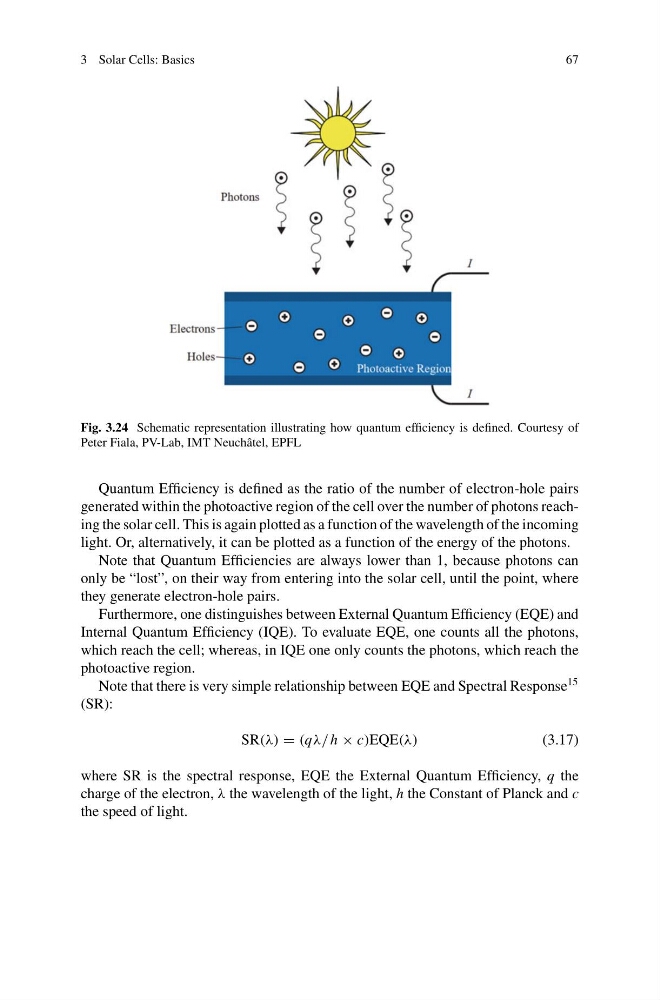
Fig. 3.24 Schematic representation illustrating how quantum efficiency is defined. Courtesy of
Peter Fiala, PV-Lab, IMT Neuchâtel, EPFL
Quantum Efficiency is defined as the ratio of the number of electron-hole pairs
generated within the photoactive region of the cell over the number of photons reaching the solar cell. This is again plotted as a function of the wavelength of the incoming
light. Or, alternatively, it can be plotted as a function of the energy of the photons.
Note that Quantum Efficiencies are always lower than 1, because photons can
only be “lost”, on their way from entering into the solar cell, until the point, where
they generate electron-hole pairs.
Furthermore, one distinguishes between External Quantum Efficiency (EQE) and
Internal Quantum Efficiency (IQE). To evaluate EQE, one counts all the photons,
which reach the cell; whereas, in IQE one only counts the photons, which reach the
photoactive region.
Note that there is very simple relationship between EQE and Spectral Response
15
(SR):
SR(λ) = (qλ/ h × c)EQE(λ)
(3.17)
where SR is the spectral response, EQE the External Quantum Efficiency, q the
charge of the electron, λ the wavelength of the light, h the Constant of Planck and c
the speed of light.
67
Fig. 3.24 Schematic representation illustrating how quantum efficiency is defined. Courtesy of
Peter Fiala, PV-Lab, IMT Neuchâtel, EPFL
Quantum Efficiency is defined as the ratio of the number of electron-hole pairs
generated within the photoactive region of the cell over the number of photons reaching the solar cell. This is again plotted as a function of the wavelength of the incoming
light. Or, alternatively, it can be plotted as a function of the energy of the photons.
Note that Quantum Efficiencies are always lower than 1, because photons can
only be “lost”, on their way from entering into the solar cell, until the point, where
they generate electron-hole pairs.
Furthermore, one distinguishes between External Quantum Efficiency (EQE) and
Internal Quantum Efficiency (IQE). To evaluate EQE, one counts all the photons,
which reach the cell; whereas, in IQE one only counts the photons, which reach the
photoactive region.
Note that there is very simple relationship between EQE and Spectral Response
15
(SR):
SR(λ) = (qλ/ h × c)EQE(λ)
(3.17)
where SR is the spectral response, EQE the External Quantum Efficiency, q the
charge of the electron, λ the wavelength of the light, h the Constant of Planck and c
the speed of light.