

3 Solar Cells: Basics
45
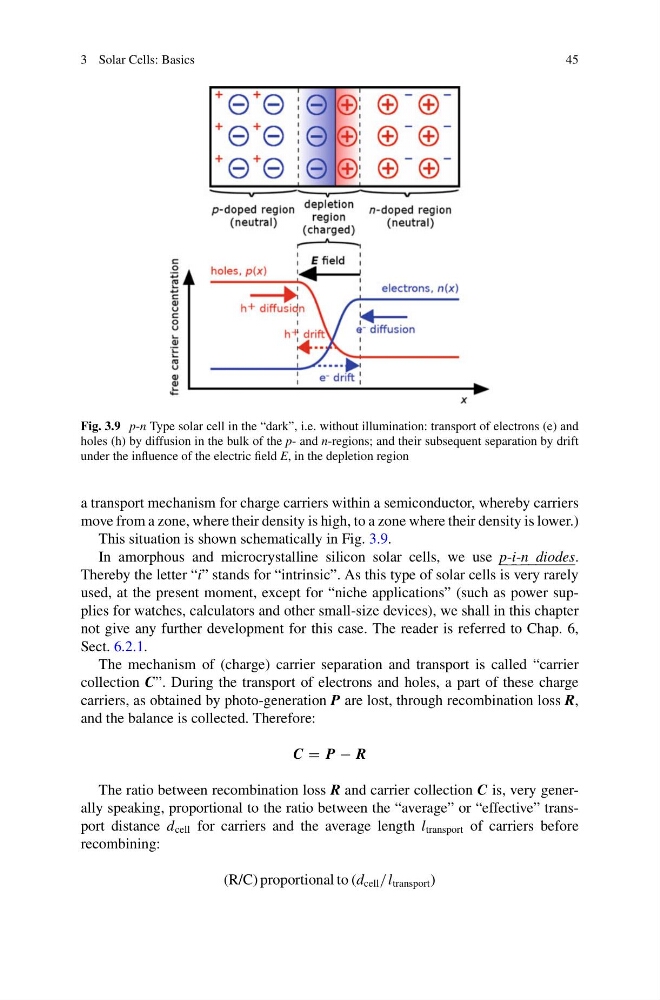
Fig. 3.9 p-n Type solar cell in the “dark”, i.e. without illumination: transport of electrons (e) and
holes (h) by diffusion in the bulk of the p- and n-regions; and their subsequent separation by drift
under the influence of the electric field E, in the depletion region
a transport mechanism for charge carriers within a semiconductor, whereby carriers
move from a zone, where their density is high, to a zone where their density is lower.)
This situation is shown schematically in Fig. 3.9.
In amorphous and microcrystalline silicon solar cells, we use p-i-n diodes.
Thereby the letter “i” stands for “intrinsic”. As this type of solar cells is very rarely
used, at the present moment, except for “niche applications” (such as power supplies for watches, calculators and other small-size devices), we shall in this chapter
not give any further development for this case. The reader is referred to Chap. 6,
Sect. 6.2.1.
The mechanism of (charge) carrier separation and transport is called “carrier
collection C”. During the transport of electrons and holes, a part of these charge
carriers, as obtained by photo-generation P are lost, through recombination loss R,
and the balance is collected. Therefore:
C = P − R
The ratio between recombination loss R and carrier collection C is, very generally speaking, proportional to the ratio between the “average” or “effective” transport distance d cell for carriers and the average length l transport of carriers before
recombining:
(R/C) proportional to (d cell /l transport )
45
Fig. 3.9 p-n Type solar cell in the “dark”, i.e. without illumination: transport of electrons (e) and
holes (h) by diffusion in the bulk of the p- and n-regions; and their subsequent separation by drift
under the influence of the electric field E, in the depletion region
a transport mechanism for charge carriers within a semiconductor, whereby carriers
move from a zone, where their density is high, to a zone where their density is lower.)
This situation is shown schematically in Fig. 3.9.
In amorphous and microcrystalline silicon solar cells, we use p-i-n diodes.
Thereby the letter “i” stands for “intrinsic”. As this type of solar cells is very rarely
used, at the present moment, except for “niche applications” (such as power supplies for watches, calculators and other small-size devices), we shall in this chapter
not give any further development for this case. The reader is referred to Chap. 6,
Sect. 6.2.1.
The mechanism of (charge) carrier separation and transport is called “carrier
collection C”. During the transport of electrons and holes, a part of these charge
carriers, as obtained by photo-generation P are lost, through recombination loss R,
and the balance is collected. Therefore:
C = P − R
The ratio between recombination loss R and carrier collection C is, very generally speaking, proportional to the ratio between the “average” or “effective” transport distance d cell for carriers and the average length l transport of carriers before
recombining:
(R/C) proportional to (d cell /l transport )