

336
S. Nowak
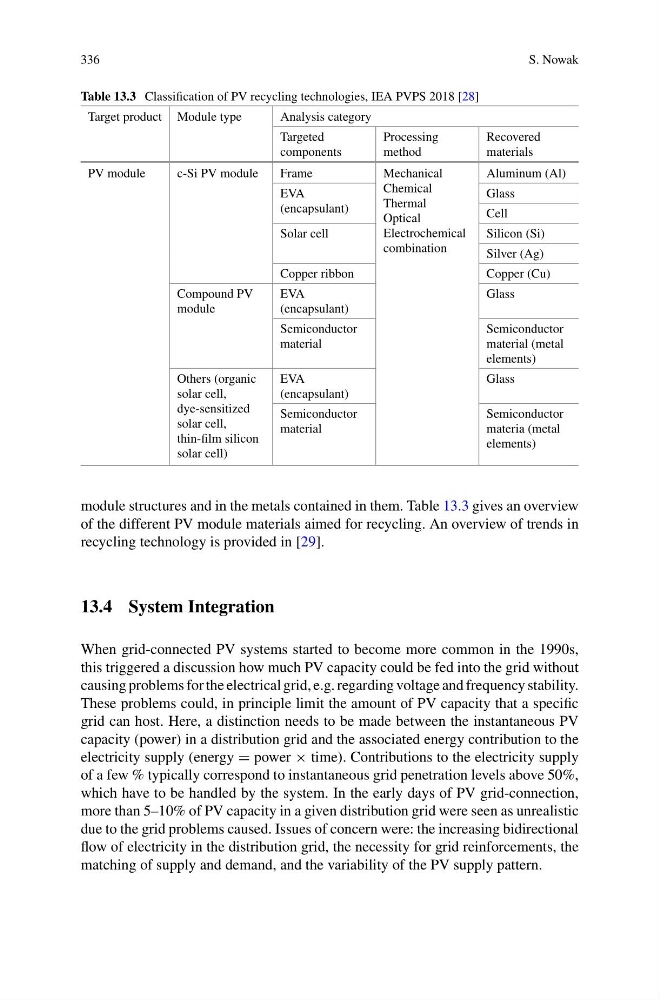
Table 13.3 Classification of PV recycling technologies, IEA PVPS 2018 [28]
Target product Module type
Analysis category
Targeted
components
Processing
method
Recovered
materials
PV module
c-Si PV module
Frame
Mechanical
Chemical
Thermal
Optical
Electrochemical
combination
Aluminum (Al)
EVA
(encapsulant)
Glass
Cell
Solar cell
Silicon (Si)
Silver (Ag)
Copper ribbon
Copper (Cu)
Compound PV
module
EVA
(encapsulant)
Glass
Semiconductor
material
Semiconductor
material (metal
elements)
Others (organic
solar cell,
dye-sensitized
solar cell,
thin-film silicon
solar cell)
EVA
(encapsulant)
Glass
Semiconductor
material
Semiconductor
materia (metal
elements)
module structures and in the metals contained in them. Table 13.3 gives an overview
of the different PV module materials aimed for recycling. An overview of trends in
recycling technology is provided in [29].
13.4 System Integration
When grid-connected PV systems started to become more common in the 1990s,
this triggered a discussion how much PV capacity could be fed into the grid without
causing problems for the electrical grid, e.g. regarding voltage and frequency stability.
These problems could, in principle limit the amount of PV capacity that a specific
grid can host. Here, a distinction needs to be made between the instantaneous PV
capacity (power) in a distribution grid and the associated energy contribution to the
electricity supply (energy = power × time). Contributions to the electricity supply
of a few % typically correspond to instantaneous grid penetration levels above 50%,
which have to be handled by the system. In the early days of PV grid-connection,
more than 5–10% of PV capacity in a given distribution grid were seen as unrealistic
due to the grid problems caused. Issues of concern were: the increasing bidirectional
flow of electricity in the distribution grid, the necessity for grid reinforcements, the
matching of supply and demand, and the variability of the PV supply pattern.
S. Nowak
Table 13.3 Classification of PV recycling technologies, IEA PVPS 2018 [28]
Target product Module type
Analysis category
Targeted
components
Processing
method
Recovered
materials
PV module
c-Si PV module
Frame
Mechanical
Chemical
Thermal
Optical
Electrochemical
combination
Aluminum (Al)
EVA
(encapsulant)
Glass
Cell
Solar cell
Silicon (Si)
Silver (Ag)
Copper ribbon
Copper (Cu)
Compound PV
module
EVA
(encapsulant)
Glass
Semiconductor
material
Semiconductor
material (metal
elements)
Others (organic
solar cell,
dye-sensitized
solar cell,
thin-film silicon
solar cell)
EVA
(encapsulant)
Glass
Semiconductor
material
Semiconductor
materia (metal
elements)
module structures and in the metals contained in them. Table 13.3 gives an overview
of the different PV module materials aimed for recycling. An overview of trends in
recycling technology is provided in [29].
13.4 System Integration
When grid-connected PV systems started to become more common in the 1990s,
this triggered a discussion how much PV capacity could be fed into the grid without
causing problems for the electrical grid, e.g. regarding voltage and frequency stability.
These problems could, in principle limit the amount of PV capacity that a specific
grid can host. Here, a distinction needs to be made between the instantaneous PV
capacity (power) in a distribution grid and the associated energy contribution to the
electricity supply (energy = power × time). Contributions to the electricity supply
of a few % typically correspond to instantaneous grid penetration levels above 50%,
which have to be handled by the system. In the early days of PV grid-connection,
more than 5–10% of PV capacity in a given distribution grid were seen as unrealistic
due to the grid problems caused. Issues of concern were: the increasing bidirectional
flow of electricity in the distribution grid, the necessity for grid reinforcements, the
matching of supply and demand, and the variability of the PV supply pattern.