

13 Photovoltaics in the Future Energy System
331
13.2 Regulatory Issues
Since a large majority of photovoltaic power systems are connected to the electric
grid, regulatory issues play a dominant role in PV market development, both in
technical and economic terms.
Feeding electricity at low power levels into the distribution grid is associated
with the following aspects: safety issues in case of grid shut-down and subsequent
potential islanding of the PV system, as well as voltage and frequency stability in the
distribution grid. Technical grid integration aspects are therefore an important topic,
in particular for high PV penetration rates (see Sect. 13.4 below).
Regulatory issues address the question how PV electricity is remunerated, and
more broadly, how PV is integrated into the electricity market. In order to kickstart the PV market in the early 2000s, due to the initially very high costs of gridconnected PV systems, a regulatory framework was necessary which allowed for
the market entry in economic terms. For this purpose, various support schemes were
introduced by the policy makers in different countries over the past 20 years—they
have since strongly evolved. Among these, one can distinguish in particular between
pure investment subsidies (grants), remuneration schemes (e.g. FIT, premium tariffs, net metering, self-consumption), tax credits and measures (e.g. investment tax,
VAT), green certificates and labels, renewable portfolio standards (RPS) and auctions
(tenders, power purchase agreements (PPAs)).
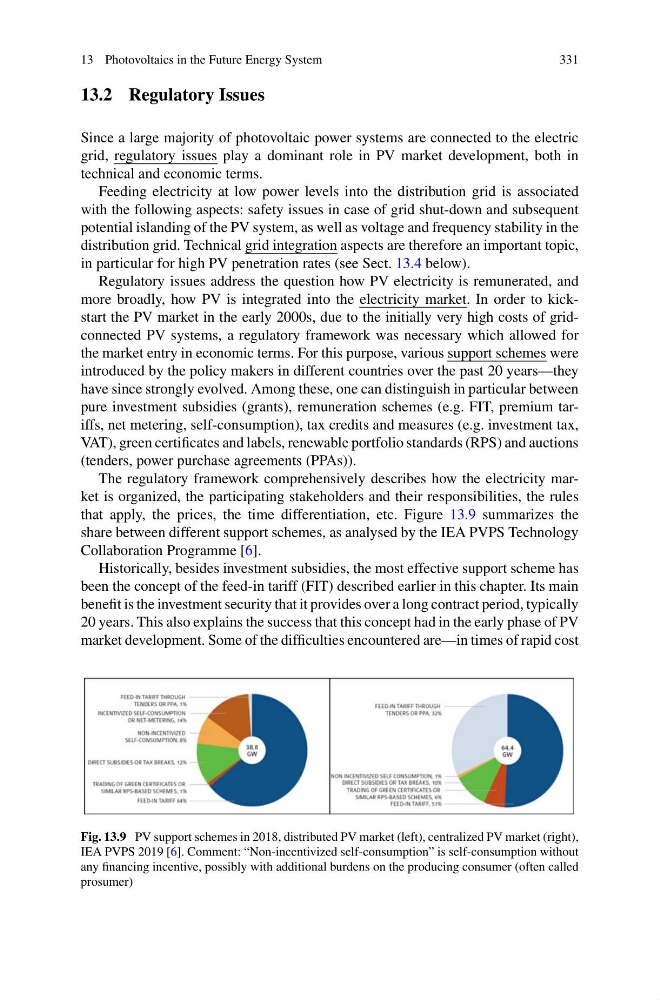
The regulatory framework comprehensively describes how the electricity market is organized, the participating stakeholders and their responsibilities, the rules
that apply, the prices, the time differentiation, etc. Figure 13.9 summarizes the
share between different support schemes, as analysed by the IEA PVPS Technology
Collaboration Programme [6].
Historically, besides investment subsidies, the most effective support scheme has
been the concept of the feed-in tariff (FIT) described earlier in this chapter. Its main
benefit is the investment security that it provides over a long contract period, typically
20 years. This also explains the success that this concept had in the early phase of PV
market development. Some of the difficulties encountered are—in times of rapid cost
Fig. 13.9 PV support schemes in 2018, distributed PV market (left), centralized PV market (right),
IEA PVPS 2019 [6]. Comment: “Non-incentivized self-consumption” is self-consumption without
any financing incentive, possibly with additional burdens on the producing consumer (often called
prosumer)
331
13.2 Regulatory Issues
Since a large majority of photovoltaic power systems are connected to the electric
grid, regulatory issues play a dominant role in PV market development, both in
technical and economic terms.
Feeding electricity at low power levels into the distribution grid is associated
with the following aspects: safety issues in case of grid shut-down and subsequent
potential islanding of the PV system, as well as voltage and frequency stability in the
distribution grid. Technical grid integration aspects are therefore an important topic,
in particular for high PV penetration rates (see Sect. 13.4 below).
Regulatory issues address the question how PV electricity is remunerated, and
more broadly, how PV is integrated into the electricity market. In order to kickstart the PV market in the early 2000s, due to the initially very high costs of gridconnected PV systems, a regulatory framework was necessary which allowed for
the market entry in economic terms. For this purpose, various support schemes were
introduced by the policy makers in different countries over the past 20 years—they
have since strongly evolved. Among these, one can distinguish in particular between
pure investment subsidies (grants), remuneration schemes (e.g. FIT, premium tariffs, net metering, self-consumption), tax credits and measures (e.g. investment tax,
VAT), green certificates and labels, renewable portfolio standards (RPS) and auctions
(tenders, power purchase agreements (PPAs)).
The regulatory framework comprehensively describes how the electricity market is organized, the participating stakeholders and their responsibilities, the rules
that apply, the prices, the time differentiation, etc. Figure 13.9 summarizes the
share between different support schemes, as analysed by the IEA PVPS Technology
Collaboration Programme [6].
Historically, besides investment subsidies, the most effective support scheme has
been the concept of the feed-in tariff (FIT) described earlier in this chapter. Its main
benefit is the investment security that it provides over a long contract period, typically
20 years. This also explains the success that this concept had in the early phase of PV
market development. Some of the difficulties encountered are—in times of rapid cost
Fig. 13.9 PV support schemes in 2018, distributed PV market (left), centralized PV market (right),
IEA PVPS 2019 [6]. Comment: “Non-incentivized self-consumption” is self-consumption without
any financing incentive, possibly with additional burdens on the producing consumer (often called
prosumer)