

328
S. Nowak
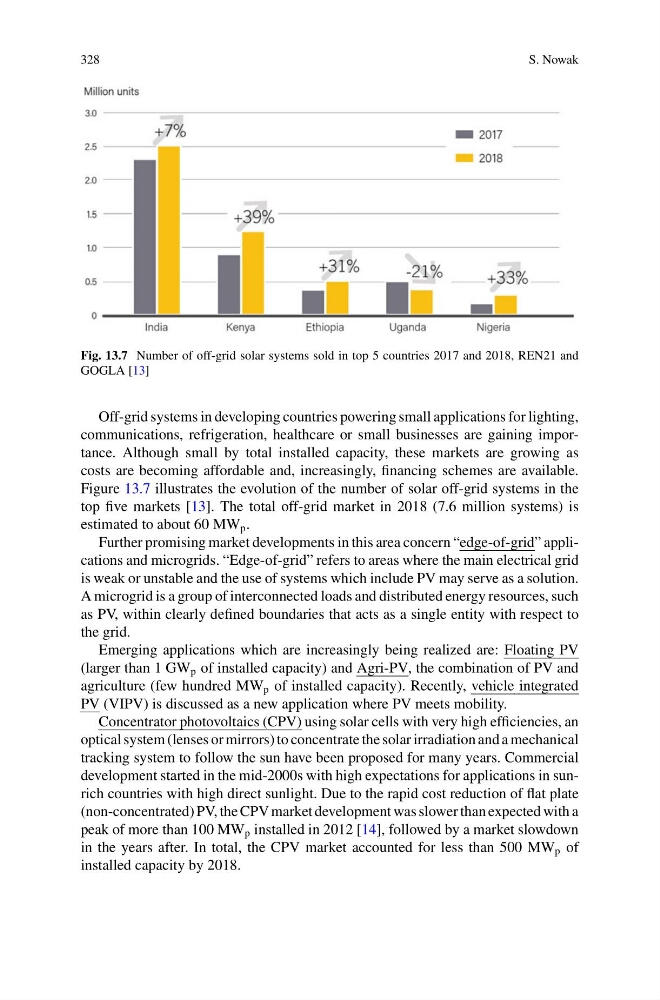
Fig. 13.7 Number of off-grid solar systems sold in top 5 countries 2017 and 2018, REN21 and
GOGLA [13]
Off-grid systems in developing countries powering small applications for lighting,
communications, refrigeration, healthcare or small businesses are gaining importance. Although small by total installed capacity, these markets are growing as
costs are becoming affordable and, increasingly, financing schemes are available.
Figure 13.7 illustrates the evolution of the number of solar off-grid systems in the
top five markets [13]. The total off-grid market in 2018 (7.6 million systems) is
estimated to about 60 MW p .
Further promising market developments in this area concern “edge-of-grid” applications and microgrids. “Edge-of-grid” refers to areas where the main electrical grid
is weak or unstable and the use of systems which include PV may serve as a solution.
A microgrid is a group of interconnected loads and distributed energy resources, such
as PV, within clearly defined boundaries that acts as a single entity with respect to
the grid.
Emerging applications which are increasingly being realized are: Floating PV
(larger than 1 GW p of installed capacity) and Agri-PV, the combination of PV and
agriculture (few hundred MW p of installed capacity). Recently, vehicle integrated
PV (VIPV) is discussed as a new application where PV meets mobility.
Concentrator photovoltaics (CPV) using solar cells with very high efficiencies, an
optical system (lenses or mirrors) to concentrate the solar irradiation and a mechanical
tracking system to follow the sun have been proposed for many years. Commercial
development started in the mid-2000s with high expectations for applications in sunrich countries with high direct sunlight. Due to the rapid cost reduction of flat plate
(non-concentrated) PV, the CPV market development was slower than expected with a
peak of more than 100 MW p installed in 2012 [14], followed by a market slowdown
in the years after. In total, the CPV market accounted for less than 500 MW p of
installed capacity by 2018.
S. Nowak
Fig. 13.7 Number of off-grid solar systems sold in top 5 countries 2017 and 2018, REN21 and
GOGLA [13]
Off-grid systems in developing countries powering small applications for lighting,
communications, refrigeration, healthcare or small businesses are gaining importance. Although small by total installed capacity, these markets are growing as
costs are becoming affordable and, increasingly, financing schemes are available.
Figure 13.7 illustrates the evolution of the number of solar off-grid systems in the
top five markets [13]. The total off-grid market in 2018 (7.6 million systems) is
estimated to about 60 MW p .
Further promising market developments in this area concern “edge-of-grid” applications and microgrids. “Edge-of-grid” refers to areas where the main electrical grid
is weak or unstable and the use of systems which include PV may serve as a solution.
A microgrid is a group of interconnected loads and distributed energy resources, such
as PV, within clearly defined boundaries that acts as a single entity with respect to
the grid.
Emerging applications which are increasingly being realized are: Floating PV
(larger than 1 GW p of installed capacity) and Agri-PV, the combination of PV and
agriculture (few hundred MW p of installed capacity). Recently, vehicle integrated
PV (VIPV) is discussed as a new application where PV meets mobility.
Concentrator photovoltaics (CPV) using solar cells with very high efficiencies, an
optical system (lenses or mirrors) to concentrate the solar irradiation and a mechanical
tracking system to follow the sun have been proposed for many years. Commercial
development started in the mid-2000s with high expectations for applications in sunrich countries with high direct sunlight. Due to the rapid cost reduction of flat plate
(non-concentrated) PV, the CPV market development was slower than expected with a
peak of more than 100 MW p installed in 2012 [14], followed by a market slowdown
in the years after. In total, the CPV market accounted for less than 500 MW p of
installed capacity by 2018.