

276
M. Pravettoni
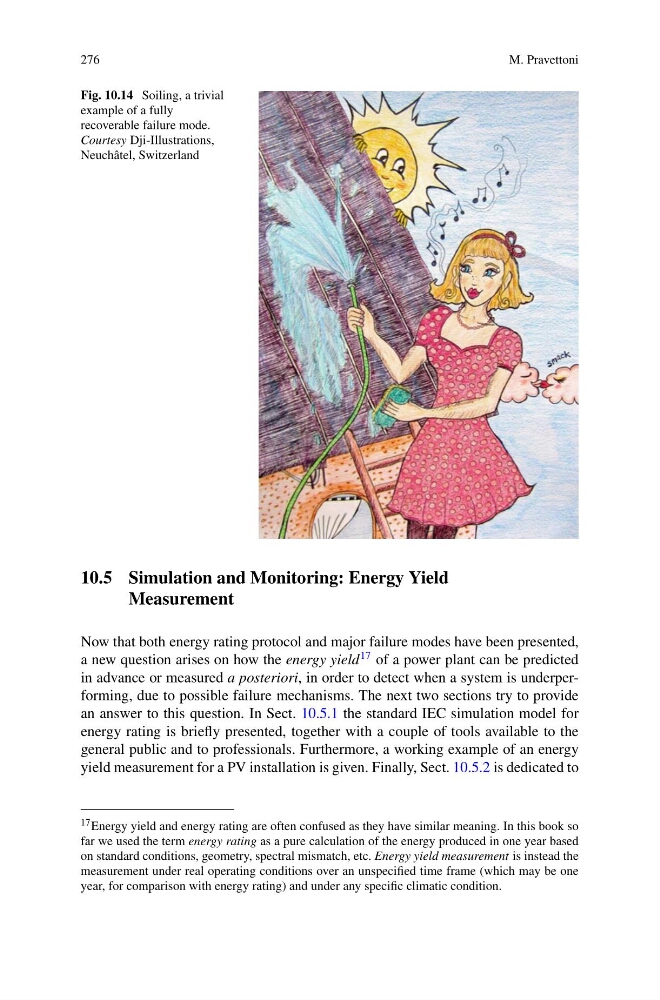
Fig. 10.14 Soiling, a trivial
example of a fully
recoverable failure mode.
Courtesy Dji-Illustrations,
Neuchâtel, Switzerland
10.5 Simulation and Monitoring: Energy Yield
Measurement
Now that both energy rating protocol and major failure modes have been presented,
a new question arises on how the energy yield
17 of a power plant can be predicted
in advance or measured a posteriori, in order to detect when a system is underperforming, due to possible failure mechanisms. The next two sections try to provide
an answer to this question. In Sect. 10.5.1 the standard IEC simulation model for
energy rating is briefly presented, together with a couple of tools available to the
general public and to professionals. Furthermore, a working example of an energy
yield measurement for a PV installation is given. Finally, Sect. 10.5.2 is dedicated to
17 Energy yield and energy rating are often confused as they have similar meaning. In this book so
far we used the term energy rating as a pure calculation of the energy produced in one year based
on standard conditions, geometry, spectral mismatch, etc. Energy yield measurement is instead the
measurement under real operating conditions over an unspecified time frame (which may be one
year, for comparison with energy rating) and under any specific climatic condition.
M. Pravettoni
Fig. 10.14 Soiling, a trivial
example of a fully
recoverable failure mode.
Courtesy Dji-Illustrations,
Neuchâtel, Switzerland
10.5 Simulation and Monitoring: Energy Yield
Measurement
Now that both energy rating protocol and major failure modes have been presented,
a new question arises on how the energy yield
17 of a power plant can be predicted
in advance or measured a posteriori, in order to detect when a system is underperforming, due to possible failure mechanisms. The next two sections try to provide
an answer to this question. In Sect. 10.5.1 the standard IEC simulation model for
energy rating is briefly presented, together with a couple of tools available to the
general public and to professionals. Furthermore, a working example of an energy
yield measurement for a PV installation is given. Finally, Sect. 10.5.2 is dedicated to
17 Energy yield and energy rating are often confused as they have similar meaning. In this book so
far we used the term energy rating as a pure calculation of the energy produced in one year based
on standard conditions, geometry, spectral mismatch, etc. Energy yield measurement is instead the
measurement under real operating conditions over an unspecified time frame (which may be one
year, for comparison with energy rating) and under any specific climatic condition.