

8
C. Ballif
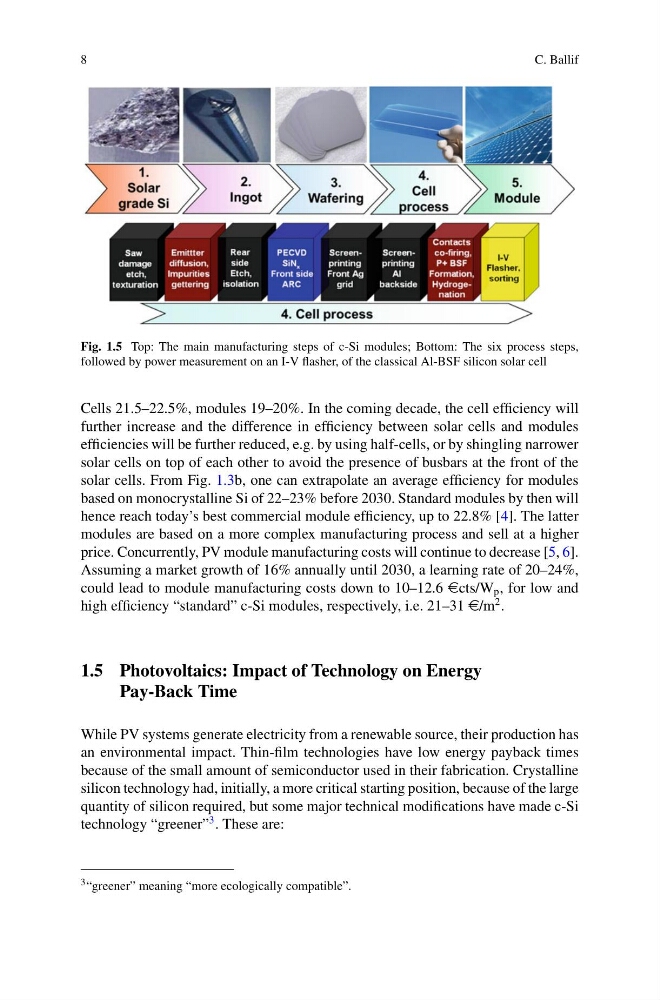
Fig. 1.5 Top: The main manufacturing steps of c-Si modules; Bottom: The six process steps,
followed by power measurement on an I-V flasher, of the classical Al-BSF silicon solar cell
Cells 21.5–22.5%, modules 19–20%. In the coming decade, the cell efficiency will
further increase and the difference in efficiency between solar cells and modules
efficiencies will be further reduced, e.g. by using half-cells, or by shingling narrower
solar cells on top of each other to avoid the presence of busbars at the front of the
solar cells. From Fig. 1.3b, one can extrapolate an average efficiency for modules
based on monocrystalline Si of 22–23% before 2030. Standard modules by then will
hence reach today’s best commercial module efficiency, up to 22.8% [4]. The latter
modules are based on a more complex manufacturing process and sell at a higher
price. Concurrently, PV module manufacturing costs will continue to decrease [5, 6].
Assuming a market growth of 16% annually until 2030, a learning rate of 20–24%,
could lead to module manufacturing costs down to 10–12.6 ects/W p , for low and
high efficiency “standard” c-Si modules, respectively, i.e. 21–31 e/m
2 .
1.5 Photovoltaics: Impact of Technology on Energy
Pay-Back Time
While PV systems generate electricity from a renewable source, their production has
an environmental impact. Thin-film technologies have low energy payback times
because of the small amount of semiconductor used in their fabrication. Crystalline
silicon technology had, initially, a more critical starting position, because of the large
quantity of silicon required, but some major technical modifications have made c-Si
technology “greener”
3 . These are:
3 “greener” meaning “more ecologically compatible”.
C. Ballif
Fig. 1.5 Top: The main manufacturing steps of c-Si modules; Bottom: The six process steps,
followed by power measurement on an I-V flasher, of the classical Al-BSF silicon solar cell
Cells 21.5–22.5%, modules 19–20%. In the coming decade, the cell efficiency will
further increase and the difference in efficiency between solar cells and modules
efficiencies will be further reduced, e.g. by using half-cells, or by shingling narrower
solar cells on top of each other to avoid the presence of busbars at the front of the
solar cells. From Fig. 1.3b, one can extrapolate an average efficiency for modules
based on monocrystalline Si of 22–23% before 2030. Standard modules by then will
hence reach today’s best commercial module efficiency, up to 22.8% [4]. The latter
modules are based on a more complex manufacturing process and sell at a higher
price. Concurrently, PV module manufacturing costs will continue to decrease [5, 6].
Assuming a market growth of 16% annually until 2030, a learning rate of 20–24%,
could lead to module manufacturing costs down to 10–12.6 ects/W p , for low and
high efficiency “standard” c-Si modules, respectively, i.e. 21–31 e/m
2 .
1.5 Photovoltaics: Impact of Technology on Energy
Pay-Back Time
While PV systems generate electricity from a renewable source, their production has
an environmental impact. Thin-film technologies have low energy payback times
because of the small amount of semiconductor used in their fabrication. Crystalline
silicon technology had, initially, a more critical starting position, because of the large
quantity of silicon required, but some major technical modifications have made c-Si
technology “greener”
3 . These are:
3 “greener” meaning “more ecologically compatible”.