

9 Solar Module Technology
243
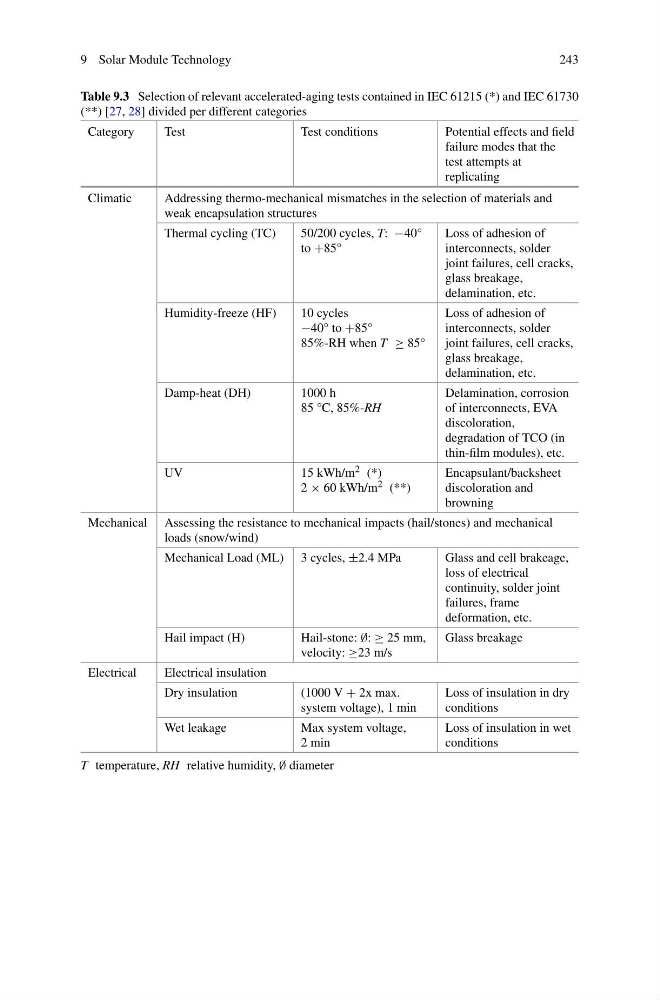
Table 9.3 Selection of relevant accelerated-aging tests contained in IEC 61215 (*) and IEC 61730
(**) [27, 28] divided per different categories
Category
Test
Test conditions
Potential effects and field
failure modes that the
test attempts at
replicating
Climatic
Addressing thermo-mechanical mismatches in the selection of materials and
weak encapsulation structures
Thermal cycling (TC)
50/200 cycles, T: −40°
to +85°
Loss of adhesion of
interconnects, solder
joint failures, cell cracks,
glass breakage,
delamination, etc.
Humidity-freeze (HF)
10 cycles
−40° to +85°
85%-RH when T ≥ 85°
Loss of adhesion of
interconnects, solder
joint failures, cell cracks,
glass breakage,
delamination, etc.
Damp-heat (DH)
1000 h
85 °C, 85%-RH
Delamination, corrosion
of interconnects, EVA
discoloration,
degradation of TCO (in
thin-film modules), etc.
UV
15 kWh/m 2 (*)
2 × 60 kWh/m 2 (**)
Encapsulant/backsheet
discoloration and
browning
Mechanical Assessing the resistance to mechanical impacts (hail/stones) and mechanical
loads (snow/wind)
Mechanical Load (ML) 3 cycles, ±2.4 MPa
Glass and cell brakeage,
loss of electrical
continuity, solder joint
failures, frame
deformation, etc.
Hail impact (H)
Hail-stone: ∅: ≥ 25 mm,
velocity: ≥23 m/s
Glass breakage
Electrical
Electrical insulation
Dry insulation
(1000 V + 2x max.
system voltage), 1 min
Loss of insulation in dry
conditions
Wet leakage
Max system voltage,
2 min
Loss of insulation in wet
conditions
T temperature, RH relative humidity, ∅ diameter
243
Table 9.3 Selection of relevant accelerated-aging tests contained in IEC 61215 (*) and IEC 61730
(**) [27, 28] divided per different categories
Category
Test
Test conditions
Potential effects and field
failure modes that the
test attempts at
replicating
Climatic
Addressing thermo-mechanical mismatches in the selection of materials and
weak encapsulation structures
Thermal cycling (TC)
50/200 cycles, T: −40°
to +85°
Loss of adhesion of
interconnects, solder
joint failures, cell cracks,
glass breakage,
delamination, etc.
Humidity-freeze (HF)
10 cycles
−40° to +85°
85%-RH when T ≥ 85°
Loss of adhesion of
interconnects, solder
joint failures, cell cracks,
glass breakage,
delamination, etc.
Damp-heat (DH)
1000 h
85 °C, 85%-RH
Delamination, corrosion
of interconnects, EVA
discoloration,
degradation of TCO (in
thin-film modules), etc.
UV
15 kWh/m 2 (*)
2 × 60 kWh/m 2 (**)
Encapsulant/backsheet
discoloration and
browning
Mechanical Assessing the resistance to mechanical impacts (hail/stones) and mechanical
loads (snow/wind)
Mechanical Load (ML) 3 cycles, ±2.4 MPa
Glass and cell brakeage,
loss of electrical
continuity, solder joint
failures, frame
deformation, etc.
Hail impact (H)
Hail-stone: ∅: ≥ 25 mm,
velocity: ≥23 m/s
Glass breakage
Electrical
Electrical insulation
Dry insulation
(1000 V + 2x max.
system voltage), 1 min
Loss of insulation in dry
conditions
Wet leakage
Max system voltage,
2 min
Loss of insulation in wet
conditions
T temperature, RH relative humidity, ∅ diameter