

242
A. Virtuani
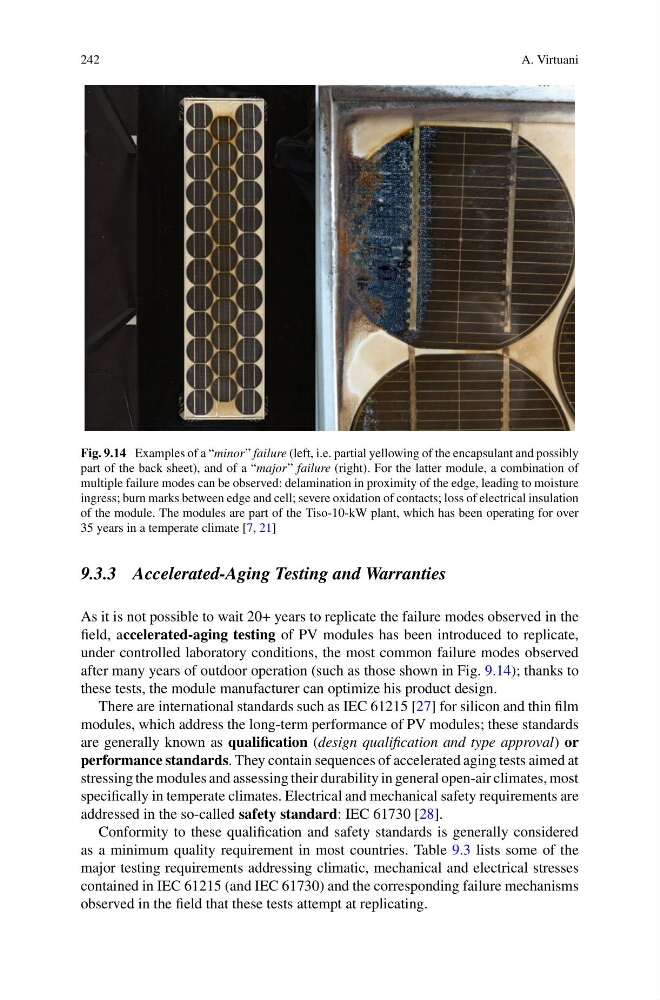
Fig. 9.14 Examples of a “minor” failure (left, i.e. partial yellowing of the encapsulant and possibly
part of the back sheet), and of a “major” failure (right). For the latter module, a combination of
multiple failure modes can be observed: delamination in proximity of the edge, leading to moisture
ingress; burn marks between edge and cell; severe oxidation of contacts; loss of electrical insulation
of the module. The modules are part of the Tiso-10-kW plant, which has been operating for over
35 years in a temperate climate [7, 21]
9.3.3 Accelerated-Aging Testing and Warranties
As it is not possible to wait 20+ years to replicate the failure modes observed in the
field, accelerated-aging testing of PV modules has been introduced to replicate,
under controlled laboratory conditions, the most common failure modes observed
after many years of outdoor operation (such as those shown in Fig. 9.14); thanks to
these tests, the module manufacturer can optimize his product design.
There are international standards such as IEC 61215 [27] for silicon and thin film
modules, which address the long-term performance of PV modules; these standards
are generally known as qualification (design qualification and type approval) or
performance standards. They contain sequences of accelerated aging tests aimed at
stressing the modules and assessing their durability in general open-air climates, most
specifically in temperate climates. Electrical and mechanical safety requirements are
addressed in the so-called safety standard: IEC 61730 [28].
Conformity to these qualification and safety standards is generally considered
as a minimum quality requirement in most countries. Table 9.3 lists some of the
major testing requirements addressing climatic, mechanical and electrical stresses
contained in IEC 61215 (and IEC 61730) and the corresponding failure mechanisms
observed in the field that these tests attempt at replicating.
A. Virtuani
Fig. 9.14 Examples of a “minor” failure (left, i.e. partial yellowing of the encapsulant and possibly
part of the back sheet), and of a “major” failure (right). For the latter module, a combination of
multiple failure modes can be observed: delamination in proximity of the edge, leading to moisture
ingress; burn marks between edge and cell; severe oxidation of contacts; loss of electrical insulation
of the module. The modules are part of the Tiso-10-kW plant, which has been operating for over
35 years in a temperate climate [7, 21]
9.3.3 Accelerated-Aging Testing and Warranties
As it is not possible to wait 20+ years to replicate the failure modes observed in the
field, accelerated-aging testing of PV modules has been introduced to replicate,
under controlled laboratory conditions, the most common failure modes observed
after many years of outdoor operation (such as those shown in Fig. 9.14); thanks to
these tests, the module manufacturer can optimize his product design.
There are international standards such as IEC 61215 [27] for silicon and thin film
modules, which address the long-term performance of PV modules; these standards
are generally known as qualification (design qualification and type approval) or
performance standards. They contain sequences of accelerated aging tests aimed at
stressing the modules and assessing their durability in general open-air climates, most
specifically in temperate climates. Electrical and mechanical safety requirements are
addressed in the so-called safety standard: IEC 61730 [28].
Conformity to these qualification and safety standards is generally considered
as a minimum quality requirement in most countries. Table 9.3 lists some of the
major testing requirements addressing climatic, mechanical and electrical stresses
contained in IEC 61215 (and IEC 61730) and the corresponding failure mechanisms
observed in the field that these tests attempt at replicating.