

234
A. Virtuani
-80
-60
-40
-20
0
0.5
0.6
0.7
0.8
0.9
1.0
1.1
1. AR coating
Standard
4. Fine-PT
2. Large-pyramid texture (PT)
5. Semitransparent
3. Self-cleaning
Power P
max
( ) [ a.u.]
Angle of Incidence [
o ]
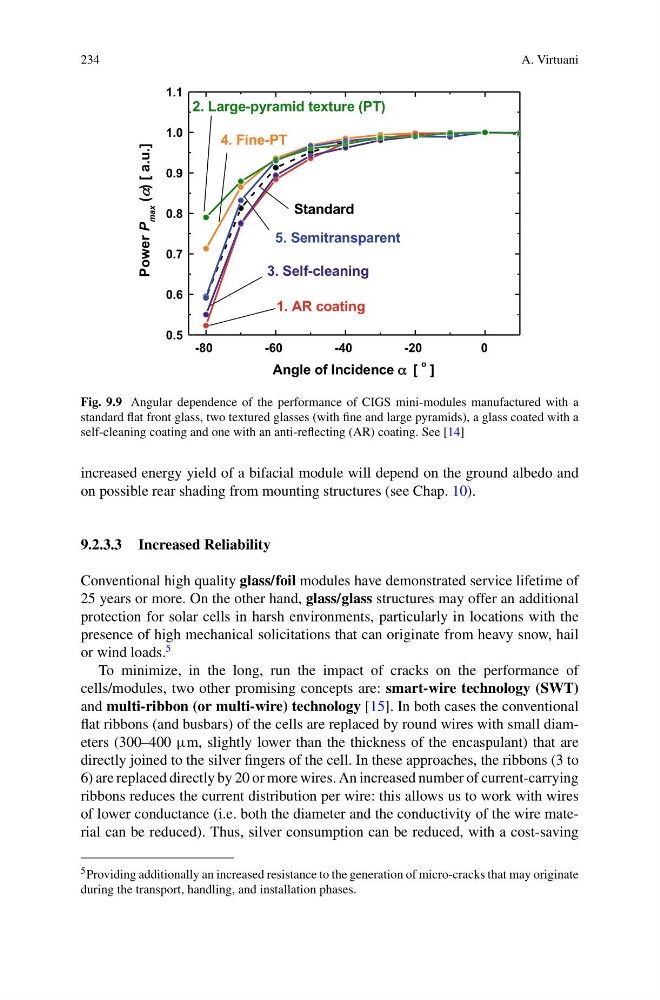
Fig. 9.9 Angular dependence of the performance of CIGS mini-modules manufactured with a
standard flat front glass, two textured glasses (with fine and large pyramids), a glass coated with a
self-cleaning coating and one with an anti-reflecting (AR) coating. See [14]
increased energy yield of a bifacial module will depend on the ground albedo and
on possible rear shading from mounting structures (see Chap. 10).
9.2.3.3 Increased Reliability
Conventional high quality glass/foil modules have demonstrated service lifetime of
25 years or more. On the other hand, glass/glass structures may offer an additional
protection for solar cells in harsh environments, particularly in locations with the
presence of high mechanical solicitations that can originate from heavy snow, hail
or wind loads.
5
To minimize, in the long, run the impact of cracks on the performance of
cells/modules, two other promising concepts are: smart-wire technology (SWT)
and multi-ribbon (or multi-wire) technology [15]. In both cases the conventional
flat ribbons (and busbars) of the cells are replaced by round wires with small diameters (300–400 μm, slightly lower than the thickness of the encaspulant) that are
directly joined to the silver fingers of the cell. In these approaches, the ribbons (3 to
6) are replaced directly by 20 or more wires. An increased number of current-carrying
ribbons reduces the current distribution per wire: this allows us to work with wires
of lower conductance (i.e. both the diameter and the conductivity of the wire material can be reduced). Thus, silver consumption can be reduced, with a cost-saving
5 Providing additionally an increased resistance to the generation of micro-cracks that may originate
during the transport, handling, and installation phases.
A. Virtuani
-80
-60
-40
-20
0
0.5
0.6
0.7
0.8
0.9
1.0
1.1
1. AR coating
Standard
4. Fine-PT
2. Large-pyramid texture (PT)
5. Semitransparent
3. Self-cleaning
Power P
max
( ) [ a.u.]
Angle of Incidence [
o ]
Fig. 9.9 Angular dependence of the performance of CIGS mini-modules manufactured with a
standard flat front glass, two textured glasses (with fine and large pyramids), a glass coated with a
self-cleaning coating and one with an anti-reflecting (AR) coating. See [14]
increased energy yield of a bifacial module will depend on the ground albedo and
on possible rear shading from mounting structures (see Chap. 10).
9.2.3.3 Increased Reliability
Conventional high quality glass/foil modules have demonstrated service lifetime of
25 years or more. On the other hand, glass/glass structures may offer an additional
protection for solar cells in harsh environments, particularly in locations with the
presence of high mechanical solicitations that can originate from heavy snow, hail
or wind loads.
5
To minimize, in the long, run the impact of cracks on the performance of
cells/modules, two other promising concepts are: smart-wire technology (SWT)
and multi-ribbon (or multi-wire) technology [15]. In both cases the conventional
flat ribbons (and busbars) of the cells are replaced by round wires with small diameters (300–400 μm, slightly lower than the thickness of the encaspulant) that are
directly joined to the silver fingers of the cell. In these approaches, the ribbons (3 to
6) are replaced directly by 20 or more wires. An increased number of current-carrying
ribbons reduces the current distribution per wire: this allows us to work with wires
of lower conductance (i.e. both the diameter and the conductivity of the wire material can be reduced). Thus, silver consumption can be reduced, with a cost-saving
5 Providing additionally an increased resistance to the generation of micro-cracks that may originate
during the transport, handling, and installation phases.