

9 Solar Module Technology
233
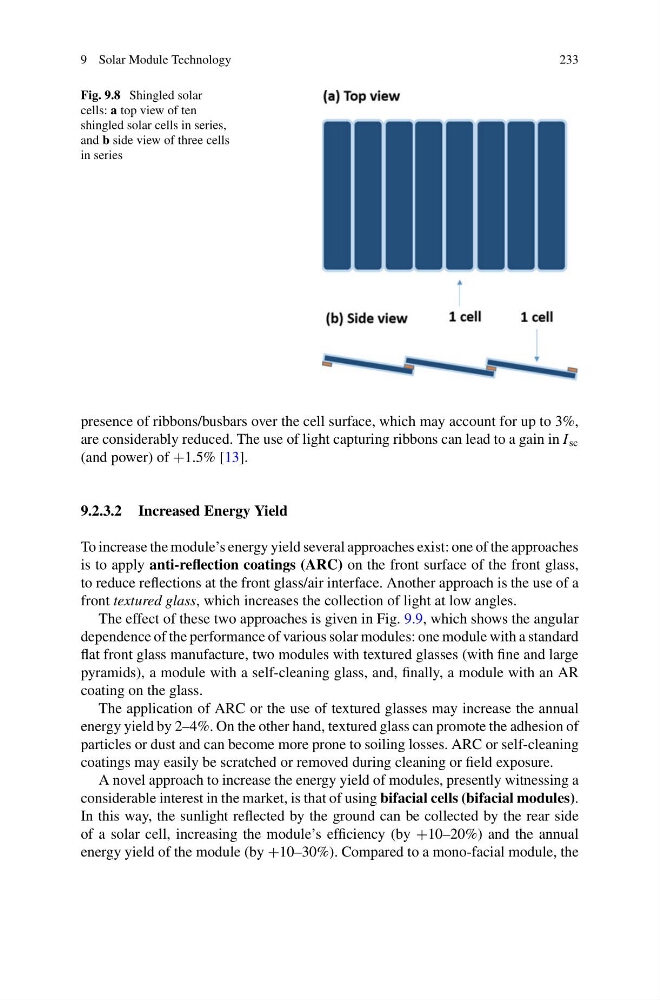
Fig. 9.8 Shingled solar
cells: a top view of ten
shingled solar cells in series,
and b side view of three cells
in series
presence of ribbons/busbars over the cell surface, which may account for up to 3%,
are considerably reduced. The use of light capturing ribbons can lead to a gain in I sc
(and power) of +1.5% [13].
9.2.3.2 Increased Energy Yield
To increase the module’s energy yield several approaches exist: one of the approaches
is to apply anti-reflection coatings (ARC) on the front surface of the front glass,
to reduce reflections at the front glass/air interface. Another approach is the use of a
front textured glass, which increases the collection of light at low angles.
The effect of these two approaches is given in Fig. 9.9, which shows the angular
dependence of the performance of various solar modules: one module with a standard
flat front glass manufacture, two modules with textured glasses (with fine and large
pyramids), a module with a self-cleaning glass, and, finally, a module with an AR
coating on the glass.
The application of ARC or the use of textured glasses may increase the annual
energy yield by 2–4%. On the other hand, textured glass can promote the adhesion of
particles or dust and can become more prone to soiling losses. ARC or self-cleaning
coatings may easily be scratched or removed during cleaning or field exposure.
A novel approach to increase the energy yield of modules, presently witnessing a
considerable interest in the market, is that of using bifacial cells (bifacial modules).
In this way, the sunlight reflected by the ground can be collected by the rear side
of a solar cell, increasing the module’s efficiency (by +10–20%) and the annual
energy yield of the module (by +10–30%). Compared to a mono-facial module, the
233
Fig. 9.8 Shingled solar
cells: a top view of ten
shingled solar cells in series,
and b side view of three cells
in series
presence of ribbons/busbars over the cell surface, which may account for up to 3%,
are considerably reduced. The use of light capturing ribbons can lead to a gain in I sc
(and power) of +1.5% [13].
9.2.3.2 Increased Energy Yield
To increase the module’s energy yield several approaches exist: one of the approaches
is to apply anti-reflection coatings (ARC) on the front surface of the front glass,
to reduce reflections at the front glass/air interface. Another approach is the use of a
front textured glass, which increases the collection of light at low angles.
The effect of these two approaches is given in Fig. 9.9, which shows the angular
dependence of the performance of various solar modules: one module with a standard
flat front glass manufacture, two modules with textured glasses (with fine and large
pyramids), a module with a self-cleaning glass, and, finally, a module with an AR
coating on the glass.
The application of ARC or the use of textured glasses may increase the annual
energy yield by 2–4%. On the other hand, textured glass can promote the adhesion of
particles or dust and can become more prone to soiling losses. ARC or self-cleaning
coatings may easily be scratched or removed during cleaning or field exposure.
A novel approach to increase the energy yield of modules, presently witnessing a
considerable interest in the market, is that of using bifacial cells (bifacial modules).
In this way, the sunlight reflected by the ground can be collected by the rear side
of a solar cell, increasing the module’s efficiency (by +10–20%) and the annual
energy yield of the module (by +10–30%). Compared to a mono-facial module, the