

226
A. Virtuani
9.2.1 General Structure
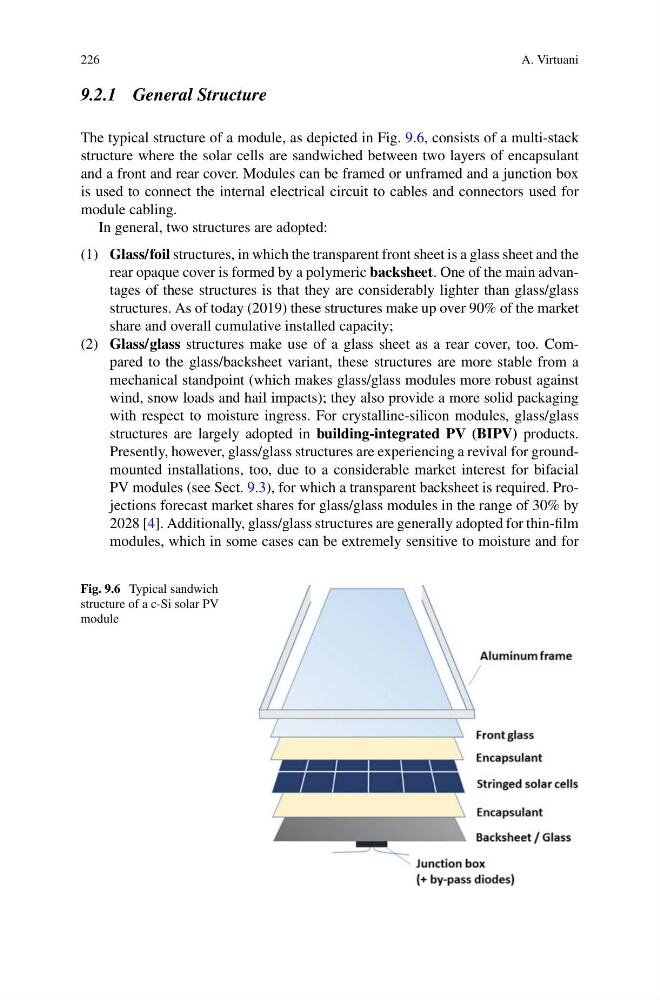
The typical structure of a module, as depicted in Fig. 9.6, consists of a multi-stack
structure where the solar cells are sandwiched between two layers of encapsulant
and a front and rear cover. Modules can be framed or unframed and a junction box
is used to connect the internal electrical circuit to cables and connectors used for
module cabling.
In general, two structures are adopted:
(1) Glass/foil structures, in which the transparent front sheet is a glass sheet and the
rear opaque cover is formed by a polymeric backsheet. One of the main advantages of these structures is that they are considerably lighter than glass/glass
structures. As of today (2019) these structures make up over 90% of the market
share and overall cumulative installed capacity;
(2) Glass/glass structures make use of a glass sheet as a rear cover, too. Compared to the glass/backsheet variant, these structures are more stable from a
mechanical standpoint (which makes glass/glass modules more robust against
wind, snow loads and hail impacts); they also provide a more solid packaging
with respect to moisture ingress. For crystalline-silicon modules, glass/glass
structures are largely adopted in building-integrated PV (BIPV) products.
Presently, however, glass/glass structures are experiencing a revival for groundmounted installations, too, due to a considerable market interest for bifacial
PV modules (see Sect. 9.3), for which a transparent backsheet is required. Projections forecast market shares for glass/glass modules in the range of 30% by
2028 [4]. Additionally, glass/glass structures are generally adopted for thin-film
modules, which in some cases can be extremely sensitive to moisture and for
Fig. 9.6 Typical sandwich
structure of a c-Si solar PV
module
A. Virtuani
9.2.1 General Structure
The typical structure of a module, as depicted in Fig. 9.6, consists of a multi-stack
structure where the solar cells are sandwiched between two layers of encapsulant
and a front and rear cover. Modules can be framed or unframed and a junction box
is used to connect the internal electrical circuit to cables and connectors used for
module cabling.
In general, two structures are adopted:
(1) Glass/foil structures, in which the transparent front sheet is a glass sheet and the
rear opaque cover is formed by a polymeric backsheet. One of the main advantages of these structures is that they are considerably lighter than glass/glass
structures. As of today (2019) these structures make up over 90% of the market
share and overall cumulative installed capacity;
(2) Glass/glass structures make use of a glass sheet as a rear cover, too. Compared to the glass/backsheet variant, these structures are more stable from a
mechanical standpoint (which makes glass/glass modules more robust against
wind, snow loads and hail impacts); they also provide a more solid packaging
with respect to moisture ingress. For crystalline-silicon modules, glass/glass
structures are largely adopted in building-integrated PV (BIPV) products.
Presently, however, glass/glass structures are experiencing a revival for groundmounted installations, too, due to a considerable market interest for bifacial
PV modules (see Sect. 9.3), for which a transparent backsheet is required. Projections forecast market shares for glass/glass modules in the range of 30% by
2028 [4]. Additionally, glass/glass structures are generally adopted for thin-film
modules, which in some cases can be extremely sensitive to moisture and for
Fig. 9.6 Typical sandwich
structure of a c-Si solar PV
module