

9 Solar Module Technology
225
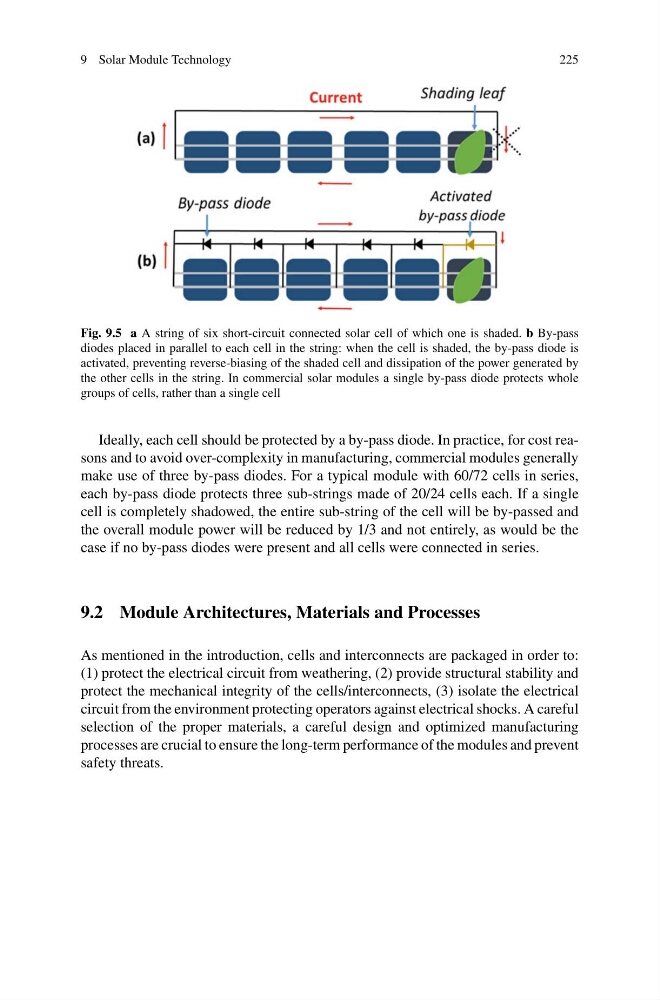
Fig. 9.5 a A string of six short-circuit connected solar cell of which one is shaded. b By-pass
diodes placed in parallel to each cell in the string: when the cell is shaded, the by-pass diode is
activated, preventing reverse-biasing of the shaded cell and dissipation of the power generated by
the other cells in the string. In commercial solar modules a single by-pass diode protects whole
groups of cells, rather than a single cell
Ideally, each cell should be protected by a by-pass diode. In practice, for cost reasons and to avoid over-complexity in manufacturing, commercial modules generally
make use of three by-pass diodes. For a typical module with 60/72 cells in series,
each by-pass diode protects three sub-strings made of 20/24 cells each. If a single
cell is completely shadowed, the entire sub-string of the cell will be by-passed and
the overall module power will be reduced by 1/3 and not entirely, as would be the
case if no by-pass diodes were present and all cells were connected in series.
9.2 Module Architectures, Materials and Processes
As mentioned in the introduction, cells and interconnects are packaged in order to:
(1) protect the electrical circuit from weathering, (2) provide structural stability and
protect the mechanical integrity of the cells/interconnects, (3) isolate the electrical
circuit from the environment protecting operators against electrical shocks. A careful
selection of the proper materials, a careful design and optimized manufacturing
processes are crucial to ensure the long-term performance of the modules and prevent
safety threats.
225
Fig. 9.5 a A string of six short-circuit connected solar cell of which one is shaded. b By-pass
diodes placed in parallel to each cell in the string: when the cell is shaded, the by-pass diode is
activated, preventing reverse-biasing of the shaded cell and dissipation of the power generated by
the other cells in the string. In commercial solar modules a single by-pass diode protects whole
groups of cells, rather than a single cell
Ideally, each cell should be protected by a by-pass diode. In practice, for cost reasons and to avoid over-complexity in manufacturing, commercial modules generally
make use of three by-pass diodes. For a typical module with 60/72 cells in series,
each by-pass diode protects three sub-strings made of 20/24 cells each. If a single
cell is completely shadowed, the entire sub-string of the cell will be by-passed and
the overall module power will be reduced by 1/3 and not entirely, as would be the
case if no by-pass diodes were present and all cells were connected in series.
9.2 Module Architectures, Materials and Processes
As mentioned in the introduction, cells and interconnects are packaged in order to:
(1) protect the electrical circuit from weathering, (2) provide structural stability and
protect the mechanical integrity of the cells/interconnects, (3) isolate the electrical
circuit from the environment protecting operators against electrical shocks. A careful
selection of the proper materials, a careful design and optimized manufacturing
processes are crucial to ensure the long-term performance of the modules and prevent
safety threats.