

212
A. Romeo
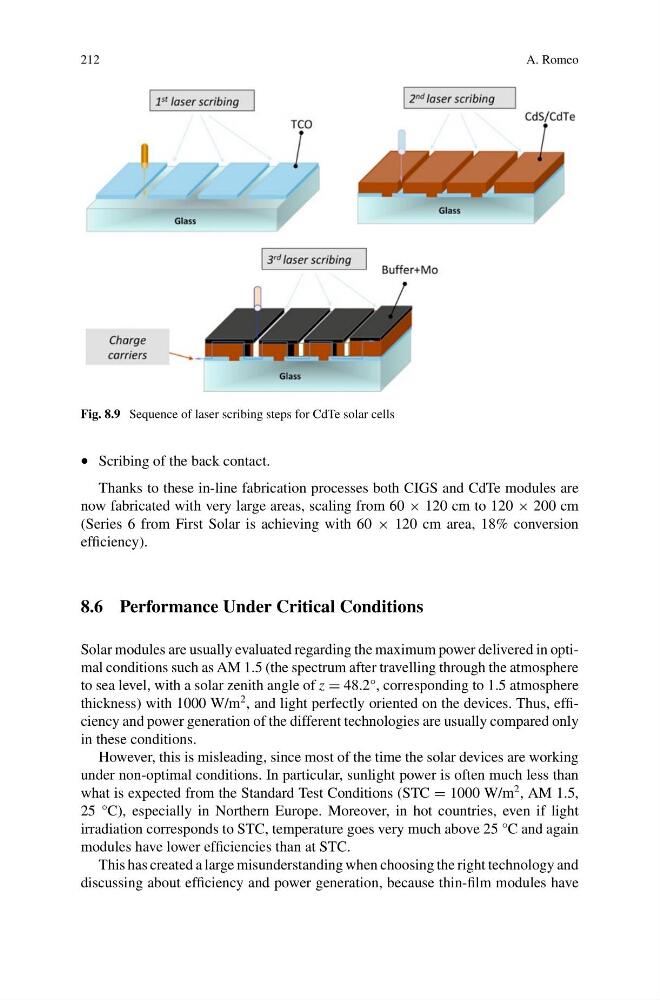
Fig. 8.9 Sequence of laser scribing steps for CdTe solar cells
• Scribing of the back contact.
Thanks to these in-line fabrication processes both CIGS and CdTe modules are
now fabricated with very large areas, scaling from 60 × 120 cm to 120 × 200 cm
(Series 6 from First Solar is achieving with 60 × 120 cm area, 18% conversion
efficiency).
8.6 Performance Under Critical Conditions
Solar modules are usually evaluated regarding the maximum power delivered in optimal conditions such as AM 1.5 (the spectrum after travelling through the atmosphere
to sea level, with a solar zenith angle of z = 48.2°, corresponding to 1.5 atmosphere
thickness) with 1000 W/m
2 , and light perfectly oriented on the devices. Thus, efficiency and power generation of the different technologies are usually compared only
in these conditions.
However, this is misleading, since most of the time the solar devices are working
under non-optimal conditions. In particular, sunlight power is often much less than
what is expected from the Standard Test Conditions (STC = 1000 W/m
2 , AM 1.5,
25 °C), especially in Northern Europe. Moreover, in hot countries, even if light
irradiation corresponds to STC, temperature goes very much above 25 °C and again
modules have lower efficiencies than at STC.
This has created a large misunderstanding when choosing the right technology and
discussing about efficiency and power generation, because thin-film modules have
A. Romeo
Fig. 8.9 Sequence of laser scribing steps for CdTe solar cells
• Scribing of the back contact.
Thanks to these in-line fabrication processes both CIGS and CdTe modules are
now fabricated with very large areas, scaling from 60 × 120 cm to 120 × 200 cm
(Series 6 from First Solar is achieving with 60 × 120 cm area, 18% conversion
efficiency).
8.6 Performance Under Critical Conditions
Solar modules are usually evaluated regarding the maximum power delivered in optimal conditions such as AM 1.5 (the spectrum after travelling through the atmosphere
to sea level, with a solar zenith angle of z = 48.2°, corresponding to 1.5 atmosphere
thickness) with 1000 W/m
2 , and light perfectly oriented on the devices. Thus, efficiency and power generation of the different technologies are usually compared only
in these conditions.
However, this is misleading, since most of the time the solar devices are working
under non-optimal conditions. In particular, sunlight power is often much less than
what is expected from the Standard Test Conditions (STC = 1000 W/m
2 , AM 1.5,
25 °C), especially in Northern Europe. Moreover, in hot countries, even if light
irradiation corresponds to STC, temperature goes very much above 25 °C and again
modules have lower efficiencies than at STC.
This has created a large misunderstanding when choosing the right technology and
discussing about efficiency and power generation, because thin-film modules have