

7 Crystalline Silicon Solar Cells: Heterojunction Cells
179
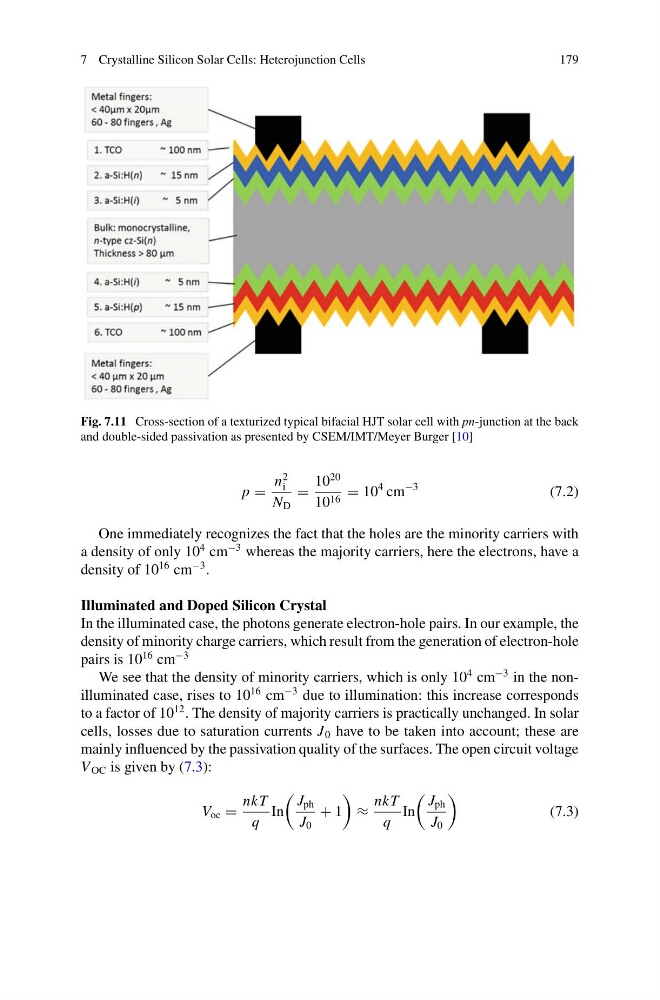
Fig. 7.11 Cross-section of a texturized typical bifacial HJT solar cell with pn-junction at the back
and double-sided passivation as presented by CSEM/IMT/Meyer Burger [10]
p =
n
2
i
N D
=
10
20
10 16 = 10
4 cm
−3
(7.2)
One immediately recognizes the fact that the holes are the minority carriers with
a density of only 10
4 cm
−3 whereas the majority carriers, here the electrons, have a
density of 10
16 cm
−3 .
Illuminated and Doped Silicon Crystal
In the illuminated case, the photons generate electron-hole pairs. In our example, the
density of minority charge carriers, which result from the generation of electron-hole
pairs is 10
16 cm
−3
We see that the density of minority carriers, which is only 10
4 cm
−3 in the nonilluminated case, rises to 10
16 cm
−3 due to illumination: this increase corresponds
to a factor of 10
12 . The density of majority carriers is practically unchanged. In solar
cells, losses due to saturation currents J 0 have to be taken into account; these are
mainly influenced by the passivation quality of the surfaces. The open circuit voltage
V OC is given by (7.3):
V oc =
nkT
q
In
J ph
J 0
+ 1
≈
nkT
q
In
J ph
J 0
(7.3)
179
Fig. 7.11 Cross-section of a texturized typical bifacial HJT solar cell with pn-junction at the back
and double-sided passivation as presented by CSEM/IMT/Meyer Burger [10]
p =
n
2
i
N D
=
10
20
10 16 = 10
4 cm
−3
(7.2)
One immediately recognizes the fact that the holes are the minority carriers with
a density of only 10
4 cm
−3 whereas the majority carriers, here the electrons, have a
density of 10
16 cm
−3 .
Illuminated and Doped Silicon Crystal
In the illuminated case, the photons generate electron-hole pairs. In our example, the
density of minority charge carriers, which result from the generation of electron-hole
pairs is 10
16 cm
−3
We see that the density of minority carriers, which is only 10
4 cm
−3 in the nonilluminated case, rises to 10
16 cm
−3 due to illumination: this increase corresponds
to a factor of 10
12 . The density of majority carriers is practically unchanged. In solar
cells, losses due to saturation currents J 0 have to be taken into account; these are
mainly influenced by the passivation quality of the surfaces. The open circuit voltage
V OC is given by (7.3):
V oc =
nkT
q
In
J ph
J 0
+ 1
≈
nkT
q
In
J ph
J 0
(7.3)