

6 Amorphous Silicon Solar Cells
161
6. A. Kolodziej, Staebler-Wronski effect in amorphous silicon and its alloys. Opto-Electron. Rev.
12(1), 21–32 (2004)
7. T. Shimizu, Staebler Wronski effect in hydrogenated amorphous silicon and related alloy films.
Jpn. J. Appl. Phys. 43, 3257–3268 (2004)
8. R. Platz, S. Wagner, C. Hof, A. Shah. S. Wieder, B. Rech, Influence of excitation frequency, temperature, and hydrogen dilution on the stability of plasma enhanced chemical vapor deposited
a-Si: H. J. Appl. Phys. 84, 3949–3953 (1998)
9. S. Guha, J. Yang, A. Banerjee, B. Yan, K. Lord, High-quality amorphous silicon materials and
cells grown with hydrogen dilution. Sol. Energy Mater. Sol. Cells 78, 329–347 (2003)
10. C. Ballif, S. De Wolf, A. Descoeudres, Z. C.Holman, Amorphous Silicon/Crystalline Silicon
Heterojunction Solar Cells, in Advances in Photovoltaics: Part 3 vol. 90; ed. by G. P. Willeke,
E.R. Weber, Semiconductors and Semimetals (Elsevier, Amsterdam 2014), pp. 73–120
11. S. Olibet, Properties of interfaces in amorphous/crystalline silicon heterojunctions, Ph.D.
Thesis at the “Faculté des Sciences” of the University of Neuchâtel (2008), Section 4.6
12. A. Shah, Thin-Film Silicon Solar Cells”, Chapter IC-1 in Practical Handbook of Photovoltaics,
2nd edn. ed. by A. Mc Evoy et al. (Elsevier, Amsterdam 2012), pp. 209–281
13. A. Virtuani, D. Pavanello, G. Friesen, Overview of temperature coefficients of different thin
film photovoltaic technologies, in Proceedings of the 22nd EU PVSEC Conference (2007,
Milano)
14. M. Zeman, R.E.I. Schropp, Amorphous silicon based solar cells and modules. Appl. Solar
Energy 31, 22–29 (1995)
15. K. Ghosh, A. Guha, S.P. Duttagupta, Power generation on a solar photovoltaic array integrated
with lighter-than-air platform at low altitudes. Energy Convers. Manag. 154, 286–298 (2017)
16. Y. Kuwano, K. Yoshida, Sanyo’s flat diamond: Integrating R & D into the business. Long Range
Plan. 30, 473–492 (1997)
17. A. Shah et al., Basic efficiency limits, recent experimental results and novel light trapping
schemes in a-Si:H, µc-Si:H and “micromorph tandem” solar cells. J. Non-Crystall. Solids,
338–340, 639–645 (2004)
18. J.S. Cashmore et al., Improved conversion efficiencies of thin-film silicon tandem (MICROMORPH™) photovoltaic modules. Sol. Energy Mater. Sol. Cells 144, 84–95 (2016)
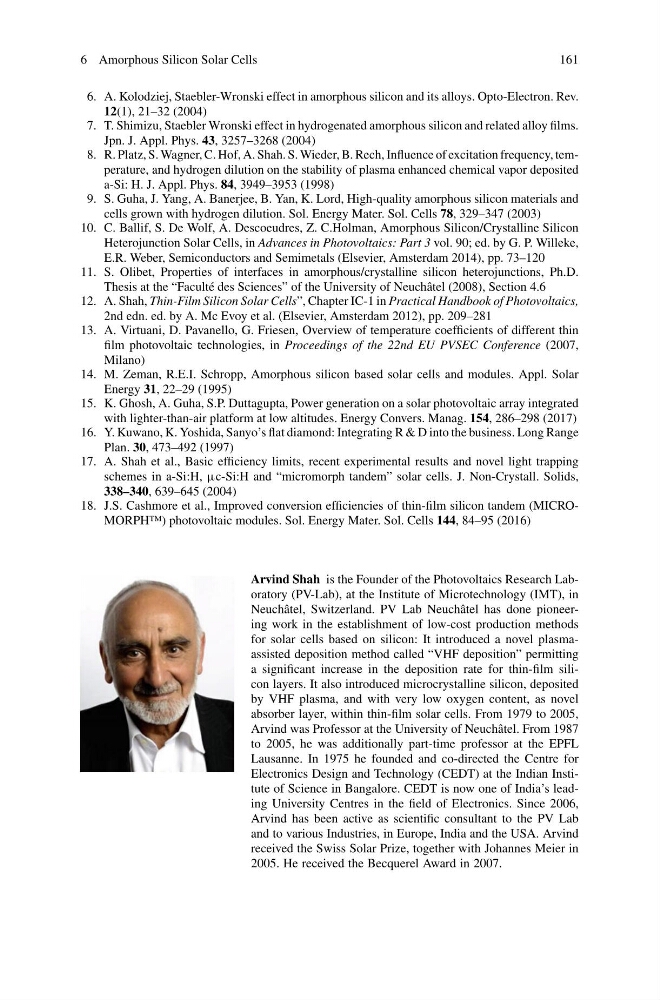
Arvind Shah is the Founder of the Photovoltaics Research Laboratory (PV-Lab), at the Institute of Microtechnology (IMT), in
Neuchâtel, Switzerland. PV Lab Neuchâtel has done pioneering work in the establishment of low-cost production methods
for solar cells based on silicon: It introduced a novel plasmaassisted deposition method called “VHF deposition” permitting
a significant increase in the deposition rate for thin-film silicon layers. It also introduced microcrystalline silicon, deposited
by VHF plasma, and with very low oxygen content, as novel
absorber layer, within thin-film solar cells. From 1979 to 2005,
Arvind was Professor at the University of Neuchâtel. From 1987
to 2005, he was additionally part-time professor at the EPFL
Lausanne. In 1975 he founded and co-directed the Centre for
Electronics Design and Technology (CEDT) at the Indian Institute of Science in Bangalore. CEDT is now one of India’s leading University Centres in the field of Electronics. Since 2006,
Arvind has been active as scientific consultant to the PV Lab
and to various Industries, in Europe, India and the USA. Arvind
received the Swiss Solar Prize, together with Johannes Meier in
2005. He received the Becquerel Award in 2007.
161
6. A. Kolodziej, Staebler-Wronski effect in amorphous silicon and its alloys. Opto-Electron. Rev.
12(1), 21–32 (2004)
7. T. Shimizu, Staebler Wronski effect in hydrogenated amorphous silicon and related alloy films.
Jpn. J. Appl. Phys. 43, 3257–3268 (2004)
8. R. Platz, S. Wagner, C. Hof, A. Shah. S. Wieder, B. Rech, Influence of excitation frequency, temperature, and hydrogen dilution on the stability of plasma enhanced chemical vapor deposited
a-Si: H. J. Appl. Phys. 84, 3949–3953 (1998)
9. S. Guha, J. Yang, A. Banerjee, B. Yan, K. Lord, High-quality amorphous silicon materials and
cells grown with hydrogen dilution. Sol. Energy Mater. Sol. Cells 78, 329–347 (2003)
10. C. Ballif, S. De Wolf, A. Descoeudres, Z. C.Holman, Amorphous Silicon/Crystalline Silicon
Heterojunction Solar Cells, in Advances in Photovoltaics: Part 3 vol. 90; ed. by G. P. Willeke,
E.R. Weber, Semiconductors and Semimetals (Elsevier, Amsterdam 2014), pp. 73–120
11. S. Olibet, Properties of interfaces in amorphous/crystalline silicon heterojunctions, Ph.D.
Thesis at the “Faculté des Sciences” of the University of Neuchâtel (2008), Section 4.6
12. A. Shah, Thin-Film Silicon Solar Cells”, Chapter IC-1 in Practical Handbook of Photovoltaics,
2nd edn. ed. by A. Mc Evoy et al. (Elsevier, Amsterdam 2012), pp. 209–281
13. A. Virtuani, D. Pavanello, G. Friesen, Overview of temperature coefficients of different thin
film photovoltaic technologies, in Proceedings of the 22nd EU PVSEC Conference (2007,
Milano)
14. M. Zeman, R.E.I. Schropp, Amorphous silicon based solar cells and modules. Appl. Solar
Energy 31, 22–29 (1995)
15. K. Ghosh, A. Guha, S.P. Duttagupta, Power generation on a solar photovoltaic array integrated
with lighter-than-air platform at low altitudes. Energy Convers. Manag. 154, 286–298 (2017)
16. Y. Kuwano, K. Yoshida, Sanyo’s flat diamond: Integrating R & D into the business. Long Range
Plan. 30, 473–492 (1997)
17. A. Shah et al., Basic efficiency limits, recent experimental results and novel light trapping
schemes in a-Si:H, µc-Si:H and “micromorph tandem” solar cells. J. Non-Crystall. Solids,
338–340, 639–645 (2004)
18. J.S. Cashmore et al., Improved conversion efficiencies of thin-film silicon tandem (MICROMORPH™) photovoltaic modules. Sol. Energy Mater. Sol. Cells 144, 84–95 (2016)
Arvind Shah is the Founder of the Photovoltaics Research Laboratory (PV-Lab), at the Institute of Microtechnology (IMT), in
Neuchâtel, Switzerland. PV Lab Neuchâtel has done pioneering work in the establishment of low-cost production methods
for solar cells based on silicon: It introduced a novel plasmaassisted deposition method called “VHF deposition” permitting
a significant increase in the deposition rate for thin-film silicon layers. It also introduced microcrystalline silicon, deposited
by VHF plasma, and with very low oxygen content, as novel
absorber layer, within thin-film solar cells. From 1979 to 2005,
Arvind was Professor at the University of Neuchâtel. From 1987
to 2005, he was additionally part-time professor at the EPFL
Lausanne. In 1975 he founded and co-directed the Centre for
Electronics Design and Technology (CEDT) at the Indian Institute of Science in Bangalore. CEDT is now one of India’s leading University Centres in the field of Electronics. Since 2006,
Arvind has been active as scientific consultant to the PV Lab
and to various Industries, in Europe, India and the USA. Arvind
received the Swiss Solar Prize, together with Johannes Meier in
2005. He received the Becquerel Award in 2007.