

6 Amorphous Silicon Solar Cells
155
Table 6.1 a Specific power density at the cell level of commercially available space cells and
for a-Si:H on polyimide (PI) as a function of the substrate thickness, as well as the achieved (or
expected) specific power at the solar array level
Technology
Efficiency (%)
Substrate/ wafer
thickness
Cell specific
power density
(W/kg)
Array specific
power density
(W/kg)
c-Si
16
c-Si, 130 µm
676
<100
DJ (GaInP 2 /GaAs) 22
Ge, 140 µm
354
<100
TJ
(GaInP 2 /GaAs/Ge)
30
Ge, 140 µm
483
<100
a-Si:H
6
PI, 50 µm
940
>500
a-Si:H
6
PI, 5 µm
3680
>1000
Abbreviations used: Double Junction DJ; Triple Junction TJ. Reproduced from [1], with the kind
permission of the EPFL Press
a Efficiency Values given in this Table are from the Year 2010 (when [1] was published). Today
(2020) much higher values for space cells are reached. However, the scope of this Table is not
to present commercially available space cells, but merely to illustrate the potential of a-Si:H to
increase the power density in (W/kg) of space cells, in view of specific applications as detailed in
Sect. 6.2.4 under the heading “power supplies for dirigibles”
In this category, the solar calculator is the example of a solar-powered object
of general utility: When the first pocket calculators came on the market, after the
introduction of low-cost transistors and integrated circuits in the ‘70s, they were
powered by batteries, which had to be replaced very frequently. It was Kuwano [16]
and his team at Sanyo Inc., who in the early 80s replaced the batteries with small
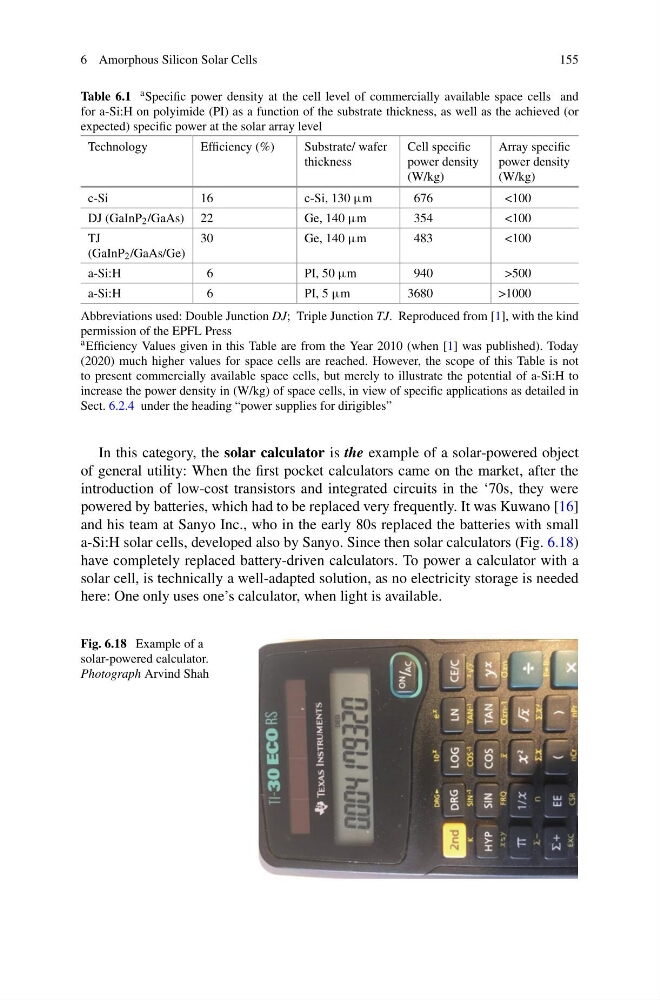
a-Si:H solar cells, developed also by Sanyo. Since then solar calculators (Fig. 6.18)
have completely replaced battery-driven calculators. To power a calculator with a
solar cell, is technically a well-adapted solution, as no electricity storage is needed
here: One only uses one’s calculator, when light is available.
Fig. 6.18 Example of a
solar-powered calculator.
Photograph Arvind Shah
155
Table 6.1 a Specific power density at the cell level of commercially available space cells and
for a-Si:H on polyimide (PI) as a function of the substrate thickness, as well as the achieved (or
expected) specific power at the solar array level
Technology
Efficiency (%)
Substrate/ wafer
thickness
Cell specific
power density
(W/kg)
Array specific
power density
(W/kg)
c-Si
16
c-Si, 130 µm
676
<100
DJ (GaInP 2 /GaAs) 22
Ge, 140 µm
354
<100
TJ
(GaInP 2 /GaAs/Ge)
30
Ge, 140 µm
483
<100
a-Si:H
6
PI, 50 µm
940
>500
a-Si:H
6
PI, 5 µm
3680
>1000
Abbreviations used: Double Junction DJ; Triple Junction TJ. Reproduced from [1], with the kind
permission of the EPFL Press
a Efficiency Values given in this Table are from the Year 2010 (when [1] was published). Today
(2020) much higher values for space cells are reached. However, the scope of this Table is not
to present commercially available space cells, but merely to illustrate the potential of a-Si:H to
increase the power density in (W/kg) of space cells, in view of specific applications as detailed in
Sect. 6.2.4 under the heading “power supplies for dirigibles”
In this category, the solar calculator is the example of a solar-powered object
of general utility: When the first pocket calculators came on the market, after the
introduction of low-cost transistors and integrated circuits in the ‘70s, they were
powered by batteries, which had to be replaced very frequently. It was Kuwano [16]
and his team at Sanyo Inc., who in the early 80s replaced the batteries with small
a-Si:H solar cells, developed also by Sanyo. Since then solar calculators (Fig. 6.18)
have completely replaced battery-driven calculators. To power a calculator with a
solar cell, is technically a well-adapted solution, as no electricity storage is needed
here: One only uses one’s calculator, when light is available.
Fig. 6.18 Example of a
solar-powered calculator.
Photograph Arvind Shah