

6 Amorphous Silicon Solar Cells
149
DR DR
DR
DR
x
p n
Vbi ≈ 1.1V
(a-Si:H)
a)
b)
Vbi ≈ 0.9V
(c-Si)
Eint+Eext
Ei
Eint+Eext
Eint
E
d i
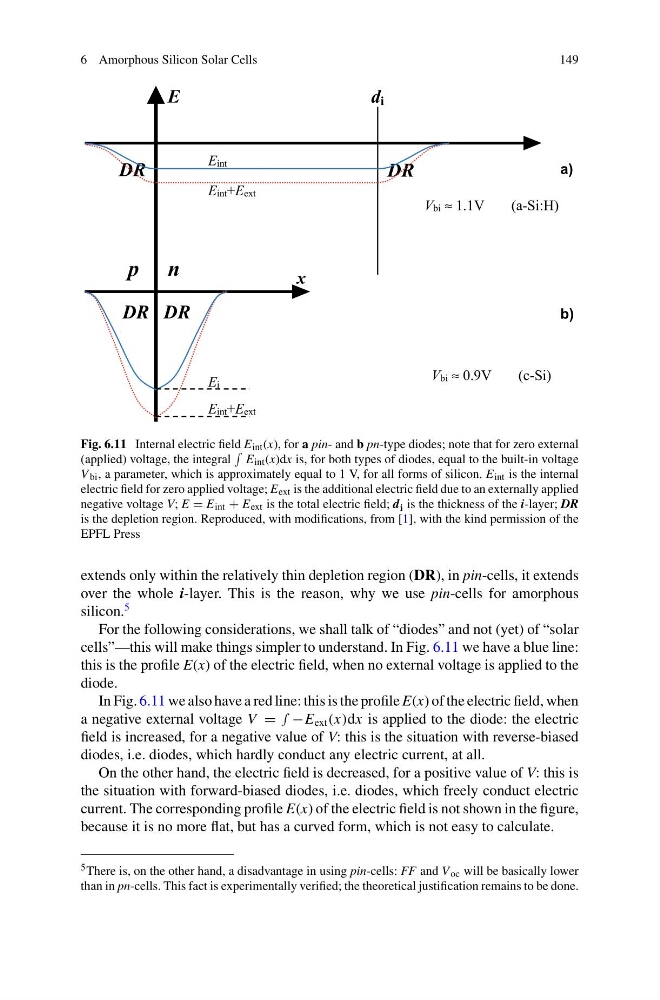
Fig. 6.11 Internal electric field E int (x), for a pin- and b pn-type diodes; note that for zero external
(applied) voltage, the integral
E int (x)dx is, for both types of diodes, equal to the built-in voltage
V bi , a parameter, which is approximately equal to 1 V, for all forms of silicon. E int is the internal
electric field for zero applied voltage; E ext is the additional electric field due to an externally applied
negative voltage V; E = E int + E ext is the total electric field; d i is the thickness of the i-layer; DR
is the depletion region. Reproduced, with modifications, from [1], with the kind permission of the
EPFL Press
extends only within the relatively thin depletion region (DR), in pin-cells, it extends
over the whole i-layer. This is the reason, why we use pin-cells for amorphous
silicon.
5
For the following considerations, we shall talk of “diodes” and not (yet) of “solar
cells”—this will make things simpler to understand. In Fig. 6.11 we have a blue line:
this is the profile E(x) of the electric field, when no external voltage is applied to the
diode.
In Fig. 6.11 we also have a red line: this is the profile E(x) of the electric field, when
a negative external voltage V = ∫ −E ext (x)dx is applied to the diode: the electric
field is increased, for a negative value of V: this is the situation with reverse-biased
diodes, i.e. diodes, which hardly conduct any electric current, at all.
On the other hand, the electric field is decreased, for a positive value of V: this is
the situation with forward-biased diodes, i.e. diodes, which freely conduct electric
current. The corresponding profile E(x) of the electric field is not shown in the figure,
because it is no more flat, but has a curved form, which is not easy to calculate.
5 There is, on the other hand, a disadvantage in using pin-cells: FF and V oc will be basically lower
than in pn-cells. This fact is experimentally verified; the theoretical justification remains to be done.
149
DR DR
DR
DR
x
p n
Vbi ≈ 1.1V
(a-Si:H)
a)
b)
Vbi ≈ 0.9V
(c-Si)
Eint+Eext
Ei
Eint+Eext
Eint
E
d i
Fig. 6.11 Internal electric field E int (x), for a pin- and b pn-type diodes; note that for zero external
(applied) voltage, the integral
E int (x)dx is, for both types of diodes, equal to the built-in voltage
V bi , a parameter, which is approximately equal to 1 V, for all forms of silicon. E int is the internal
electric field for zero applied voltage; E ext is the additional electric field due to an externally applied
negative voltage V; E = E int + E ext is the total electric field; d i is the thickness of the i-layer; DR
is the depletion region. Reproduced, with modifications, from [1], with the kind permission of the
EPFL Press
extends only within the relatively thin depletion region (DR), in pin-cells, it extends
over the whole i-layer. This is the reason, why we use pin-cells for amorphous
silicon.
5
For the following considerations, we shall talk of “diodes” and not (yet) of “solar
cells”—this will make things simpler to understand. In Fig. 6.11 we have a blue line:
this is the profile E(x) of the electric field, when no external voltage is applied to the
diode.
In Fig. 6.11 we also have a red line: this is the profile E(x) of the electric field, when
a negative external voltage V = ∫ −E ext (x)dx is applied to the diode: the electric
field is increased, for a negative value of V: this is the situation with reverse-biased
diodes, i.e. diodes, which hardly conduct any electric current, at all.
On the other hand, the electric field is decreased, for a positive value of V: this is
the situation with forward-biased diodes, i.e. diodes, which freely conduct electric
current. The corresponding profile E(x) of the electric field is not shown in the figure,
because it is no more flat, but has a curved form, which is not easy to calculate.
5 There is, on the other hand, a disadvantage in using pin-cells: FF and V oc will be basically lower
than in pn-cells. This fact is experimentally verified; the theoretical justification remains to be done.