

6 Amorphous Silicon Solar Cells
143
H
H
Si
Si
Si
c)
a)
b)
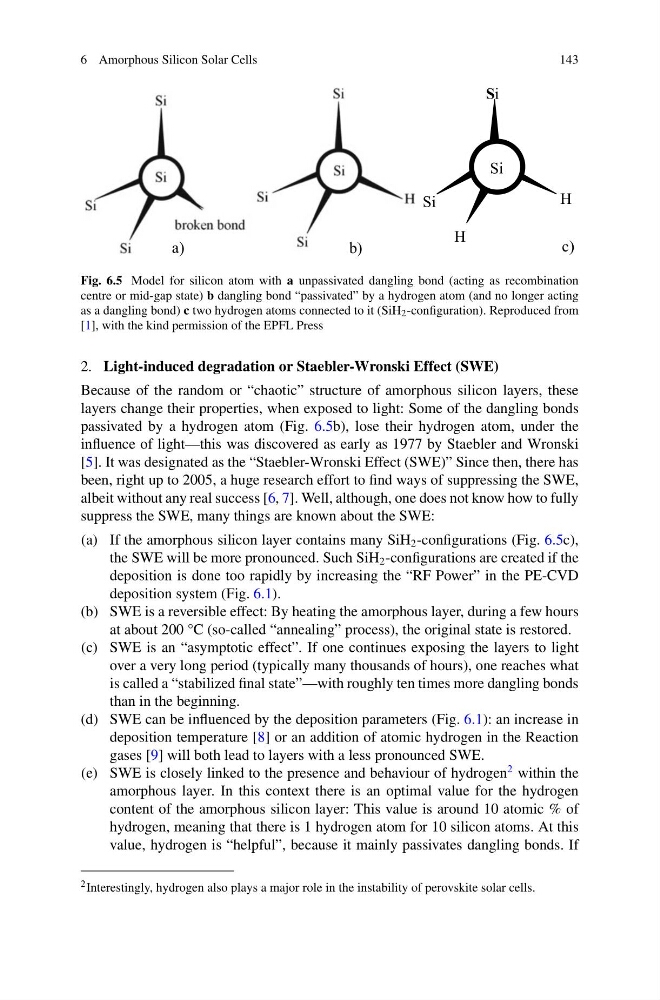
Fig. 6.5 Model for silicon atom with a unpassivated dangling bond (acting as recombination
centre or mid-gap state) b dangling bond “passivated” by a hydrogen atom (and no longer acting
as a dangling bond) c two hydrogen atoms connected to it (SiH 2 -configuration). Reproduced from
[1], with the kind permission of the EPFL Press
2. Light-induced degradation or Staebler-Wronski Effect (SWE)
Because of the random or “chaotic” structure of amorphous silicon layers, these
layers change their properties, when exposed to light: Some of the dangling bonds
passivated by a hydrogen atom (Fig. 6.5b), lose their hydrogen atom, under the
influence of light—this was discovered as early as 1977 by Staebler and Wronski
[5]. It was designated as the “Staebler-Wronski Effect (SWE)” Since then, there has
been, right up to 2005, a huge research effort to find ways of suppressing the SWE,
albeit without any real success [6, 7]. Well, although, one does not know how to fully
suppress the SWE, many things are known about the SWE:
(a) If the amorphous silicon layer contains many SiH 2 -configurations (Fig. 6.5c),
the SWE will be more pronounced. Such SiH 2 -configurations are created if the
deposition is done too rapidly by increasing the “RF Power” in the PE-CVD
deposition system (Fig. 6.1).
(b) SWE is a reversible effect: By heating the amorphous layer, during a few hours
at about 200 °C (so-called “annealing” process), the original state is restored.
(c) SWE is an “asymptotic effect”. If one continues exposing the layers to light
over a very long period (typically many thousands of hours), one reaches what
is called a “stabilized final state”—with roughly ten times more dangling bonds
than in the beginning.
(d) SWE can be influenced by the deposition parameters (Fig. 6.1): an increase in
deposition temperature [8] or an addition of atomic hydrogen in the Reaction
gases [9] will both lead to layers with a less pronounced SWE.
(e) SWE is closely linked to the presence and behaviour of hydrogen
2 within the
amorphous layer. In this context there is an optimal value for the hydrogen
content of the amorphous silicon layer: This value is around 10 atomic % of
hydrogen, meaning that there is 1 hydrogen atom for 10 silicon atoms. At this
value, hydrogen is “helpful”, because it mainly passivates dangling bonds. If
2 Interestingly, hydrogen also plays a major role in the instability of perovskite solar cells.
143
H
H
Si
Si
Si
c)
a)
b)
Fig. 6.5 Model for silicon atom with a unpassivated dangling bond (acting as recombination
centre or mid-gap state) b dangling bond “passivated” by a hydrogen atom (and no longer acting
as a dangling bond) c two hydrogen atoms connected to it (SiH 2 -configuration). Reproduced from
[1], with the kind permission of the EPFL Press
2. Light-induced degradation or Staebler-Wronski Effect (SWE)
Because of the random or “chaotic” structure of amorphous silicon layers, these
layers change their properties, when exposed to light: Some of the dangling bonds
passivated by a hydrogen atom (Fig. 6.5b), lose their hydrogen atom, under the
influence of light—this was discovered as early as 1977 by Staebler and Wronski
[5]. It was designated as the “Staebler-Wronski Effect (SWE)” Since then, there has
been, right up to 2005, a huge research effort to find ways of suppressing the SWE,
albeit without any real success [6, 7]. Well, although, one does not know how to fully
suppress the SWE, many things are known about the SWE:
(a) If the amorphous silicon layer contains many SiH 2 -configurations (Fig. 6.5c),
the SWE will be more pronounced. Such SiH 2 -configurations are created if the
deposition is done too rapidly by increasing the “RF Power” in the PE-CVD
deposition system (Fig. 6.1).
(b) SWE is a reversible effect: By heating the amorphous layer, during a few hours
at about 200 °C (so-called “annealing” process), the original state is restored.
(c) SWE is an “asymptotic effect”. If one continues exposing the layers to light
over a very long period (typically many thousands of hours), one reaches what
is called a “stabilized final state”—with roughly ten times more dangling bonds
than in the beginning.
(d) SWE can be influenced by the deposition parameters (Fig. 6.1): an increase in
deposition temperature [8] or an addition of atomic hydrogen in the Reaction
gases [9] will both lead to layers with a less pronounced SWE.
(e) SWE is closely linked to the presence and behaviour of hydrogen
2 within the
amorphous layer. In this context there is an optimal value for the hydrogen
content of the amorphous silicon layer: This value is around 10 atomic % of
hydrogen, meaning that there is 1 hydrogen atom for 10 silicon atoms. At this
value, hydrogen is “helpful”, because it mainly passivates dangling bonds. If
2 Interestingly, hydrogen also plays a major role in the instability of perovskite solar cells.