

5 Crystalline Silicon Solar Cells: Homojunction Cells
133
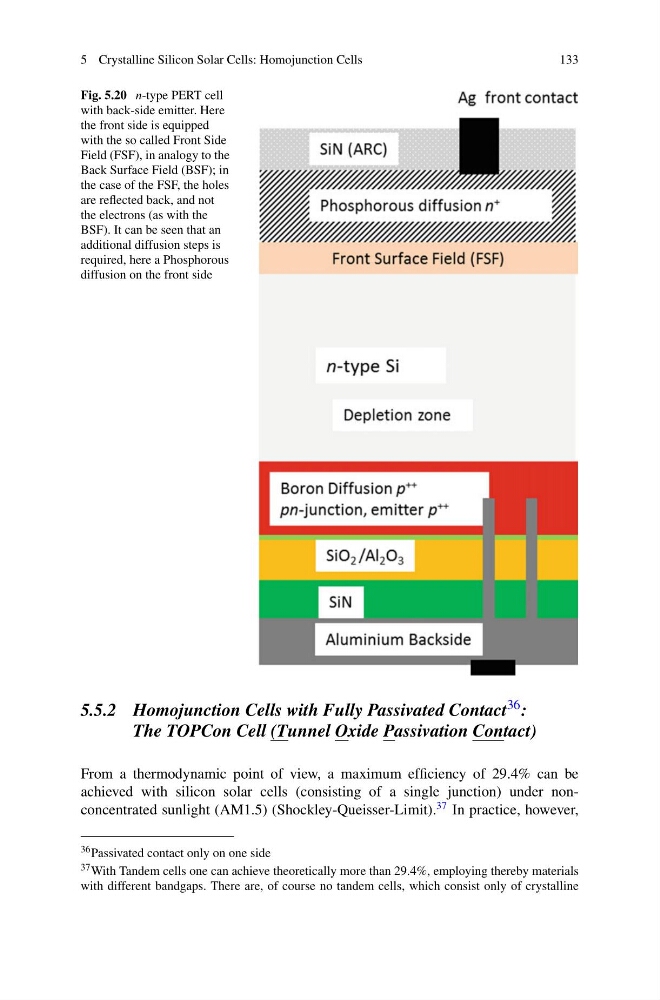
Fig. 5.20 n-type PERT cell
with back-side emitter. Here
the front side is equipped
with the so called Front Side
Field (FSF), in analogy to the
Back Surface Field (BSF); in
the case of the FSF, the holes
are reflected back, and not
the electrons (as with the
BSF). It can be seen that an
additional diffusion steps is
required, here a Phosphorous
diffusion on the front side
5.5.2 Homojunction Cells with Fully Passivated Contact 36 :
The TOPCon Cell (Tunnel Oxide Passivation Contact)
From a thermodynamic point of view, a maximum efficiency of 29.4% can be
achieved with silicon solar cells (consisting of a single junction) under nonconcentrated sunlight (AM1.5) (Shockley-Queisser-Limit).
37 In practice, however,
36 Passivated contact only on one side
37 With Tandem cells one can achieve theoretically more than 29.4%, employing thereby materials
with different bandgaps. There are, of course no tandem cells, which consist only of crystalline
133
Fig. 5.20 n-type PERT cell
with back-side emitter. Here
the front side is equipped
with the so called Front Side
Field (FSF), in analogy to the
Back Surface Field (BSF); in
the case of the FSF, the holes
are reflected back, and not
the electrons (as with the
BSF). It can be seen that an
additional diffusion steps is
required, here a Phosphorous
diffusion on the front side
5.5.2 Homojunction Cells with Fully Passivated Contact 36 :
The TOPCon Cell (Tunnel Oxide Passivation Contact)
From a thermodynamic point of view, a maximum efficiency of 29.4% can be
achieved with silicon solar cells (consisting of a single junction) under nonconcentrated sunlight (AM1.5) (Shockley-Queisser-Limit).
37 In practice, however,
36 Passivated contact only on one side
37 With Tandem cells one can achieve theoretically more than 29.4%, employing thereby materials
with different bandgaps. There are, of course no tandem cells, which consist only of crystalline