

126
S. Leu and D. Sontag
back of the cell. The aluminium paste is pressed through openings made by the laser,
to ensure an Ohmic contact. The laser openings can be connected to one another via
a full-area Al layer. The PERC cell obtained in this way is a monofacial cell because
the aluminium on the back side of the cell covers the entire surface.
In the course of development, a variety of technologies for the production of
local openings on the back have been developed. The technology used today is laser
ablation: One locally removes the passivation layer with a short laser pulse without
causing deep damage to the underlying silicon surface. Depending on the thickness
and the composition of the passivation layer, lasers in the IR or UV range are better
suited for this step.
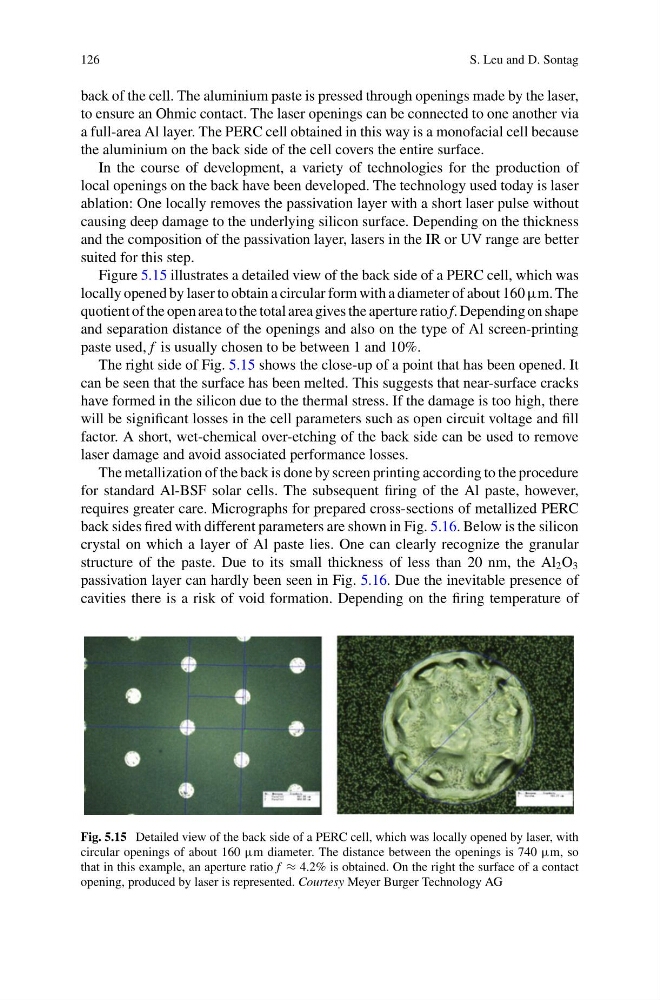
Figure 5.15 illustrates a detailed view of the back side of a PERC cell, which was
locally opened by laser to obtain a circular form with a diameter of about 160 μm. The
quotient of the open area to the total area gives the aperture ratio f. Depending on shape
and separation distance of the openings and also on the type of Al screen-printing
paste used, f is usually chosen to be between 1 and 10%.
The right side of Fig. 5.15 shows the close-up of a point that has been opened. It
can be seen that the surface has been melted. This suggests that near-surface cracks
have formed in the silicon due to the thermal stress. If the damage is too high, there
will be significant losses in the cell parameters such as open circuit voltage and fill
factor. A short, wet-chemical over-etching of the back side can be used to remove
laser damage and avoid associated performance losses.
The metallization of the back is done by screen printing according to the procedure
for standard Al-BSF solar cells. The subsequent firing of the Al paste, however,
requires greater care. Micrographs for prepared cross-sections of metallized PERC
back sides fired with different parameters are shown in Fig. 5.16. Below is the silicon
crystal on which a layer of Al paste lies. One can clearly recognize the granular
structure of the paste. Due to its small thickness of less than 20 nm, the Al 2 O 3
passivation layer can hardly been seen in Fig. 5.16. Due the inevitable presence of
cavities there is a risk of void formation. Depending on the firing temperature of
Fig. 5.15 Detailed view of the back side of a PERC cell, which was locally opened by laser, with
circular openings of about 160 μm diameter. The distance between the openings is 740 μm, so
that in this example, an aperture ratio f ≈ 4.2% is obtained. On the right the surface of a contact
opening, produced by laser is represented. Courtesy Meyer Burger Technology AG
S. Leu and D. Sontag
back of the cell. The aluminium paste is pressed through openings made by the laser,
to ensure an Ohmic contact. The laser openings can be connected to one another via
a full-area Al layer. The PERC cell obtained in this way is a monofacial cell because
the aluminium on the back side of the cell covers the entire surface.
In the course of development, a variety of technologies for the production of
local openings on the back have been developed. The technology used today is laser
ablation: One locally removes the passivation layer with a short laser pulse without
causing deep damage to the underlying silicon surface. Depending on the thickness
and the composition of the passivation layer, lasers in the IR or UV range are better
suited for this step.
Figure 5.15 illustrates a detailed view of the back side of a PERC cell, which was
locally opened by laser to obtain a circular form with a diameter of about 160 μm. The
quotient of the open area to the total area gives the aperture ratio f. Depending on shape
and separation distance of the openings and also on the type of Al screen-printing
paste used, f is usually chosen to be between 1 and 10%.
The right side of Fig. 5.15 shows the close-up of a point that has been opened. It
can be seen that the surface has been melted. This suggests that near-surface cracks
have formed in the silicon due to the thermal stress. If the damage is too high, there
will be significant losses in the cell parameters such as open circuit voltage and fill
factor. A short, wet-chemical over-etching of the back side can be used to remove
laser damage and avoid associated performance losses.
The metallization of the back is done by screen printing according to the procedure
for standard Al-BSF solar cells. The subsequent firing of the Al paste, however,
requires greater care. Micrographs for prepared cross-sections of metallized PERC
back sides fired with different parameters are shown in Fig. 5.16. Below is the silicon
crystal on which a layer of Al paste lies. One can clearly recognize the granular
structure of the paste. Due to its small thickness of less than 20 nm, the Al 2 O 3
passivation layer can hardly been seen in Fig. 5.16. Due the inevitable presence of
cavities there is a risk of void formation. Depending on the firing temperature of
Fig. 5.15 Detailed view of the back side of a PERC cell, which was locally opened by laser, with
circular openings of about 160 μm diameter. The distance between the openings is 740 μm, so
that in this example, an aperture ratio f ≈ 4.2% is obtained. On the right the surface of a contact
opening, produced by laser is represented. Courtesy Meyer Burger Technology AG