

5 Crystalline Silicon Solar Cells: Homojunction Cells
119
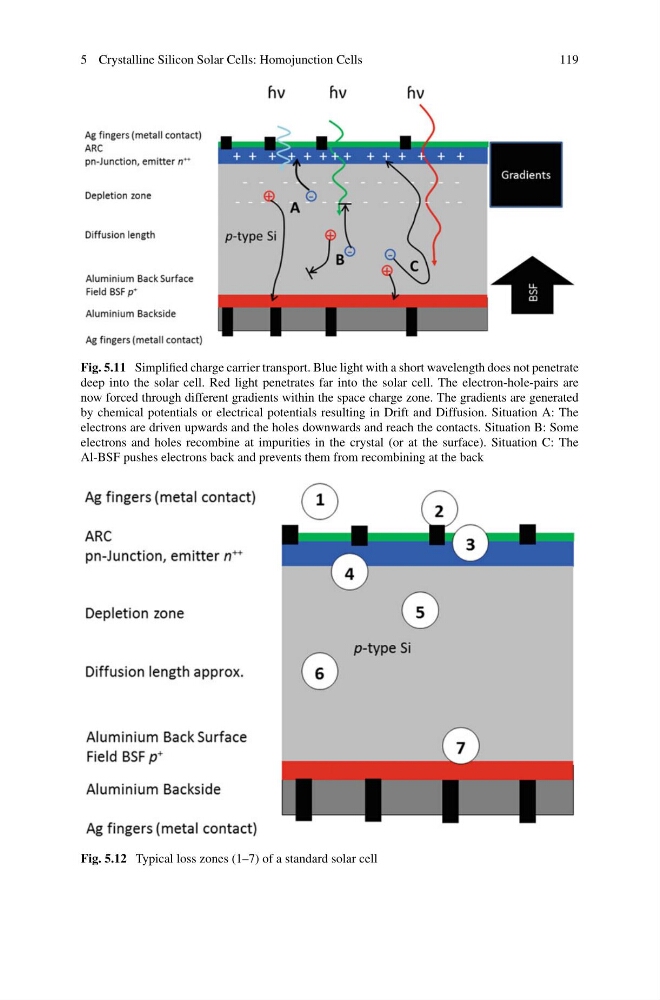
Fig. 5.11 Simplified charge carrier transport. Blue light with a short wavelength does not penetrate
deep into the solar cell. Red light penetrates far into the solar cell. The electron-hole-pairs are
now forced through different gradients within the space charge zone. The gradients are generated
by chemical potentials or electrical potentials resulting in Drift and Diffusion. Situation A: The
electrons are driven upwards and the holes downwards and reach the contacts. Situation B: Some
electrons and holes recombine at impurities in the crystal (or at the surface). Situation C: The
Al-BSF pushes electrons back and prevents them from recombining at the back
Fig. 5.12 Typical loss zones (1–7) of a standard solar cell
119
Fig. 5.11 Simplified charge carrier transport. Blue light with a short wavelength does not penetrate
deep into the solar cell. Red light penetrates far into the solar cell. The electron-hole-pairs are
now forced through different gradients within the space charge zone. The gradients are generated
by chemical potentials or electrical potentials resulting in Drift and Diffusion. Situation A: The
electrons are driven upwards and the holes downwards and reach the contacts. Situation B: Some
electrons and holes recombine at impurities in the crystal (or at the surface). Situation C: The
Al-BSF pushes electrons back and prevents them from recombining at the back
Fig. 5.12 Typical loss zones (1–7) of a standard solar cell