

5 Crystalline Silicon Solar Cells: Homojunction Cells
109
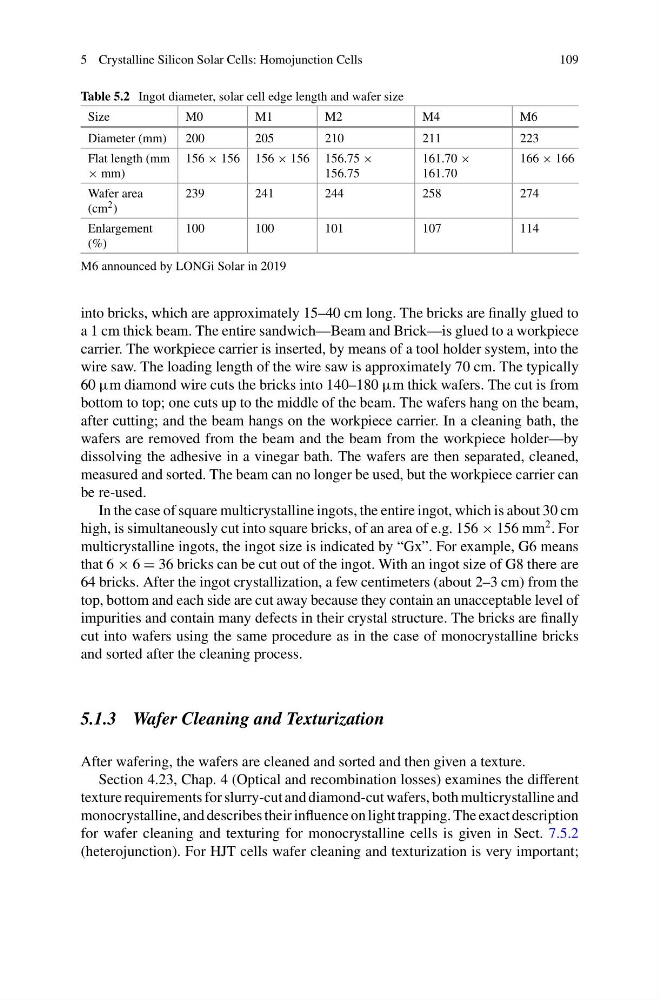
Table 5.2 Ingot diameter, solar cell edge length and wafer size
Size
M0
M1
M2
M4
M6
Diameter (mm) 200
205
210
211
223
Flat length (mm
× mm)
156 × 156 156 × 156 156.75 ×
156.75
161.70 ×
161.70
166 × 166
Wafer area
(cm 2 )
239
241
244
258
274
Enlargement
(%)
100
100
101
107
114
M6 announced by LONGi Solar in 2019
into bricks, which are approximately 15–40 cm long. The bricks are finally glued to
a 1 cm thick beam. The entire sandwich—Beam and Brick—is glued to a workpiece
carrier. The workpiece carrier is inserted, by means of a tool holder system, into the
wire saw. The loading length of the wire saw is approximately 70 cm. The typically
60 μm diamond wire cuts the bricks into 140–180 μm thick wafers. The cut is from
bottom to top; one cuts up to the middle of the beam. The wafers hang on the beam,
after cutting; and the beam hangs on the workpiece carrier. In a cleaning bath, the
wafers are removed from the beam and the beam from the workpiece holder—by
dissolving the adhesive in a vinegar bath. The wafers are then separated, cleaned,
measured and sorted. The beam can no longer be used, but the workpiece carrier can
be re-used.
In the case of square multicrystalline ingots, the entire ingot, which is about 30 cm
high, is simultaneously cut into square bricks, of an area of e.g. 156 × 156 mm
2 . For
multicrystalline ingots, the ingot size is indicated by “Gx”. For example, G6 means
that 6 × 6 = 36 bricks can be cut out of the ingot. With an ingot size of G8 there are
64 bricks. After the ingot crystallization, a few centimeters (about 2–3 cm) from the
top, bottom and each side are cut away because they contain an unacceptable level of
impurities and contain many defects in their crystal structure. The bricks are finally
cut into wafers using the same procedure as in the case of monocrystalline bricks
and sorted after the cleaning process.
5.1.3 Wafer Cleaning and Texturization
After wafering, the wafers are cleaned and sorted and then given a texture.
Section 4.23, Chap. 4 (Optical and recombination losses) examines the different
texture requirements for slurry-cut and diamond-cut wafers, both multicrystalline and
monocrystalline, and describes their influence on light trapping. The exact description
for wafer cleaning and texturing for monocrystalline cells is given in Sect. 7.5.2
(heterojunction). For HJT cells wafer cleaning and texturization is very important;
109
Table 5.2 Ingot diameter, solar cell edge length and wafer size
Size
M0
M1
M2
M4
M6
Diameter (mm) 200
205
210
211
223
Flat length (mm
× mm)
156 × 156 156 × 156 156.75 ×
156.75
161.70 ×
161.70
166 × 166
Wafer area
(cm 2 )
239
241
244
258
274
Enlargement
(%)
100
100
101
107
114
M6 announced by LONGi Solar in 2019
into bricks, which are approximately 15–40 cm long. The bricks are finally glued to
a 1 cm thick beam. The entire sandwich—Beam and Brick—is glued to a workpiece
carrier. The workpiece carrier is inserted, by means of a tool holder system, into the
wire saw. The loading length of the wire saw is approximately 70 cm. The typically
60 μm diamond wire cuts the bricks into 140–180 μm thick wafers. The cut is from
bottom to top; one cuts up to the middle of the beam. The wafers hang on the beam,
after cutting; and the beam hangs on the workpiece carrier. In a cleaning bath, the
wafers are removed from the beam and the beam from the workpiece holder—by
dissolving the adhesive in a vinegar bath. The wafers are then separated, cleaned,
measured and sorted. The beam can no longer be used, but the workpiece carrier can
be re-used.
In the case of square multicrystalline ingots, the entire ingot, which is about 30 cm
high, is simultaneously cut into square bricks, of an area of e.g. 156 × 156 mm
2 . For
multicrystalline ingots, the ingot size is indicated by “Gx”. For example, G6 means
that 6 × 6 = 36 bricks can be cut out of the ingot. With an ingot size of G8 there are
64 bricks. After the ingot crystallization, a few centimeters (about 2–3 cm) from the
top, bottom and each side are cut away because they contain an unacceptable level of
impurities and contain many defects in their crystal structure. The bricks are finally
cut into wafers using the same procedure as in the case of monocrystalline bricks
and sorted after the cleaning process.
5.1.3 Wafer Cleaning and Texturization
After wafering, the wafers are cleaned and sorted and then given a texture.
Section 4.23, Chap. 4 (Optical and recombination losses) examines the different
texture requirements for slurry-cut and diamond-cut wafers, both multicrystalline and
monocrystalline, and describes their influence on light trapping. The exact description
for wafer cleaning and texturing for monocrystalline cells is given in Sect. 7.5.2
(heterojunction). For HJT cells wafer cleaning and texturization is very important;