

4 Solar Cells: Optical and Recombination Losses
91
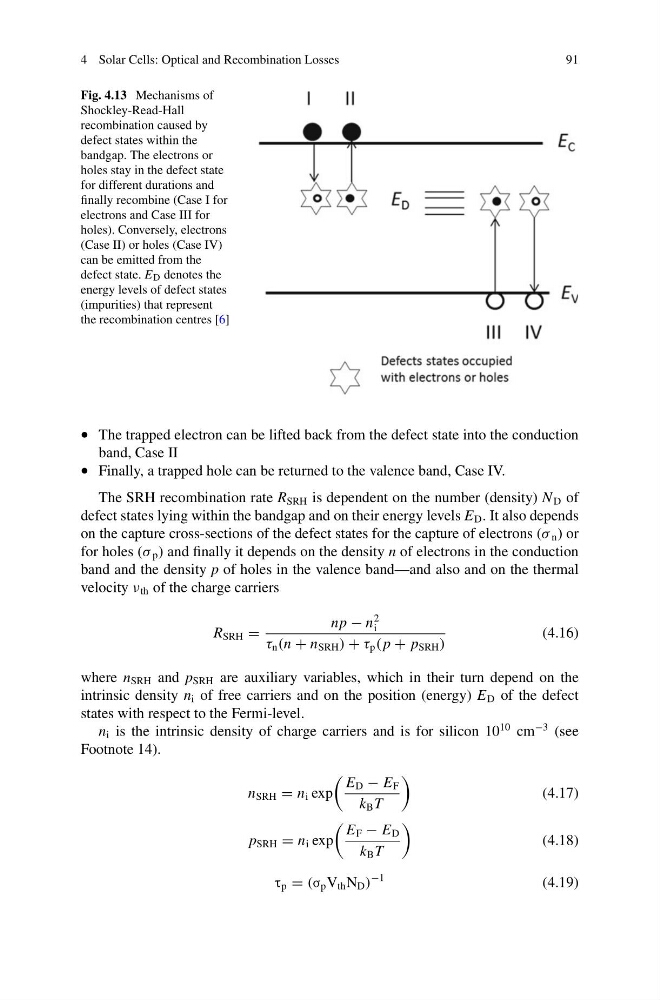
Fig. 4.13 Mechanisms of
Shockley-Read-Hall
recombination caused by
defect states within the
bandgap. The electrons or
holes stay in the defect state
for different durations and
finally recombine (Case I for
electrons and Case III for
holes). Conversely, electrons
(Case II) or holes (Case IV)
can be emitted from the
defect state. E D denotes the
energy levels of defect states
(impurities) that represent
the recombination centres [6]
• The trapped electron can be lifted back from the defect state into the conduction
band, Case II
• Finally, a trapped hole can be returned to the valence band, Case IV.
The SRH recombination rate R SRH is dependent on the number (density) N D of
defect states lying within the bandgap and on their energy levels E D . It also depends
on the capture cross-sections of the defect states for the capture of electrons (σ n ) or
for holes (σ p ) and finally it depends on the density n of electrons in the conduction
band and the density p of holes in the valence band—and also and on the thermal
velocity ν th of the charge carriers
R SRH =
np − n
2
i
τ n (n + n SRH ) + τ p ( p + p SRH )
(4.16)
where n SRH and p SRH are auxiliary variables, which in their turn depend on the
intrinsic density n i of free carriers and on the position (energy) E D of the defect
states with respect to the Fermi-level.
n i is the intrinsic density of charge carriers and is for silicon 10
10 cm
−3 (see
Footnote 14).
n SRH = n i exp
E D − E F
k B T
(4.17)
p SRH = n i exp
E F − E D
k B T
(4.18)
τ p = (σ p V th N D )
−1
(4.19)
91
Fig. 4.13 Mechanisms of
Shockley-Read-Hall
recombination caused by
defect states within the
bandgap. The electrons or
holes stay in the defect state
for different durations and
finally recombine (Case I for
electrons and Case III for
holes). Conversely, electrons
(Case II) or holes (Case IV)
can be emitted from the
defect state. E D denotes the
energy levels of defect states
(impurities) that represent
the recombination centres [6]
• The trapped electron can be lifted back from the defect state into the conduction
band, Case II
• Finally, a trapped hole can be returned to the valence band, Case IV.
The SRH recombination rate R SRH is dependent on the number (density) N D of
defect states lying within the bandgap and on their energy levels E D . It also depends
on the capture cross-sections of the defect states for the capture of electrons (σ n ) or
for holes (σ p ) and finally it depends on the density n of electrons in the conduction
band and the density p of holes in the valence band—and also and on the thermal
velocity ν th of the charge carriers
R SRH =
np − n
2
i
τ n (n + n SRH ) + τ p ( p + p SRH )
(4.16)
where n SRH and p SRH are auxiliary variables, which in their turn depend on the
intrinsic density n i of free carriers and on the position (energy) E D of the defect
states with respect to the Fermi-level.
n i is the intrinsic density of charge carriers and is for silicon 10
10 cm
−3 (see
Footnote 14).
n SRH = n i exp
E D − E F
k B T
(4.17)
p SRH = n i exp
E F − E D
k B T
(4.18)
τ p = (σ p V th N D )
−1
(4.19)