

82
S. Leu and D. Sontag
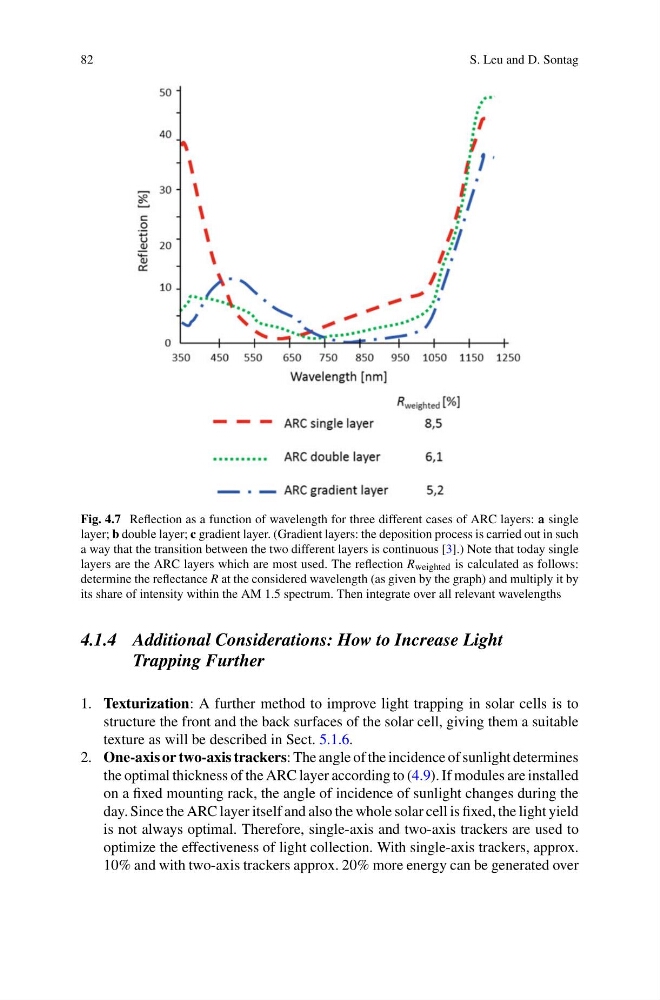
Fig. 4.7 Reflection as a function of wavelength for three different cases of ARC layers: a single
layer; b double layer; c gradient layer. (Gradient layers: the deposition process is carried out in such
a way that the transition between the two different layers is continuous [3].) Note that today single
layers are the ARC layers which are most used. The reflection R weighted is calculated as follows:
determine the reflectance R at the considered wavelength (as given by the graph) and multiply it by
its share of intensity within the AM 1.5 spectrum. Then integrate over all relevant wavelengths
4.1.4 Additional Considerations: How to Increase Light
Trapping Further
1. Texturization: A further method to improve light trapping in solar cells is to
structure the front and the back surfaces of the solar cell, giving them a suitable
texture as will be described in Sect. 5.1.6.
2. One-axis or two-axis trackers: The angle of the incidence of sunlight determines
the optimal thickness of the ARC layer according to (4.9). If modules are installed
on a fixed mounting rack, the angle of incidence of sunlight changes during the
day. Since the ARC layer itself and also the whole solar cell is fixed, the light yield
is not always optimal. Therefore, single-axis and two-axis trackers are used to
optimize the effectiveness of light collection. With single-axis trackers, approx.
10% and with two-axis trackers approx. 20% more energy can be generated over
S. Leu and D. Sontag
Fig. 4.7 Reflection as a function of wavelength for three different cases of ARC layers: a single
layer; b double layer; c gradient layer. (Gradient layers: the deposition process is carried out in such
a way that the transition between the two different layers is continuous [3].) Note that today single
layers are the ARC layers which are most used. The reflection R weighted is calculated as follows:
determine the reflectance R at the considered wavelength (as given by the graph) and multiply it by
its share of intensity within the AM 1.5 spectrum. Then integrate over all relevant wavelengths
4.1.4 Additional Considerations: How to Increase Light
Trapping Further
1. Texturization: A further method to improve light trapping in solar cells is to
structure the front and the back surfaces of the solar cell, giving them a suitable
texture as will be described in Sect. 5.1.6.
2. One-axis or two-axis trackers: The angle of the incidence of sunlight determines
the optimal thickness of the ARC layer according to (4.9). If modules are installed
on a fixed mounting rack, the angle of incidence of sunlight changes during the
day. Since the ARC layer itself and also the whole solar cell is fixed, the light yield
is not always optimal. Therefore, single-axis and two-axis trackers are used to
optimize the effectiveness of light collection. With single-axis trackers, approx.
10% and with two-axis trackers approx. 20% more energy can be generated over