

and a weight, and it is not an oscillator, which can be used in onboard equipment of
unmanned flying vehicles (UMFV) and the specific flying vehicles. As in OEOs, the
laser is one of the main elements of QFS. It is used for tuning of the generated RF
frequency to the average frequency of the Cs cell absorption. The QFS operation as a
whole and, in particular, its phase noises, depends in many aspects upon laser
characteristics including the spectral line width, which is about 1 MHz, and the
laser phase noise level. The last note also concerns to OEO with RF FODL. And
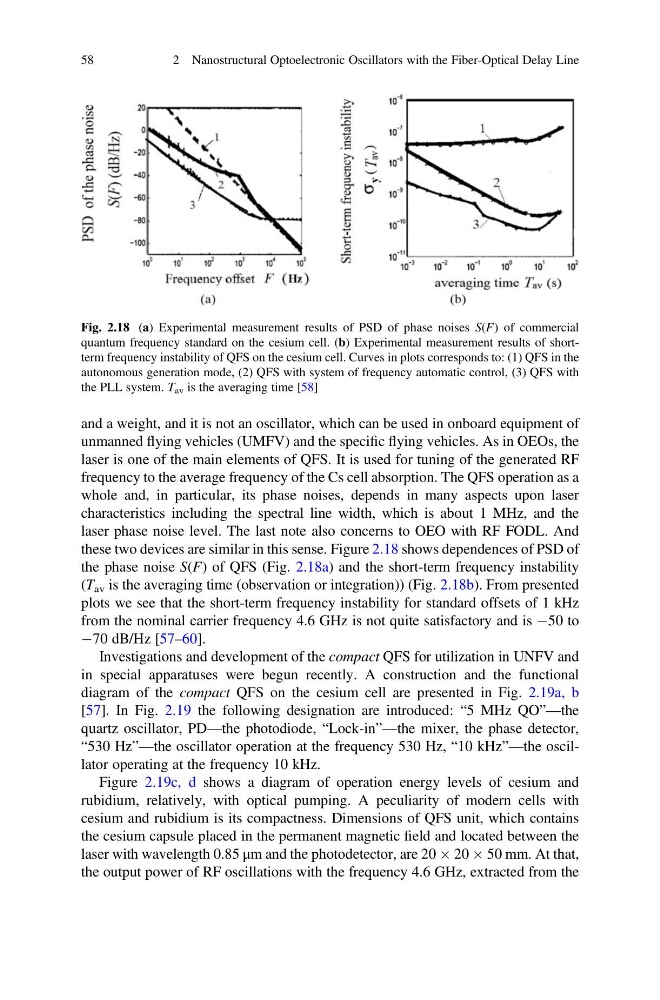
these two devices are similar in this sense. Figure 2.18 shows dependences of PSD of
the phase noise S(F) of QFS (Fig. 2.18a) and the short-term frequency instability
(T av is the averaging time (observation or integration)) (Fig. 2.18b). From presented
plots we see that the short-term frequency instability for standard offsets of 1 kHz
from the nominal carrier frequency 4.6 GHz is not quite satisfactory and is À50 to
À70 dB/Hz [57–60].
Investigations and development of the compact QFS for utilization in UNFV and
in special apparatuses were begun recently. A construction and the functional
diagram of the compact QFS on the cesium cell are presented in Fig. 2.19a, b
[57]. In Fig. 2.19 the following designation are introduced: “5 MHz QO”—the
quartz oscillator, PD—the photodiode, “Lock-in”—the mixer, the phase detector,
“530 Hz”—the oscillator operation at the frequency 530 Hz, “10 kHz”—the oscillator operating at the frequency 10 kHz.
Figure 2.19c, d shows a diagram of operation energy levels of cesium and
rubidium, relatively, with optical pumping. A peculiarity of modern cells with
cesium and rubidium is its compactness. Dimensions of QFS unit, which contains
the cesium capsule placed in the permanent magnetic field and located between the
laser with wavelength 0.85 μm and the photodetector, are 20 Â 20 Â 50 mm. At that,
the output power of RF oscillations with the frequency 4.6 GHz, extracted from the
Fig. 2.18 (a) Experimental measurement results of PSD of phase noises S(F) of commercial
quantum frequency standard on the cesium cell. (b) Experimental measurement results of shortterm frequency instability of QFS on the cesium cell. Curves in plots corresponds to: (1) QFS in the
autonomous generation mode, (2) QFS with system of frequency automatic control, (3) QFS with
the PLL system. T av is the averaging time [58]
58
2 Nanostructural Optoelectronic Oscillators with the Fiber-Optical Delay Line
unmanned flying vehicles (UMFV) and the specific flying vehicles. As in OEOs, the
laser is one of the main elements of QFS. It is used for tuning of the generated RF
frequency to the average frequency of the Cs cell absorption. The QFS operation as a
whole and, in particular, its phase noises, depends in many aspects upon laser
characteristics including the spectral line width, which is about 1 MHz, and the
laser phase noise level. The last note also concerns to OEO with RF FODL. And
these two devices are similar in this sense. Figure 2.18 shows dependences of PSD of
the phase noise S(F) of QFS (Fig. 2.18a) and the short-term frequency instability
(T av is the averaging time (observation or integration)) (Fig. 2.18b). From presented
plots we see that the short-term frequency instability for standard offsets of 1 kHz
from the nominal carrier frequency 4.6 GHz is not quite satisfactory and is À50 to
À70 dB/Hz [57–60].
Investigations and development of the compact QFS for utilization in UNFV and
in special apparatuses were begun recently. A construction and the functional
diagram of the compact QFS on the cesium cell are presented in Fig. 2.19a, b
[57]. In Fig. 2.19 the following designation are introduced: “5 MHz QO”—the
quartz oscillator, PD—the photodiode, “Lock-in”—the mixer, the phase detector,
“530 Hz”—the oscillator operation at the frequency 530 Hz, “10 kHz”—the oscillator operating at the frequency 10 kHz.
Figure 2.19c, d shows a diagram of operation energy levels of cesium and
rubidium, relatively, with optical pumping. A peculiarity of modern cells with
cesium and rubidium is its compactness. Dimensions of QFS unit, which contains
the cesium capsule placed in the permanent magnetic field and located between the
laser with wavelength 0.85 μm and the photodetector, are 20 Â 20 Â 50 mm. At that,
the output power of RF oscillations with the frequency 4.6 GHz, extracted from the
Fig. 2.18 (a) Experimental measurement results of PSD of phase noises S(F) of commercial
quantum frequency standard on the cesium cell. (b) Experimental measurement results of shortterm frequency instability of QFS on the cesium cell. Curves in plots corresponds to: (1) QFS in the
autonomous generation mode, (2) QFS with system of frequency automatic control, (3) QFS with
the PLL system. T av is the averaging time [58]
58
2 Nanostructural Optoelectronic Oscillators with the Fiber-Optical Delay Line