

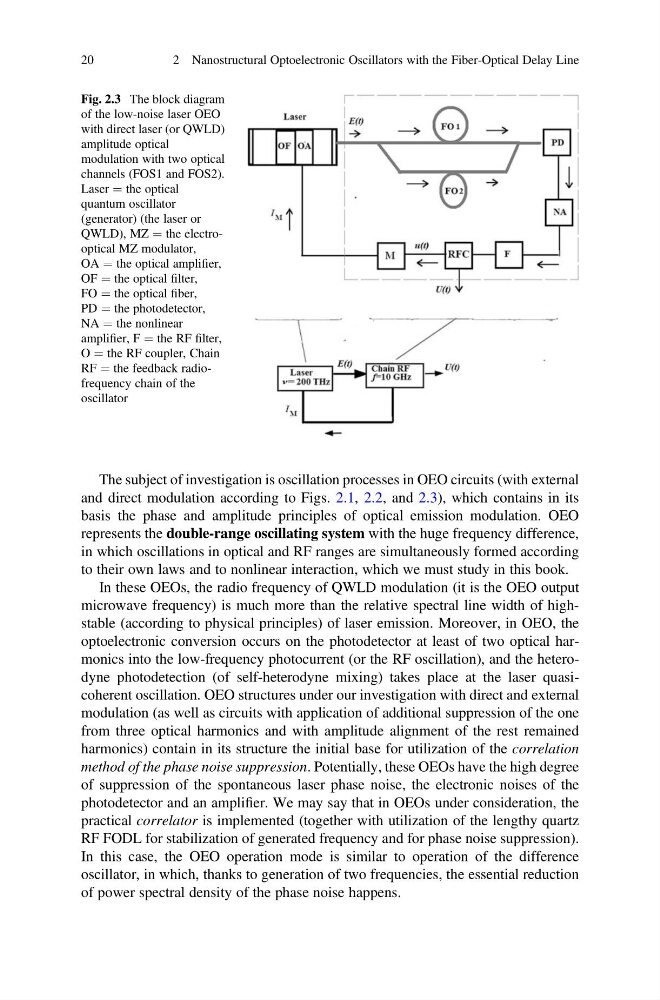
The subject of investigation is oscillation processes in OEO circuits (with external
and direct modulation according to Figs. 2.1, 2.2, and 2.3), which contains in its
basis the phase and amplitude principles of optical emission modulation. OEO
represents the double-range oscillating system with the huge frequency difference,
in which oscillations in optical and RF ranges are simultaneously formed according
to their own laws and to nonlinear interaction, which we must study in this book.
In these OEOs, the radio frequency of QWLD modulation (it is the OEO output
microwave frequency) is much more than the relative spectral line width of highstable (according to physical principles) of laser emission. Moreover, in OEO, the
optoelectronic conversion occurs on the photodetector at least of two optical harmonics into the low-frequency photocurrent (or the RF oscillation), and the heterodyne photodetection (of self-heterodyne mixing) takes place at the laser quasicoherent oscillation. OEO structures under our investigation with direct and external
modulation (as well as circuits with application of additional suppression of the one
from three optical harmonics and with amplitude alignment of the rest remained
harmonics) contain in its structure the initial base for utilization of the correlation
method of the phase noise suppression. Potentially, these OEOs have the high degree
of suppression of the spontaneous laser phase noise, the electronic noises of the
photodetector and an amplifier. We may say that in OEOs under consideration, the
practical correlator is implemented (together with utilization of the lengthy quartz
RF FODL for stabilization of generated frequency and for phase noise suppression).
In this case, the OEO operation mode is similar to operation of the difference
oscillator, in which, thanks to generation of two frequencies, the essential reduction
of power spectral density of the phase noise happens.
Fig. 2.3 The block diagram
of the low-noise laser OEO
with direct laser (or QWLD)
amplitude optical
modulation with two optical
channels (FOS1 and FOS2).
Laser ¼ the optical
quantum oscillator
(generator) (the laser or
QWLD), MZ ¼ the electrooptical MZ modulator,
OA ¼ the optical amplifier,
OF ¼ the optical filter,
FO ¼ the optical fiber,
PD ¼ the photodetector,
NA ¼ the nonlinear
amplifier, F ¼ the RF filter,
O ¼ the RF coupler, Chain
RF ¼ the feedback radiofrequency chain of the
oscillator
20
2 Nanostructural Optoelectronic Oscillators with the Fiber-Optical Delay Line
and direct modulation according to Figs. 2.1, 2.2, and 2.3), which contains in its
basis the phase and amplitude principles of optical emission modulation. OEO
represents the double-range oscillating system with the huge frequency difference,
in which oscillations in optical and RF ranges are simultaneously formed according
to their own laws and to nonlinear interaction, which we must study in this book.
In these OEOs, the radio frequency of QWLD modulation (it is the OEO output
microwave frequency) is much more than the relative spectral line width of highstable (according to physical principles) of laser emission. Moreover, in OEO, the
optoelectronic conversion occurs on the photodetector at least of two optical harmonics into the low-frequency photocurrent (or the RF oscillation), and the heterodyne photodetection (of self-heterodyne mixing) takes place at the laser quasicoherent oscillation. OEO structures under our investigation with direct and external
modulation (as well as circuits with application of additional suppression of the one
from three optical harmonics and with amplitude alignment of the rest remained
harmonics) contain in its structure the initial base for utilization of the correlation
method of the phase noise suppression. Potentially, these OEOs have the high degree
of suppression of the spontaneous laser phase noise, the electronic noises of the
photodetector and an amplifier. We may say that in OEOs under consideration, the
practical correlator is implemented (together with utilization of the lengthy quartz
RF FODL for stabilization of generated frequency and for phase noise suppression).
In this case, the OEO operation mode is similar to operation of the difference
oscillator, in which, thanks to generation of two frequencies, the essential reduction
of power spectral density of the phase noise happens.
Fig. 2.3 The block diagram
of the low-noise laser OEO
with direct laser (or QWLD)
amplitude optical
modulation with two optical
channels (FOS1 and FOS2).
Laser ¼ the optical
quantum oscillator
(generator) (the laser or
QWLD), MZ ¼ the electrooptical MZ modulator,
OA ¼ the optical amplifier,
OF ¼ the optical filter,
FO ¼ the optical fiber,
PD ¼ the photodetector,
NA ¼ the nonlinear
amplifier, F ¼ the RF filter,
O ¼ the RF coupler, Chain
RF ¼ the feedback radiofrequency chain of the
oscillator
20
2 Nanostructural Optoelectronic Oscillators with the Fiber-Optical Delay Line