

8.4 Implementation of OEO in the Microwave Range
and Its Experimental Characteristics
This section describes the OEO experimental research results in the microwave
range of 8–10 GHz. The experimental OEO breadboard in the microwave range is
developed and constructed in the hybrid implementation and created on the
completely native element base. A part of experiment plots on the experimental
amplitude and phase responses for QWLD, the watt–ampere QWLD characteristics
and spectra are presented in Chap. 4 of this book.
For tasks’ statement of the experimental investigations, this experimental OEO
breadboard is considered as the specific device for creation of available master
oscillators and local oscillators for receiving and transmitting sets for radars and
optical radars in the microwave range.
The structure of OEO of the microwave range (Fig. 8.13) does not differ
(structurally) from the OEO of the RF range. At that, main features are utilization
of the quantum-well laser diode as the modulated light source with the modulation
bandwidth 12–15 GHz. QWLD is the single-mode single-frequency highly coherent
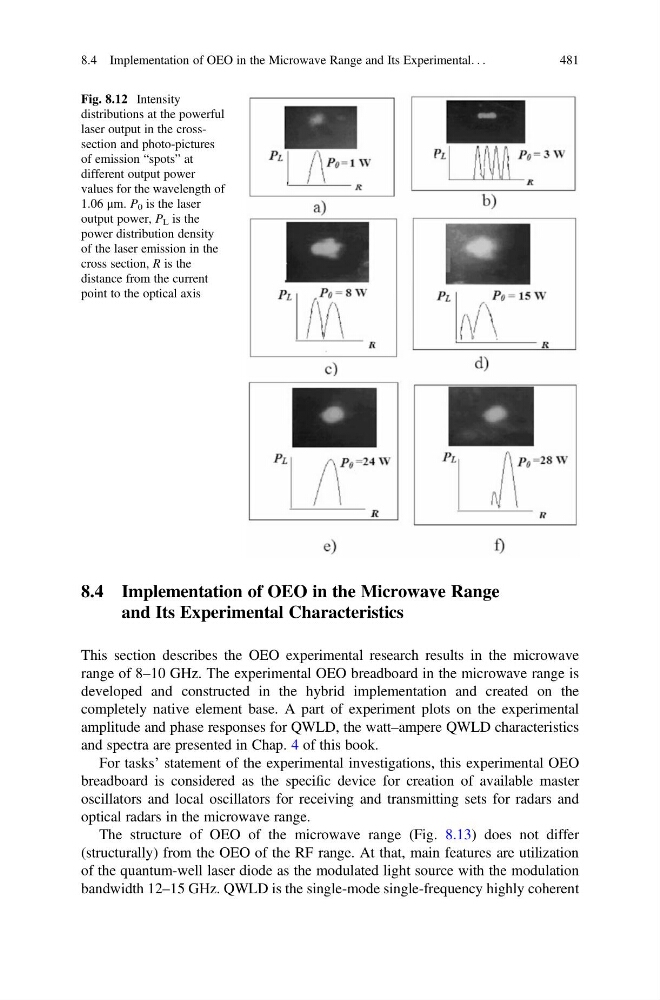
Fig. 8.12 Intensity
distributions at the powerful
laser output in the crosssection and photo-pictures
of emission “spots” at
different output power
values for the wavelength of
1.06 μm. P 0 is the laser
output power, P L is the
power distribution density
of the laser emission in the
cross section, R is the
distance from the current
point to the optical axis
8.4 Implementation of OEO in the Microwave Range and Its Experimental. . .
481
and Its Experimental Characteristics
This section describes the OEO experimental research results in the microwave
range of 8–10 GHz. The experimental OEO breadboard in the microwave range is
developed and constructed in the hybrid implementation and created on the
completely native element base. A part of experiment plots on the experimental
amplitude and phase responses for QWLD, the watt–ampere QWLD characteristics
and spectra are presented in Chap. 4 of this book.
For tasks’ statement of the experimental investigations, this experimental OEO
breadboard is considered as the specific device for creation of available master
oscillators and local oscillators for receiving and transmitting sets for radars and
optical radars in the microwave range.
The structure of OEO of the microwave range (Fig. 8.13) does not differ
(structurally) from the OEO of the RF range. At that, main features are utilization
of the quantum-well laser diode as the modulated light source with the modulation
bandwidth 12–15 GHz. QWLD is the single-mode single-frequency highly coherent
Fig. 8.12 Intensity
distributions at the powerful
laser output in the crosssection and photo-pictures
of emission “spots” at
different output power
values for the wavelength of
1.06 μm. P 0 is the laser
output power, P L is the
power distribution density
of the laser emission in the
cross section, R is the
distance from the current
point to the optical axis
8.4 Implementation of OEO in the Microwave Range and Its Experimental. . .
481