

continuous wave, the laser output power is from 1 to 30 W, emission wavelengths
are 1.06 and 0.53 μm. We investigated two types of modulators: (1) the acoustooptical modulator (AOM) on the base the para-tellurite crystal, (2) the electricoptical modulator on the base of lithium niobates. The OEO average frequency is
1.0 GHz, the long-term OEO frequency stability per 1 h is 10
À6 . The phase
difference drifts at outputs of the fiber-optical channels offsets are no worse than
2–3
. The dynamic range is 1000.
The optoelectronic oscillator workbench permitting experimental investigations
of nonlinear effects in the optical fibers and perform phase measurements using the
powerful neodymium-yttrium-aluminum-garnet laser with the power up to 40 W and
the electro-optical and acousto-optical modulators in the microwave range is developed at MPEI (Radio-Transmitters Dept) under supervision of Professor
V.V. Grigorianz. The structure of this experimental workbench of the phased
microwave fiber-optical system on the base of the powerful laser and OEO is
presented in Fig. 8.11a. The overall view of the powerful laser and the electricoptical modulator is presented in Fig. 8.11b, c.
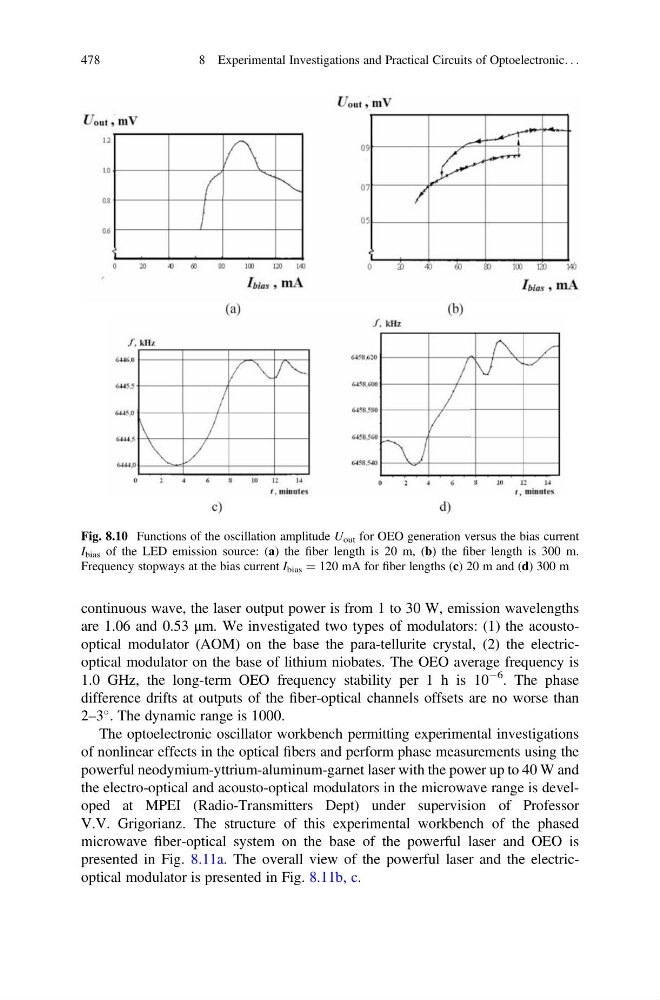
Fig. 8.10 Functions of the oscillation amplitude U out for OEO generation versus the bias current
I bias of the LED emission source: (а) the fiber length is 20 m, (b) the fiber length is 300 m.
Frequency stopways at the bias current I bias ¼ 120 mA for fiber lengths (c) 20 m and (d) 300 m
478
8 Experimental Investigations and Practical Circuits of Optoelectronic. . .
are 1.06 and 0.53 μm. We investigated two types of modulators: (1) the acoustooptical modulator (AOM) on the base the para-tellurite crystal, (2) the electricoptical modulator on the base of lithium niobates. The OEO average frequency is
1.0 GHz, the long-term OEO frequency stability per 1 h is 10
À6 . The phase
difference drifts at outputs of the fiber-optical channels offsets are no worse than
2–3
. The dynamic range is 1000.
The optoelectronic oscillator workbench permitting experimental investigations
of nonlinear effects in the optical fibers and perform phase measurements using the
powerful neodymium-yttrium-aluminum-garnet laser with the power up to 40 W and
the electro-optical and acousto-optical modulators in the microwave range is developed at MPEI (Radio-Transmitters Dept) under supervision of Professor
V.V. Grigorianz. The structure of this experimental workbench of the phased
microwave fiber-optical system on the base of the powerful laser and OEO is
presented in Fig. 8.11a. The overall view of the powerful laser and the electricoptical modulator is presented in Fig. 8.11b, c.
Fig. 8.10 Functions of the oscillation amplitude U out for OEO generation versus the bias current
I bias of the LED emission source: (а) the fiber length is 20 m, (b) the fiber length is 300 m.
Frequency stopways at the bias current I bias ¼ 120 mA for fiber lengths (c) 20 m and (d) 300 m
478
8 Experimental Investigations and Practical Circuits of Optoelectronic. . .