

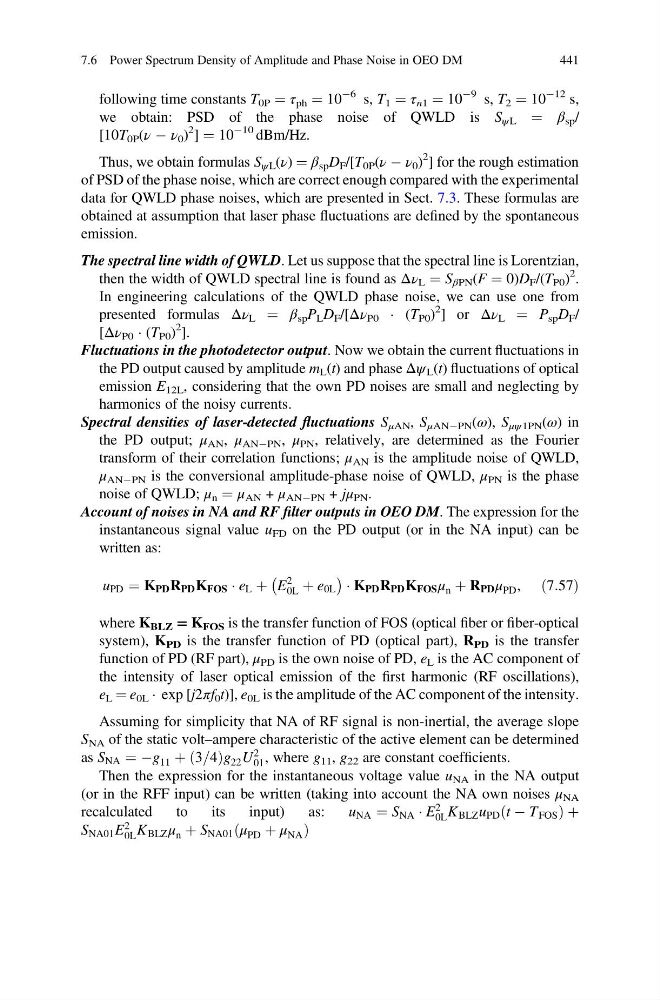
following time constants T 0P ¼ τ ph ¼ 10
À6 s, T 1 ¼ τ n1 ¼ 10
À9 s, T 2 ¼ 10
À12 s,
we obtain: PSD of the phase noise of QWLD is S ψ L ¼ β sp /
[10T 0P (ν À ν 0 )
2 ] ¼ 10
À10 dBm/Hz.
Thus, we obtain formulas S ψ L (ν) ¼ β sp D F /[T 0P (ν À ν 0 )
2 ] for the rough estimation
of PSD of the phase noise, which are correct enough compared with the experimental
data for QWLD phase noises, which are presented in Sect. 7.3. These formulas are
obtained at assumption that laser phase fluctuations are defined by the spontaneous
emission.
The spectral line width of QWLD. Let us suppose that the spectral line is Lorentzian,
then the width of QWLD spectral line is found as Δν L ¼ S βPN (F ¼ 0)D F /(T P0 )
2 .
In engineering calculations of the QWLD phase noise, we can use one from
presented formulas Δν L ¼ β sp P L D F /[Δν P0 Á (T P0 )
2 ] or Δν L ¼ P sp D F /
[Δν P0 Á (T P0 )
2 ].
Fluctuations in the photodetector output. Now we obtain the current fluctuations in
the PD output caused by amplitude m L (t) and phase Δψ L (t) fluctuations of optical
emission E 12L , considering that the own PD noises are small and neglecting by
harmonics of the noisy currents.
Spectral densities of laser-detected fluctuations S μAN , S μANÀPN (ω), S μψ 1PN (ω) in
the PD output; μ AN , μ ANÀPN , μ PN , relatively, are determined as the Fourier
transform of their correlation functions; μ AN is the amplitude noise of QWLD,
μ ANÀPN is the conversional amplitude-phase noise of QWLD, μ PN is the phase
noise of QWLD; μ n ¼ μ AN + μ ANÀPN + jμ PN .
Account of noises in NA and RF filter outputs in OEO DM. The expression for the
instantaneous signal value u FD on the PD output (or in the NA input) can be
written as:
u PD ¼ K PD R PD K FOS Á e L þ E
2
0L þ e 0L
À
Á Á K PD R PD K FOS μ n þ R PD μ PD , ð7:57Þ
where K BLZ = K FOS is the transfer function of FOS (optical fiber or fiber-optical
system), K PD is the transfer function of PD (optical part), R PD is the transfer
function of PD (RF part), μ PD is the own noise of PD, e L is the AC component of
the intensity of laser optical emission of the first harmonic (RF oscillations),
e L ¼ e 0L Á exp [j2πf 0 t)], e 0L is the amplitude of the AC component of the intensity.
Assuming for simplicity that NA of RF signal is non-inertial, the average slope
S NA of the static volt–ampere characteristic of the active element can be determined
as S NA ¼ Àg 11 þ 3=4
ð
Þg 22 U
2
01 , where g 11 , g 22 are constant coefficients.
Then the expression for the instantaneous voltage value u NA in the NA output
(or in the RFF input) can be written (taking into account the NA own noises μ NA
recalculated
to
its
input)
as:
u NA ¼ S NA Á E
2
0L K BLZ u PD t À T FOS
ð
Þþ
S NA01 E
2
0L K BLZ μ n þ S NA01 μ PD þ μ NA
ð
Þ
7.6 Power Spectrum Density of Amplitude and Phase Noise in OEO DM
441
À6 s, T 1 ¼ τ n1 ¼ 10
À9 s, T 2 ¼ 10
À12 s,
we obtain: PSD of the phase noise of QWLD is S ψ L ¼ β sp /
[10T 0P (ν À ν 0 )
2 ] ¼ 10
À10 dBm/Hz.
Thus, we obtain formulas S ψ L (ν) ¼ β sp D F /[T 0P (ν À ν 0 )
2 ] for the rough estimation
of PSD of the phase noise, which are correct enough compared with the experimental
data for QWLD phase noises, which are presented in Sect. 7.3. These formulas are
obtained at assumption that laser phase fluctuations are defined by the spontaneous
emission.
The spectral line width of QWLD. Let us suppose that the spectral line is Lorentzian,
then the width of QWLD spectral line is found as Δν L ¼ S βPN (F ¼ 0)D F /(T P0 )
2 .
In engineering calculations of the QWLD phase noise, we can use one from
presented formulas Δν L ¼ β sp P L D F /[Δν P0 Á (T P0 )
2 ] or Δν L ¼ P sp D F /
[Δν P0 Á (T P0 )
2 ].
Fluctuations in the photodetector output. Now we obtain the current fluctuations in
the PD output caused by amplitude m L (t) and phase Δψ L (t) fluctuations of optical
emission E 12L , considering that the own PD noises are small and neglecting by
harmonics of the noisy currents.
Spectral densities of laser-detected fluctuations S μAN , S μANÀPN (ω), S μψ 1PN (ω) in
the PD output; μ AN , μ ANÀPN , μ PN , relatively, are determined as the Fourier
transform of their correlation functions; μ AN is the amplitude noise of QWLD,
μ ANÀPN is the conversional amplitude-phase noise of QWLD, μ PN is the phase
noise of QWLD; μ n ¼ μ AN + μ ANÀPN + jμ PN .
Account of noises in NA and RF filter outputs in OEO DM. The expression for the
instantaneous signal value u FD on the PD output (or in the NA input) can be
written as:
u PD ¼ K PD R PD K FOS Á e L þ E
2
0L þ e 0L
À
Á Á K PD R PD K FOS μ n þ R PD μ PD , ð7:57Þ
where K BLZ = K FOS is the transfer function of FOS (optical fiber or fiber-optical
system), K PD is the transfer function of PD (optical part), R PD is the transfer
function of PD (RF part), μ PD is the own noise of PD, e L is the AC component of
the intensity of laser optical emission of the first harmonic (RF oscillations),
e L ¼ e 0L Á exp [j2πf 0 t)], e 0L is the amplitude of the AC component of the intensity.
Assuming for simplicity that NA of RF signal is non-inertial, the average slope
S NA of the static volt–ampere characteristic of the active element can be determined
as S NA ¼ Àg 11 þ 3=4
ð
Þg 22 U
2
01 , where g 11 , g 22 are constant coefficients.
Then the expression for the instantaneous voltage value u NA in the NA output
(or in the RFF input) can be written (taking into account the NA own noises μ NA
recalculated
to
its
input)
as:
u NA ¼ S NA Á E
2
0L K BLZ u PD t À T FOS
ð
Þþ
S NA01 E
2
0L K BLZ μ n þ S NA01 μ PD þ μ NA
ð
Þ
7.6 Power Spectrum Density of Amplitude and Phase Noise in OEO DM
441