

single optical fiber. If the thickness of the protective polymer envelope is commensurable with the thickness of the quartz envelope, then, at that, the thickness of the
protective polymer envelope determines the effective extension of the optical fiber.
If the relatively small segments of the optical fiber, for instance, 50–150 m in
length, are used in OEO, then it is recommended to take into consideration the time
constant of the high-Q filter T F , which natural frequency is equal to f F .
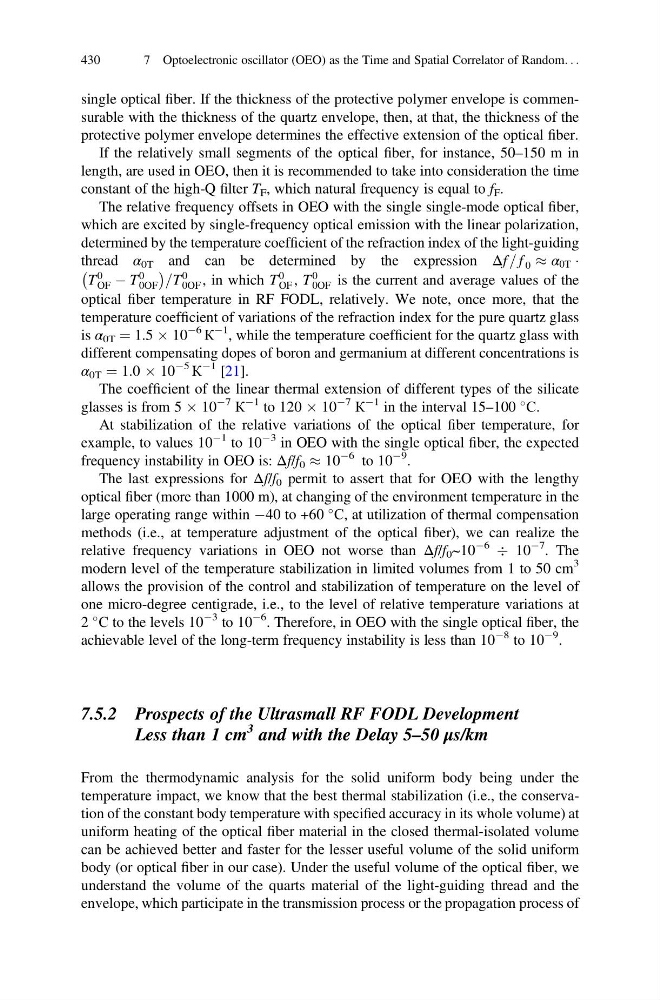
The relative frequency offsets in OEO with the single single-mode optical fiber,
which are excited by single-frequency optical emission with the linear polarization,
determined by the temperature coefficient of the refraction index of the light-guiding
thread α 0T and can be determined by the expression Δf = f 0 % α 0T Á
T
0
OF À T
0
0OF
À
Á =T
0
0OF , in which T
0
OF , T
0
0OF is the current and average values of the
optical fiber temperature in RF FODL, relatively. We note, once more, that the
temperature coefficient of variations of the refraction index for the pure quartz glass
is α 0T ¼ 1.5 Â 10
À6
К
À1 , while the temperature coefficient for the quartz glass with
different compensating dopes of boron and germanium at different concentrations is
α 0T ¼ 1.0 Â 10
À5
К
À1 [21].
The coefficient of the linear thermal extension of different types of the silicate
glasses is from 5 Â 10
À7
К
À1 to 120 Â 10
À7
К
À1 in the interval 15–100
С.
At stabilization of the relative variations of the optical fiber temperature, for
example, to values 10
À1 to 10
À3 in OEO with the single optical fiber, the expected
frequency instability in OEO is: Δf/f 0 % 10
À6 to 10
À9 .
The last expressions for Δf/f 0 permit to assert that for OEO with the lengthy
optical fiber (more than 1000 m), at changing of the environment temperature in the
large operating range within À40 to +60
С, at utilization of thermal compensation
methods (i.e., at temperature adjustment of the optical fiber), we can realize the
relative frequency variations in OEO not worse than Δf/f 0 ~10
À6
Ä 10
À7 . The
modern level of the temperature stabilization in limited volumes from 1 to 50 cm
3
allows the provision of the control and stabilization of temperature on the level of
one micro-degree centigrade, i.e., to the level of relative temperature variations at
2
С to the levels 10
À3 to 10
À6 . Therefore, in OEO with the single optical fiber, the
achievable level of the long-term frequency instability is less than 10
À8 to 10
À9 .
7.5.2 Prospects of the Ultrasmall RF FODL Development
Less than 1 cm
3 and with the Delay 5–50 μs/km
From the thermodynamic analysis for the solid uniform body being under the
temperature impact, we know that the best thermal stabilization (i.e., the conservation of the constant body temperature with specified accuracy in its whole volume) at
uniform heating of the optical fiber material in the closed thermal-isolated volume
can be achieved better and faster for the lesser useful volume of the solid uniform
body (or optical fiber in our case). Under the useful volume of the optical fiber, we
understand the volume of the quarts material of the light-guiding thread and the
envelope, which participate in the transmission process or the propagation process of
430
7 Optoelectronic oscillator (OEO) as the Time and Spatial Correlator of Random. . .
protective polymer envelope determines the effective extension of the optical fiber.
If the relatively small segments of the optical fiber, for instance, 50–150 m in
length, are used in OEO, then it is recommended to take into consideration the time
constant of the high-Q filter T F , which natural frequency is equal to f F .
The relative frequency offsets in OEO with the single single-mode optical fiber,
which are excited by single-frequency optical emission with the linear polarization,
determined by the temperature coefficient of the refraction index of the light-guiding
thread α 0T and can be determined by the expression Δf = f 0 % α 0T Á
T
0
OF À T
0
0OF
À
Á =T
0
0OF , in which T
0
OF , T
0
0OF is the current and average values of the
optical fiber temperature in RF FODL, relatively. We note, once more, that the
temperature coefficient of variations of the refraction index for the pure quartz glass
is α 0T ¼ 1.5 Â 10
À6
К
À1 , while the temperature coefficient for the quartz glass with
different compensating dopes of boron and germanium at different concentrations is
α 0T ¼ 1.0 Â 10
À5
К
À1 [21].
The coefficient of the linear thermal extension of different types of the silicate
glasses is from 5 Â 10
À7
К
À1 to 120 Â 10
À7
К
À1 in the interval 15–100
С.
At stabilization of the relative variations of the optical fiber temperature, for
example, to values 10
À1 to 10
À3 in OEO with the single optical fiber, the expected
frequency instability in OEO is: Δf/f 0 % 10
À6 to 10
À9 .
The last expressions for Δf/f 0 permit to assert that for OEO with the lengthy
optical fiber (more than 1000 m), at changing of the environment temperature in the
large operating range within À40 to +60
С, at utilization of thermal compensation
methods (i.e., at temperature adjustment of the optical fiber), we can realize the
relative frequency variations in OEO not worse than Δf/f 0 ~10
À6
Ä 10
À7 . The
modern level of the temperature stabilization in limited volumes from 1 to 50 cm
3
allows the provision of the control and stabilization of temperature on the level of
one micro-degree centigrade, i.e., to the level of relative temperature variations at
2
С to the levels 10
À3 to 10
À6 . Therefore, in OEO with the single optical fiber, the
achievable level of the long-term frequency instability is less than 10
À8 to 10
À9 .
7.5.2 Prospects of the Ultrasmall RF FODL Development
Less than 1 cm
3 and with the Delay 5–50 μs/km
From the thermodynamic analysis for the solid uniform body being under the
temperature impact, we know that the best thermal stabilization (i.e., the conservation of the constant body temperature with specified accuracy in its whole volume) at
uniform heating of the optical fiber material in the closed thermal-isolated volume
can be achieved better and faster for the lesser useful volume of the solid uniform
body (or optical fiber in our case). Under the useful volume of the optical fiber, we
understand the volume of the quarts material of the light-guiding thread and the
envelope, which participate in the transmission process or the propagation process of
430
7 Optoelectronic oscillator (OEO) as the Time and Spatial Correlator of Random. . .