

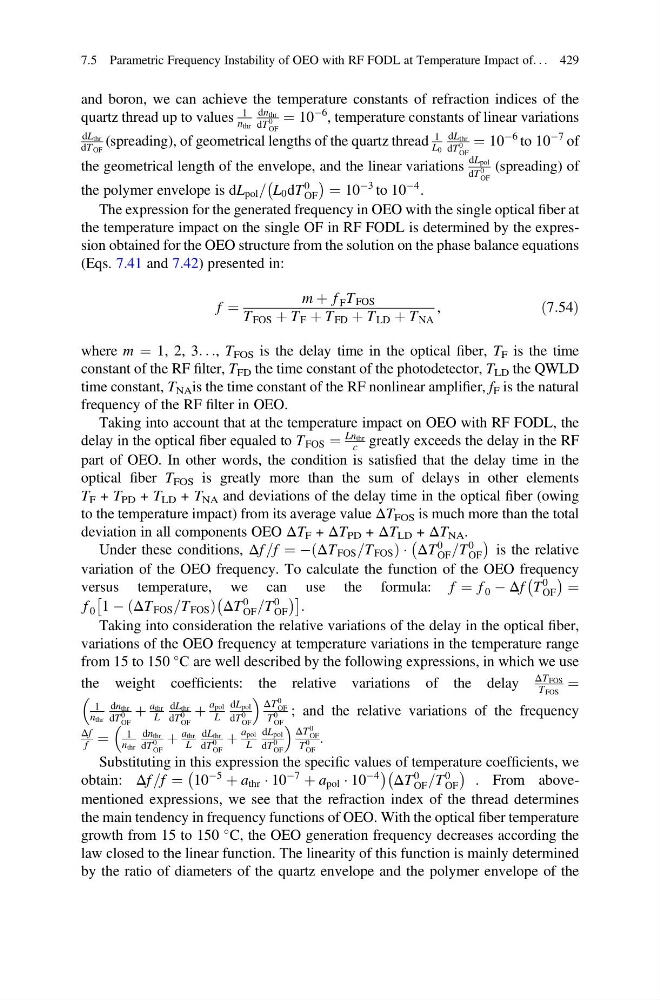
and boron, we can achieve the temperature constants of refraction indices of the
quartz thread up to values
1
n thr
dn thr
dT
0
OF
¼ 10
À6 , temperature constants of linear variations
dL thr
dT OF
(spreading), of geometrical lengths of the quartz thread
1
L 0
dL thr
dT
0
OF
¼ 10
À6 to 10
À7 of
the geometrical length of the envelope, and the linear variations
dL pol
dT
0
OF
(spreading) of
the polymer envelope is dL pol = L 0 dT
0
OF
À
Á ¼ 10
À3 to 10
À4 .
The expression for the generated frequency in OEO with the single optical fiber at
the temperature impact on the single OF in RF FODL is determined by the expression obtained for the OEO structure from the solution on the phase balance equations
(Eqs. 7.41 and 7.42) presented in:
f ¼
m þ f F T FOS
T FOS þ T F þ T FD þ T LD þ T NA
,
ð7:54Þ
where m ¼ 1, 2, 3. . ., T FOS is the delay time in the optical fiber, T F is the time
constant of the RF filter, T FD the time constant of the photodetector, T LD the QWLD
time constant, T NA is the time constant of the RF nonlinear amplifier, f F is the natural
frequency of the RF filter in OEO.
Taking into account that at the temperature impact on OEO with RF FODL, the
delay in the optical fiber equaled to T FOS ¼
Ln thr
c greatly exceeds the delay in the RF
part of OEO. In other words, the condition is satisfied that the delay time in the
optical fiber T FOS is greatly more than the sum of delays in other elements
T F + T PD + T LD + T NA and deviations of the delay time in the optical fiber (owing
to the temperature impact) from its average value ΔT FOS is much more than the total
deviation in all components OEO ΔT F + ΔT PD + ΔT LD + ΔT NA .
Under these conditions, Δf =f ¼ À ΔT FOS =T FOS
ð
ÞÁ ΔT
0
OF =T
0
OF
À
Á
is the relative
variation of the OEO frequency. To calculate the function of the OEO frequency
versus temperature, we can use the formula: f ¼ f 0 À Δf T
0
OF
À
Á ¼
f 0 1 À ΔT FOS =T FOS
ð
ÞΔT
0
OF =T
0
OF
À
Á
Â
Ã
.
Taking into consideration the relative variations of the delay in the optical fiber,
variations of the OEO frequency at temperature variations in the temperature range
from 15 to 150
С are well described by the following expressions, in which we use
the weight coefficients: the relative variations of the delay
ΔT FOS
T FOS
¼
1
n thr
dn thr
dT
0
OF
þ
a thr
L
dL thr
dT
0
OF
þ
a pol
L
dL pol
dT
0
OF
ΔT
0
OF
T
0
OF
; and the relative variations of the frequency
Δf
f ¼
1
n thr
dn thr
dT
0
OF
þ
a thr
L
dL thr
dT
0
OF
þ
a pol
L
dL pol
dT
0
OF
ΔT
0
OF
T
0
OF
.
Substituting in this expression the specific values of temperature coefficients, we
obtain: Δf =f ¼ 10
À5
þ a thr Á 10
À7
þ a pol Á 10
À4
À
Á ΔT
0
OF =T
0
OF
À
Á
. From abovementioned expressions, we see that the refraction index of the thread determines
the main tendency in frequency functions of OEO. With the optical fiber temperature
growth from 15 to 150
C, the OEO generation frequency decreases according the
law closed to the linear function. The linearity of this function is mainly determined
by the ratio of diameters of the quartz envelope and the polymer envelope of the
7.5 Parametric Frequency Instability of OEO with RF FODL at Temperature Impact of. . . 429
quartz thread up to values
1
n thr
dn thr
dT
0
OF
¼ 10
À6 , temperature constants of linear variations
dL thr
dT OF
(spreading), of geometrical lengths of the quartz thread
1
L 0
dL thr
dT
0
OF
¼ 10
À6 to 10
À7 of
the geometrical length of the envelope, and the linear variations
dL pol
dT
0
OF
(spreading) of
the polymer envelope is dL pol = L 0 dT
0
OF
À
Á ¼ 10
À3 to 10
À4 .
The expression for the generated frequency in OEO with the single optical fiber at
the temperature impact on the single OF in RF FODL is determined by the expression obtained for the OEO structure from the solution on the phase balance equations
(Eqs. 7.41 and 7.42) presented in:
f ¼
m þ f F T FOS
T FOS þ T F þ T FD þ T LD þ T NA
,
ð7:54Þ
where m ¼ 1, 2, 3. . ., T FOS is the delay time in the optical fiber, T F is the time
constant of the RF filter, T FD the time constant of the photodetector, T LD the QWLD
time constant, T NA is the time constant of the RF nonlinear amplifier, f F is the natural
frequency of the RF filter in OEO.
Taking into account that at the temperature impact on OEO with RF FODL, the
delay in the optical fiber equaled to T FOS ¼
Ln thr
c greatly exceeds the delay in the RF
part of OEO. In other words, the condition is satisfied that the delay time in the
optical fiber T FOS is greatly more than the sum of delays in other elements
T F + T PD + T LD + T NA and deviations of the delay time in the optical fiber (owing
to the temperature impact) from its average value ΔT FOS is much more than the total
deviation in all components OEO ΔT F + ΔT PD + ΔT LD + ΔT NA .
Under these conditions, Δf =f ¼ À ΔT FOS =T FOS
ð
ÞÁ ΔT
0
OF =T
0
OF
À
Á
is the relative
variation of the OEO frequency. To calculate the function of the OEO frequency
versus temperature, we can use the formula: f ¼ f 0 À Δf T
0
OF
À
Á ¼
f 0 1 À ΔT FOS =T FOS
ð
ÞΔT
0
OF =T
0
OF
À
Á
Â
Ã
.
Taking into consideration the relative variations of the delay in the optical fiber,
variations of the OEO frequency at temperature variations in the temperature range
from 15 to 150
С are well described by the following expressions, in which we use
the weight coefficients: the relative variations of the delay
ΔT FOS
T FOS
¼
1
n thr
dn thr
dT
0
OF
þ
a thr
L
dL thr
dT
0
OF
þ
a pol
L
dL pol
dT
0
OF
ΔT
0
OF
T
0
OF
; and the relative variations of the frequency
Δf
f ¼
1
n thr
dn thr
dT
0
OF
þ
a thr
L
dL thr
dT
0
OF
þ
a pol
L
dL pol
dT
0
OF
ΔT
0
OF
T
0
OF
.
Substituting in this expression the specific values of temperature coefficients, we
obtain: Δf =f ¼ 10
À5
þ a thr Á 10
À7
þ a pol Á 10
À4
À
Á ΔT
0
OF =T
0
OF
À
Á
. From abovementioned expressions, we see that the refraction index of the thread determines
the main tendency in frequency functions of OEO. With the optical fiber temperature
growth from 15 to 150
C, the OEO generation frequency decreases according the
law closed to the linear function. The linearity of this function is mainly determined
by the ratio of diameters of the quartz envelope and the polymer envelope of the
7.5 Parametric Frequency Instability of OEO with RF FODL at Temperature Impact of. . . 429