

In the general case, curves of frequency retuning in OEO with the differential RF
FODL are nonlinear functions of the α ¼ А parameter, and for α % 0.5, neglecting by
the small oscillator non-isochronity, the frequency of OEO with differential RF
FODL is:
f gen ¼
ω gen
2π
%
2πm þ ω F T F
2π T F þ T 0FOS þ AT 1FOS þ BT 2FOS
ð
Þ
,
ð7:52Þ
where T F is the time constant of the RF PBF, m ¼ 1, 2,. . . Obtained functions show a
series of features of the f gen behavior of the oscillator under investigation, which are
important for development of the fiber-optical sensors. The frequency retuning, as
we see from Eq. (7.52), is possible owing to variations not only lengths of FOS0,
FOS1 and FOS2, but owing to variations of excitation coefficients A ¼ Р 1 /
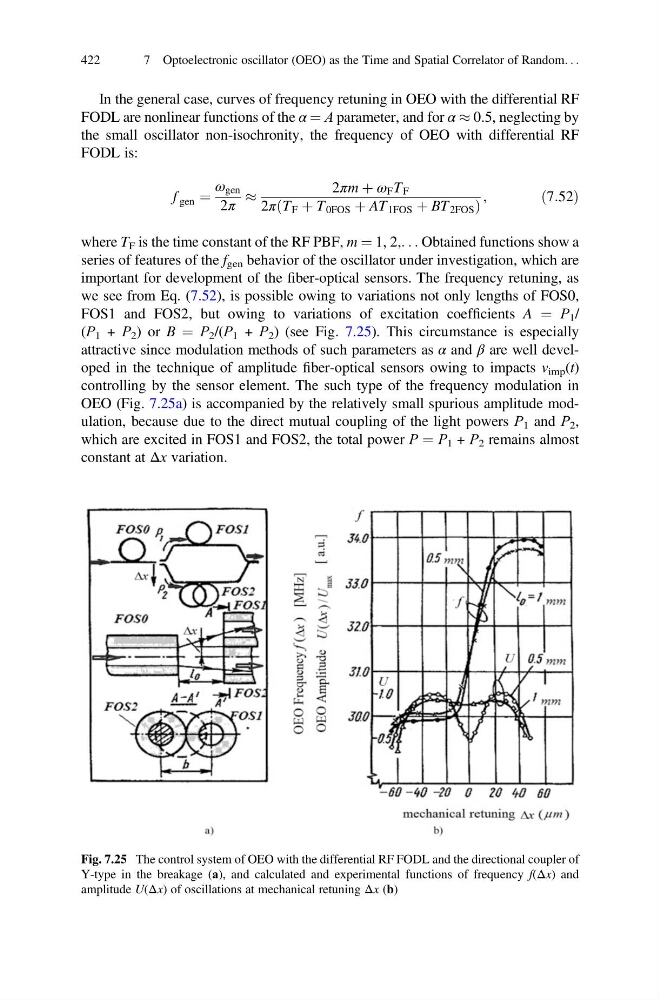
(Р 1 + Р 2 ) or B ¼ Р 2 /(Р 1 + Р 2 ) (see Fig. 7.25). This circumstance is especially
attractive since modulation methods of such parameters as α and β are well developed in the technique of amplitude fiber-optical sensors owing to impacts v imp (t)
controlling by the sensor element. The such type of the frequency modulation in
OEO (Fig. 7.25a) is accompanied by the relatively small spurious amplitude modulation, because due to the direct mutual coupling of the light powers Р 1 and Р 2 ,
which are excited in FOS1 and FOS2, the total power Р ¼ Р 1 + Р 2 remains almost
constant at Δх variation.
Fig. 7.25 The control system of OEO with the differential RF FODL and the directional coupler of
Y-type in the breakage (а), and calculated and experimental functions of frequency f(Δx) and
amplitude U(Δx) of oscillations at mechanical retuning Δx (b)
422
7 Optoelectronic oscillator (OEO) as the Time and Spatial Correlator of Random. . .
FODL are nonlinear functions of the α ¼ А parameter, and for α % 0.5, neglecting by
the small oscillator non-isochronity, the frequency of OEO with differential RF
FODL is:
f gen ¼
ω gen
2π
%
2πm þ ω F T F
2π T F þ T 0FOS þ AT 1FOS þ BT 2FOS
ð
Þ
,
ð7:52Þ
where T F is the time constant of the RF PBF, m ¼ 1, 2,. . . Obtained functions show a
series of features of the f gen behavior of the oscillator under investigation, which are
important for development of the fiber-optical sensors. The frequency retuning, as
we see from Eq. (7.52), is possible owing to variations not only lengths of FOS0,
FOS1 and FOS2, but owing to variations of excitation coefficients A ¼ Р 1 /
(Р 1 + Р 2 ) or B ¼ Р 2 /(Р 1 + Р 2 ) (see Fig. 7.25). This circumstance is especially
attractive since modulation methods of such parameters as α and β are well developed in the technique of amplitude fiber-optical sensors owing to impacts v imp (t)
controlling by the sensor element. The such type of the frequency modulation in
OEO (Fig. 7.25a) is accompanied by the relatively small spurious amplitude modulation, because due to the direct mutual coupling of the light powers Р 1 and Р 2 ,
which are excited in FOS1 and FOS2, the total power Р ¼ Р 1 + Р 2 remains almost
constant at Δх variation.
Fig. 7.25 The control system of OEO with the differential RF FODL and the directional coupler of
Y-type in the breakage (а), and calculated and experimental functions of frequency f(Δx) and
amplitude U(Δx) of oscillations at mechanical retuning Δx (b)
422
7 Optoelectronic oscillator (OEO) as the Time and Spatial Correlator of Random. . .