

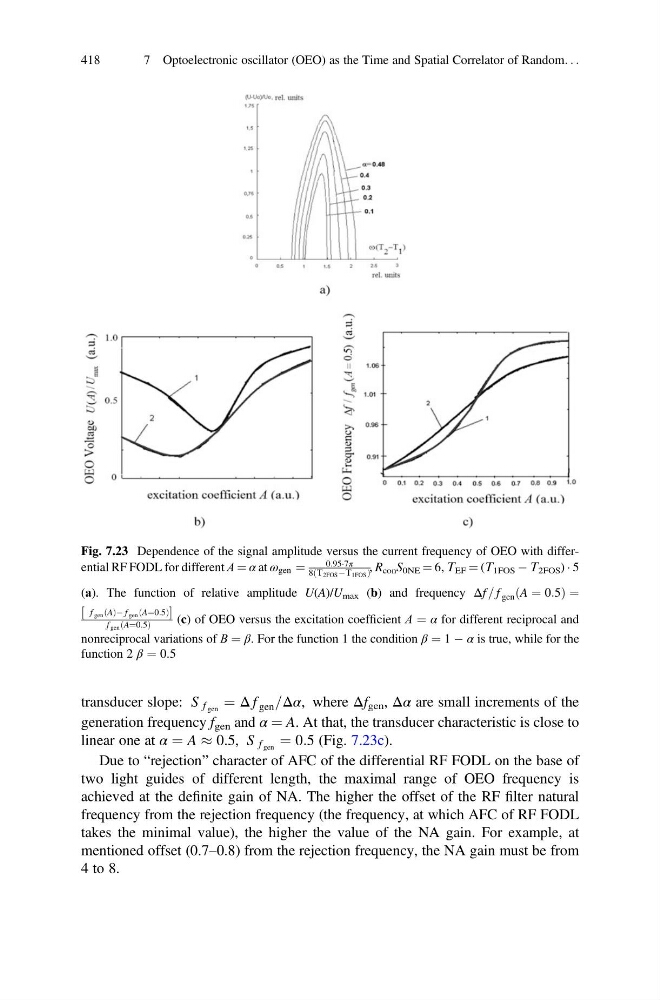
transducer slope: S f gen ¼ Δ f gen =Δα, where Δf gen , Δα are small increments of the
generation frequency f gen and α ¼ A. At that, the transducer characteristic is close to
linear one at α ¼ A % 0.5, S f gen ¼ 0:5 (Fig. 7.23c).
Due to “rejection” character of AFC of the differential RF FODL on the base of
two light guides of different length, the maximal range of OEO frequency is
achieved at the definite gain of NA. The higher the offset of the RF filter natural
frequency from the rejection frequency (the frequency, at which AFC of RF FODL
takes the minimal value), the higher the value of the NA gain. For example, at
mentioned offset (0.7–0.8) from the rejection frequency, the NA gain must be from
4 to 8.
Fig. 7.23 Dependence of the signal amplitude versus the current frequency of OEO with differential RF FODL for different А ¼ α at ω gen ¼
0:95Á7π
8 Т2FOSÀТ1FOS
ð
Þ , R con S 0NE ¼ 6, Т EF ¼ (Т 1FOS À Т 2FOS ) Á 5
(а). The function of relative amplitude U(A)/U max (b) and frequency Δf = f gen A ¼ 0:5
ð
Þ¼
f gen A
ð ÞÀ f gen A¼0:5
ð
Þ
½
f gen A¼0:5
ð
Þ
(c) of OEO versus the excitation coefficient А ¼ α for different reciprocal and
nonreciprocal variations of В ¼ β. For the function 1 the condition β ¼ 1 À α is true, while for the
function 2 β ¼ 0.5
418
7 Optoelectronic oscillator (OEO) as the Time and Spatial Correlator of Random. . .
generation frequency f gen and α ¼ A. At that, the transducer characteristic is close to
linear one at α ¼ A % 0.5, S f gen ¼ 0:5 (Fig. 7.23c).
Due to “rejection” character of AFC of the differential RF FODL on the base of
two light guides of different length, the maximal range of OEO frequency is
achieved at the definite gain of NA. The higher the offset of the RF filter natural
frequency from the rejection frequency (the frequency, at which AFC of RF FODL
takes the minimal value), the higher the value of the NA gain. For example, at
mentioned offset (0.7–0.8) from the rejection frequency, the NA gain must be from
4 to 8.
Fig. 7.23 Dependence of the signal amplitude versus the current frequency of OEO with differential RF FODL for different А ¼ α at ω gen ¼
0:95Á7π
8 Т2FOSÀТ1FOS
ð
Þ , R con S 0NE ¼ 6, Т EF ¼ (Т 1FOS À Т 2FOS ) Á 5
(а). The function of relative amplitude U(A)/U max (b) and frequency Δf = f gen A ¼ 0:5
ð
Þ¼
f gen A
ð ÞÀ f gen A¼0:5
ð
Þ
½
f gen A¼0:5
ð
Þ
(c) of OEO versus the excitation coefficient А ¼ α for different reciprocal and
nonreciprocal variations of В ¼ β. For the function 1 the condition β ¼ 1 À α is true, while for the
function 2 β ¼ 0.5
418
7 Optoelectronic oscillator (OEO) as the Time and Spatial Correlator of Random. . .