

7.3.5 The Effect of the Polarity Change of the Argument
Slope of the QWLD Transfer Function
The above-described theory is true under a condition that the spontaneous laser
emission, which applied to PD and modulated by the pumping current, is extremely
small, and the OEO generation due to spontaneous emission does not happen
because of the nonfulfillment of the amplitude balance conditions.
If the spontaneous emission power is sufficient in order to satisfy the conditions
for oscillations excitation (at high gain of NA), then OEO generation is possible
owing to the laser spontaneous emission. In this case, the law of oscillation frequency variations at the growth of the pumping current has the opposite character,
i.e., with the pumping increase, the frequency decreases.
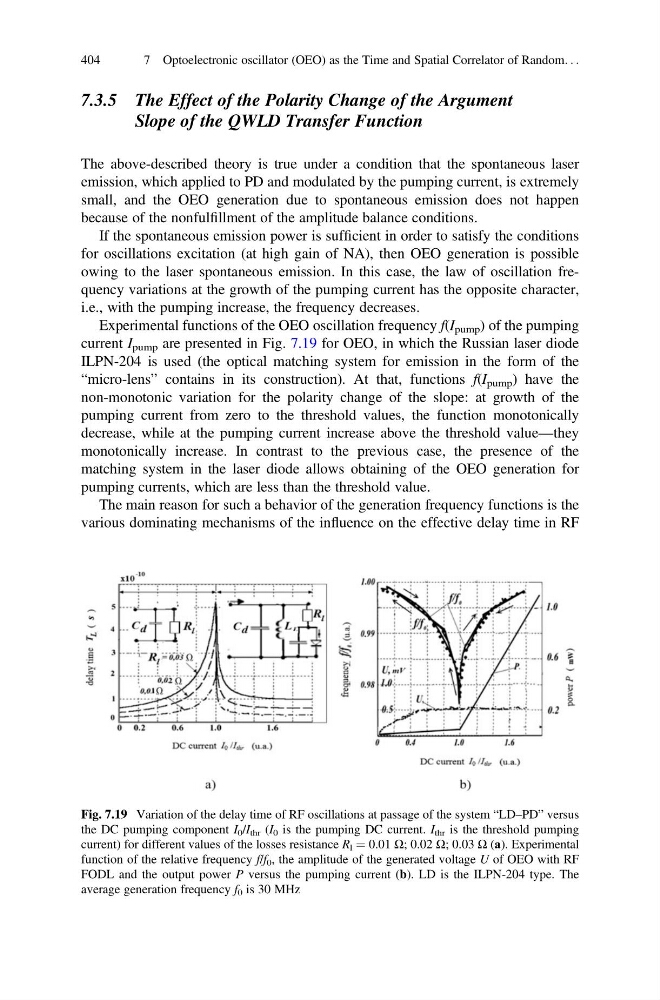
Experimental functions of the OEO oscillation frequency f(I pump ) of the pumping
current I pump are presented in Fig. 7.19 for OEO, in which the Russian laser diode
ILPN-204 is used (the optical matching system for emission in the form of the
“micro-lens” contains in its construction). At that, functions f(I pump ) have the
non-monotonic variation for the polarity change of the slope: at growth of the
pumping current from zero to the threshold values, the function monotonically
decrease, while at the pumping current increase above the threshold value—they
monotonically increase. In contrast to the previous case, the presence of the
matching system in the laser diode allows obtaining of the OEO generation for
pumping currents, which are less than the threshold value.
The main reason for such a behavior of the generation frequency functions is the
various dominating mechanisms of the influence on the effective delay time in RF
Fig. 7.19 Variation of the delay time of RF oscillations at passage of the system “LD–PD” versus
the DC pumping component I 0 /I thr (I 0 is the pumping DC current. I thr is the threshold pumping
current) for different values of the losses resistance R l ¼ 0.01 Ω; 0.02 Ω; 0.03 Ω (а). Experimental
function of the relative frequency f/f 0 , the amplitude of the generated voltage U of OEO with RF
FODL and the output power P versus the pumping current (b). LD is the ILPN-204 type. The
average generation frequency f 0 is 30 MHz
404
7 Optoelectronic oscillator (OEO) as the Time and Spatial Correlator of Random. . .
Slope of the QWLD Transfer Function
The above-described theory is true under a condition that the spontaneous laser
emission, which applied to PD and modulated by the pumping current, is extremely
small, and the OEO generation due to spontaneous emission does not happen
because of the nonfulfillment of the amplitude balance conditions.
If the spontaneous emission power is sufficient in order to satisfy the conditions
for oscillations excitation (at high gain of NA), then OEO generation is possible
owing to the laser spontaneous emission. In this case, the law of oscillation frequency variations at the growth of the pumping current has the opposite character,
i.e., with the pumping increase, the frequency decreases.
Experimental functions of the OEO oscillation frequency f(I pump ) of the pumping
current I pump are presented in Fig. 7.19 for OEO, in which the Russian laser diode
ILPN-204 is used (the optical matching system for emission in the form of the
“micro-lens” contains in its construction). At that, functions f(I pump ) have the
non-monotonic variation for the polarity change of the slope: at growth of the
pumping current from zero to the threshold values, the function monotonically
decrease, while at the pumping current increase above the threshold value—they
monotonically increase. In contrast to the previous case, the presence of the
matching system in the laser diode allows obtaining of the OEO generation for
pumping currents, which are less than the threshold value.
The main reason for such a behavior of the generation frequency functions is the
various dominating mechanisms of the influence on the effective delay time in RF
Fig. 7.19 Variation of the delay time of RF oscillations at passage of the system “LD–PD” versus
the DC pumping component I 0 /I thr (I 0 is the pumping DC current. I thr is the threshold pumping
current) for different values of the losses resistance R l ¼ 0.01 Ω; 0.02 Ω; 0.03 Ω (а). Experimental
function of the relative frequency f/f 0 , the amplitude of the generated voltage U of OEO with RF
FODL and the output power P versus the pumping current (b). LD is the ILPN-204 type. The
average generation frequency f 0 is 30 MHz
404
7 Optoelectronic oscillator (OEO) as the Time and Spatial Correlator of Random. . .