

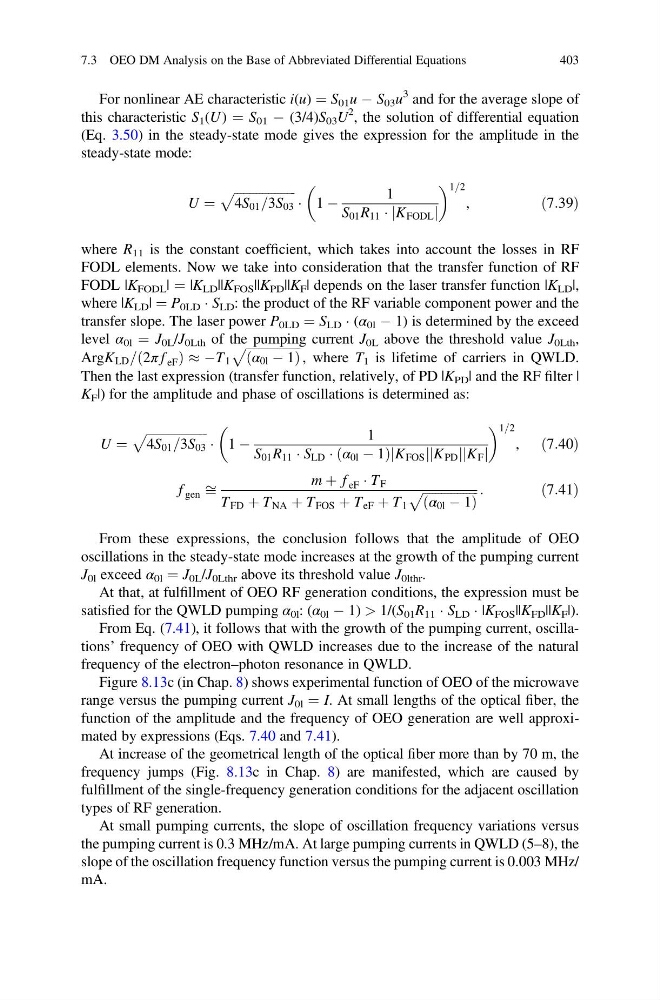
For nonlinear AE characteristic i(u) ¼ S 01 u À S 03 u
3 and for the average slope of
this characteristic S 1 (U ) ¼ S 01 À (3/4)S 03 U
2 , the solution of differential equation
(Eq. 3.50) in the steady-state mode gives the expression for the amplitude in the
steady-state mode:
U ¼
ffiffiffiffiffiffiffiffiffiffiffiffiffiffiffiffiffiffiffi ffi
4S 01 =3S 03
p
Á 1 À
1
S 01 R 11 Á K FODL
j
j
1=2
,
ð7:39Þ
where R 11 is the constant coefficient, which takes into account the losses in RF
FODL elements. Now we take into consideration that the transfer function of RF
FODL |K FODL | ¼ |K LD ||K FOS ||K PD ||K F | depends on the laser transfer function |K LD |,
where |K LD | ¼ P 0LD Á S LD : the product of the RF variable component power and the
transfer slope. The laser power P 0LD ¼ S LD Á (α 0l À 1) is determined by the exceed
level α 0l ¼ J 0L /J 0Lth of the pumping current J 0L above the threshold value J 0Lth ,
ArgK LD = 2π f eF
ð
Þ%ÀT 1
ffiffiffiffiffiffiffiffiffiffiffiffiffiffiffiffiffi ffi
α 0l À 1
ð
Þ
p
, where T 1 is lifetime of carriers in QWLD.
Then the last expression (transfer function, relatively, of PD |K PD | and the RF filter |
K F |) for the amplitude and phase of oscillations is determined as:
U ¼
ffiffiffiffiffiffiffiffiffiffiffiffiffiffiffiffiffiffiffi ffi
4S 01 =3S 03
p
Á 1 À
1
S 01 R 11 Á S LD Á α 0l À 1
ð
ÞK FOS
j
jK PD
j
j K F
j j
1=2
, ð7:40Þ
f gen ffi
m þ f eF Á T F
T FD þ T NA þ T FOS þ T eF þ T 1
ffiffiffiffiffiffiffiffiffiffiffiffiffiffiffiffiffi ffi
α 0l À 1
ð
Þ
p
:
ð7:41Þ
From these expressions, the conclusion follows that the amplitude of OEO
oscillations in the steady-state mode increases at the growth of the pumping current
J 0l exceed α 0l ¼ J 0L /J 0Lthr above its threshold value J 0lthr .
At that, at fulfillment of OEO RF generation conditions, the expression must be
satisfied for the QWLD pumping α 0l : (α 0l À 1) > 1/(S 01 R 11 Á S LD Á |K FOS ||K FD ||K F |).
From Eq. (7.41), it follows that with the growth of the pumping current, oscillations’ frequency of OEO with QWLD increases due to the increase of the natural
frequency of the electron–photon resonance in QWLD.
Figure 8.13c (in Chap. 8) shows experimental function of OEO of the microwave
range versus the pumping current J 0l ¼ I. At small lengths of the optical fiber, the
function of the amplitude and the frequency of OEO generation are well approximated by expressions (Eqs. 7.40 and 7.41).
At increase of the geometrical length of the optical fiber more than by 70 m, the
frequency jumps (Fig. 8.13c in Chap. 8) are manifested, which are caused by
fulfillment of the single-frequency generation conditions for the adjacent oscillation
types of RF generation.
At small pumping currents, the slope of oscillation frequency variations versus
the pumping current is 0.3 MHz/mA. At large pumping currents in QWLD (5–8), the
slope of the oscillation frequency function versus the pumping current is 0.003 MHz/
mA.
7.3 OEO DM Analysis on the Base of Abbreviated Differential Equations
403
3 and for the average slope of
this characteristic S 1 (U ) ¼ S 01 À (3/4)S 03 U
2 , the solution of differential equation
(Eq. 3.50) in the steady-state mode gives the expression for the amplitude in the
steady-state mode:
U ¼
ffiffiffiffiffiffiffiffiffiffiffiffiffiffiffiffiffiffiffi ffi
4S 01 =3S 03
p
Á 1 À
1
S 01 R 11 Á K FODL
j
j
1=2
,
ð7:39Þ
where R 11 is the constant coefficient, which takes into account the losses in RF
FODL elements. Now we take into consideration that the transfer function of RF
FODL |K FODL | ¼ |K LD ||K FOS ||K PD ||K F | depends on the laser transfer function |K LD |,
where |K LD | ¼ P 0LD Á S LD : the product of the RF variable component power and the
transfer slope. The laser power P 0LD ¼ S LD Á (α 0l À 1) is determined by the exceed
level α 0l ¼ J 0L /J 0Lth of the pumping current J 0L above the threshold value J 0Lth ,
ArgK LD = 2π f eF
ð
Þ%ÀT 1
ffiffiffiffiffiffiffiffiffiffiffiffiffiffiffiffiffi ffi
α 0l À 1
ð
Þ
p
, where T 1 is lifetime of carriers in QWLD.
Then the last expression (transfer function, relatively, of PD |K PD | and the RF filter |
K F |) for the amplitude and phase of oscillations is determined as:
U ¼
ffiffiffiffiffiffiffiffiffiffiffiffiffiffiffiffiffiffiffi ffi
4S 01 =3S 03
p
Á 1 À
1
S 01 R 11 Á S LD Á α 0l À 1
ð
ÞK FOS
j
jK PD
j
j K F
j j
1=2
, ð7:40Þ
f gen ffi
m þ f eF Á T F
T FD þ T NA þ T FOS þ T eF þ T 1
ffiffiffiffiffiffiffiffiffiffiffiffiffiffiffiffiffi ffi
α 0l À 1
ð
Þ
p
:
ð7:41Þ
From these expressions, the conclusion follows that the amplitude of OEO
oscillations in the steady-state mode increases at the growth of the pumping current
J 0l exceed α 0l ¼ J 0L /J 0Lthr above its threshold value J 0lthr .
At that, at fulfillment of OEO RF generation conditions, the expression must be
satisfied for the QWLD pumping α 0l : (α 0l À 1) > 1/(S 01 R 11 Á S LD Á |K FOS ||K FD ||K F |).
From Eq. (7.41), it follows that with the growth of the pumping current, oscillations’ frequency of OEO with QWLD increases due to the increase of the natural
frequency of the electron–photon resonance in QWLD.
Figure 8.13c (in Chap. 8) shows experimental function of OEO of the microwave
range versus the pumping current J 0l ¼ I. At small lengths of the optical fiber, the
function of the amplitude and the frequency of OEO generation are well approximated by expressions (Eqs. 7.40 and 7.41).
At increase of the geometrical length of the optical fiber more than by 70 m, the
frequency jumps (Fig. 8.13c in Chap. 8) are manifested, which are caused by
fulfillment of the single-frequency generation conditions for the adjacent oscillation
types of RF generation.
At small pumping currents, the slope of oscillation frequency variations versus
the pumping current is 0.3 MHz/mA. At large pumping currents in QWLD (5–8), the
slope of the oscillation frequency function versus the pumping current is 0.003 MHz/
mA.
7.3 OEO DM Analysis on the Base of Abbreviated Differential Equations
403