

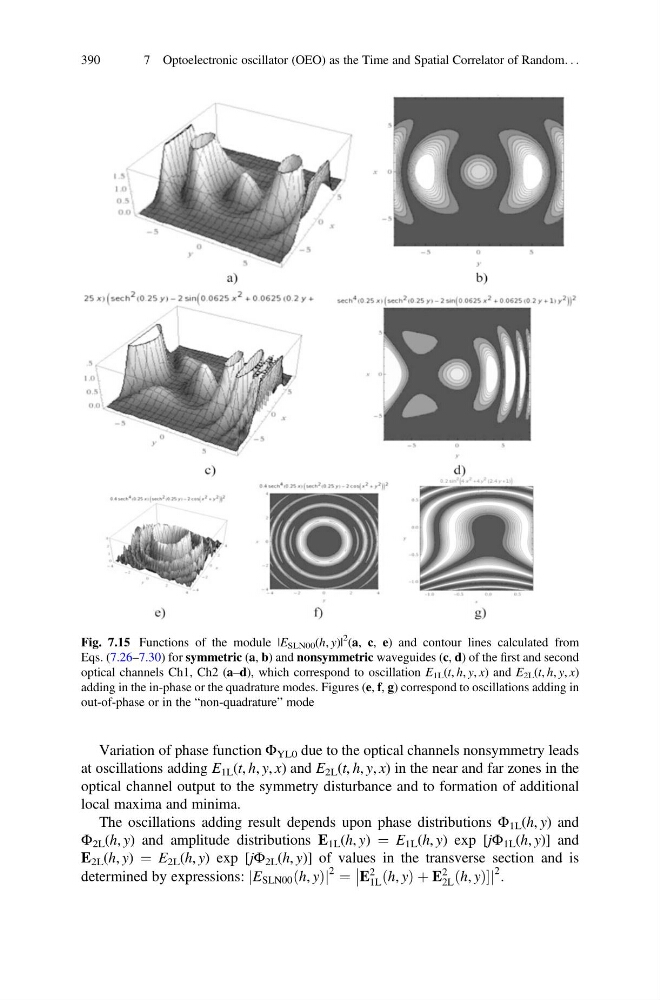
Variation of phase function Φ YL0 due to the optical channels nonsymmetry leads
at oscillations adding E 1L (t, h, y, x) and E 2L (t, h, y, x) in the near and far zones in the
optical channel output to the symmetry disturbance and to formation of additional
local maxima and minima.
The oscillations adding result depends upon phase distributions Φ 1L (h, y) and
Φ 2L (h, y) and amplitude distributions E 1L (h, y) ¼ E 1L (h, y) exp [jΦ 1L (h, y)] and
E 2L (h, y) ¼ E 2L (h, y) exp [jΦ 2L (h, y)] of values in the transverse section and is
determined by expressions: E SLN00 h, y
ð Þ
j
j
2 ¼ E
2
1L h, y
ð ÞþE
2
2L h, yÞ
ð
j
2
.
Fig. 7.15 Functions of the module |E SLN00 (h, y)|
2
(a, с, e) and contour lines calculated from
Eqs. (7.26–7.30) for symmetric (a, b) and nonsymmetric waveguides (c, d) of the first and second
optical channels Ch1, Ch2 (a–d), which correspond to oscillation E 1L (t, h, y, x) and E 2L (t, h, y, x)
adding in the in-phase or the quadrature modes. Figures (e, f, g) correspond to oscillations adding in
out-of-phase or in the “non-quadrature” mode
390
7 Optoelectronic oscillator (OEO) as the Time and Spatial Correlator of Random. . .
at oscillations adding E 1L (t, h, y, x) and E 2L (t, h, y, x) in the near and far zones in the
optical channel output to the symmetry disturbance and to formation of additional
local maxima and minima.
The oscillations adding result depends upon phase distributions Φ 1L (h, y) and
Φ 2L (h, y) and amplitude distributions E 1L (h, y) ¼ E 1L (h, y) exp [jΦ 1L (h, y)] and
E 2L (h, y) ¼ E 2L (h, y) exp [jΦ 2L (h, y)] of values in the transverse section and is
determined by expressions: E SLN00 h, y
ð Þ
j
j
2 ¼ E
2
1L h, y
ð ÞþE
2
2L h, yÞ
ð
j
2
.
Fig. 7.15 Functions of the module |E SLN00 (h, y)|
2
(a, с, e) and contour lines calculated from
Eqs. (7.26–7.30) for symmetric (a, b) and nonsymmetric waveguides (c, d) of the first and second
optical channels Ch1, Ch2 (a–d), which correspond to oscillation E 1L (t, h, y, x) and E 2L (t, h, y, x)
adding in the in-phase or the quadrature modes. Figures (e, f, g) correspond to oscillations adding in
out-of-phase or in the “non-quadrature” mode
390
7 Optoelectronic oscillator (OEO) as the Time and Spatial Correlator of Random. . .