

∂
2 E Hh
∂h
2
þ ε h
ð Þ þ p
2
À q
2
Â
Ã
E Hh ¼ 0,
ð7:14Þ
∂
2 E Yh
∂y 2 þ k
2
0 Γ 0 ε h, y
ð ÞÀp
2
Â
Ã
E Yh ¼ 0,
ð7:15Þ
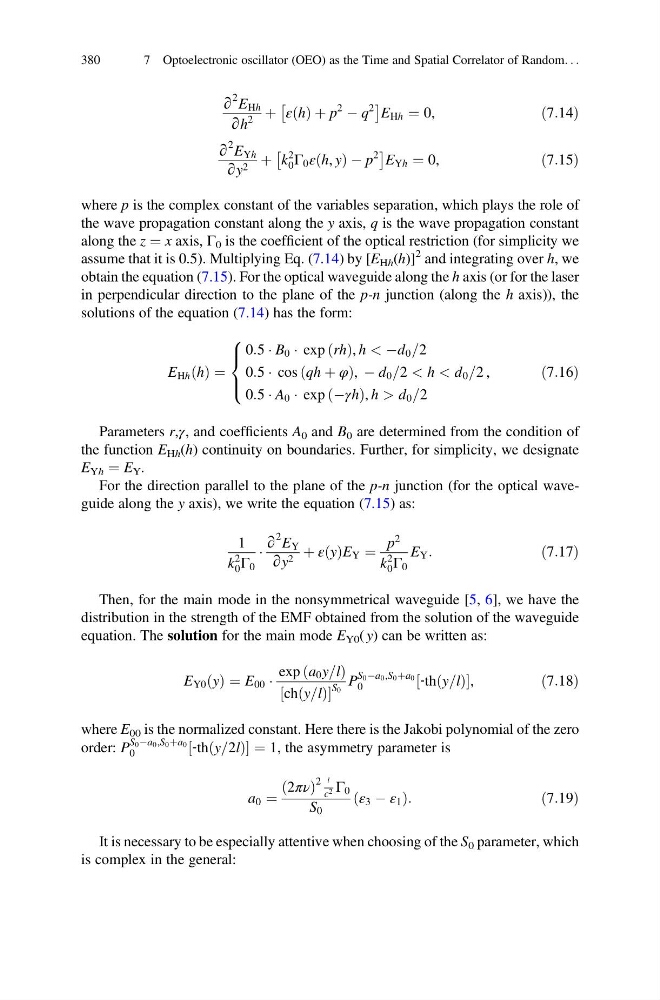
where p is the complex constant of the variables separation, which plays the role of
the wave propagation constant along the y axis, q is the wave propagation constant
along the z ¼ x axis, Γ 0 is the coefficient of the optical restriction (for simplicity we
assume that it is 0.5). Multiplying Eq. (7.14) by [E Hh (h)]
2 and integrating over h, we
obtain the equation (7.15). For the optical waveguide along the h axis (or for the laser
in perpendicular direction to the plane of the p-n junction (along the h axis)), the
solutions of the equation (7.14) has the form:
E Hh h
ð Þ ¼
0:5 Á B 0 Á exp rh
ð Þ, h < Àd 0 =2
0:5 Á cos qh þ φ
ð
Þ, À d 0 =2 < h < d 0 =2
0:5 Á A 0 Á exp Àγh
ð
Þ, h > d 0 =2
8
> <
> :
,
ð7:16Þ
Parameters r,γ, and coefficients A 0 and B 0 are determined from the condition of
the function E Hh (h) continuity on boundaries. Further, for simplicity, we designate
E Yh ¼ E Y .
For the direction parallel to the plane of the p-n junction (for the optical waveguide along the y axis), we write the equation (7.15) as:
1
k
2
0 Γ 0
Á
∂
2 E Y
∂y 2 þ ε y
ð ÞE Y ¼
p
2
k
2
0 Γ 0
E Y :
ð7:17Þ
Then, for the main mode in the nonsymmetrical waveguide [5, 6], we have the
distribution in the strength of the EMF obtained from the solution of the waveguide
equation. The solution for the main mode E Y0 ( y) can be written as:
E Y0 y
ð Þ ¼ E 00 Á
exp a 0 y=l
ð
Þ
ch y=l
ð Þ
½
S 0
P
S 0 Àa 0 ,S 0 þa 0
0
‐th y=l
ð Þ
½
,
ð7:18Þ
where E 00 is the normalized constant. Here there is the Jakobi polynomial of the zero
order: P
S 0 Àa 0 ,S 0 þa 0
0
‐th y=2l
ð
Þ
½
¼1, the asymmetry parameter is
a 0 ¼
2πν
ð
Þ
2 l
c 2 Γ 0
S 0
ε 3 À ε 1
ð
Þ:
ð7:19Þ
It is necessary to be especially attentive when choosing of the S 0 parameter, which
is complex in the general:
380
7 Optoelectronic oscillator (OEO) as the Time and Spatial Correlator of Random. . .
2 E Hh
∂h
2
þ ε h
ð Þ þ p
2
À q
2
Â
Ã
E Hh ¼ 0,
ð7:14Þ
∂
2 E Yh
∂y 2 þ k
2
0 Γ 0 ε h, y
ð ÞÀp
2
Â
Ã
E Yh ¼ 0,
ð7:15Þ
where p is the complex constant of the variables separation, which plays the role of
the wave propagation constant along the y axis, q is the wave propagation constant
along the z ¼ x axis, Γ 0 is the coefficient of the optical restriction (for simplicity we
assume that it is 0.5). Multiplying Eq. (7.14) by [E Hh (h)]
2 and integrating over h, we
obtain the equation (7.15). For the optical waveguide along the h axis (or for the laser
in perpendicular direction to the plane of the p-n junction (along the h axis)), the
solutions of the equation (7.14) has the form:
E Hh h
ð Þ ¼
0:5 Á B 0 Á exp rh
ð Þ, h < Àd 0 =2
0:5 Á cos qh þ φ
ð
Þ, À d 0 =2 < h < d 0 =2
0:5 Á A 0 Á exp Àγh
ð
Þ, h > d 0 =2
8
> <
> :
,
ð7:16Þ
Parameters r,γ, and coefficients A 0 and B 0 are determined from the condition of
the function E Hh (h) continuity on boundaries. Further, for simplicity, we designate
E Yh ¼ E Y .
For the direction parallel to the plane of the p-n junction (for the optical waveguide along the y axis), we write the equation (7.15) as:
1
k
2
0 Γ 0
Á
∂
2 E Y
∂y 2 þ ε y
ð ÞE Y ¼
p
2
k
2
0 Γ 0
E Y :
ð7:17Þ
Then, for the main mode in the nonsymmetrical waveguide [5, 6], we have the
distribution in the strength of the EMF obtained from the solution of the waveguide
equation. The solution for the main mode E Y0 ( y) can be written as:
E Y0 y
ð Þ ¼ E 00 Á
exp a 0 y=l
ð
Þ
ch y=l
ð Þ
½
S 0
P
S 0 Àa 0 ,S 0 þa 0
0
‐th y=l
ð Þ
½
,
ð7:18Þ
where E 00 is the normalized constant. Here there is the Jakobi polynomial of the zero
order: P
S 0 Àa 0 ,S 0 þa 0
0
‐th y=2l
ð
Þ
½
¼1, the asymmetry parameter is
a 0 ¼
2πν
ð
Þ
2 l
c 2 Γ 0
S 0
ε 3 À ε 1
ð
Þ:
ð7:19Þ
It is necessary to be especially attentive when choosing of the S 0 parameter, which
is complex in the general:
380
7 Optoelectronic oscillator (OEO) as the Time and Spatial Correlator of Random. . .