

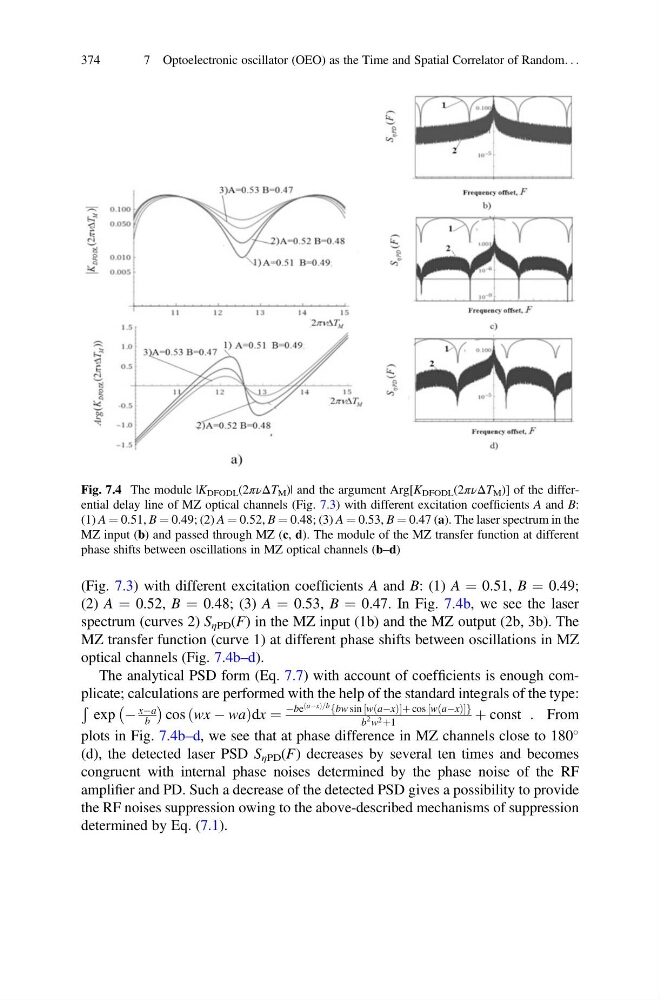
(Fig. 7.3) with different excitation coefficients A and B: (1) A ¼ 0.51, B ¼ 0.49;
(2) A ¼ 0.52, B ¼ 0.48; (3) A ¼ 0.53, B ¼ 0.47. In Fig. 7.4b, we see the laser
spectrum (curves 2) S ηPD (F) in the MZ input (1b) and the MZ output (2b, 3b). The
MZ transfer function (curve 1) at different phase shifts between oscillations in MZ
optical channels (Fig. 7.4b–d).
The analytical PSD form (Eq. 7.7) with account of coefficients is enough complicate; calculations are performed with the help of the standard integrals of the type:
Ð
exp À
xÀa
b
À
Á
cos wx À wa
ð
Þ dx ¼
Àbe
aÀx
ð
Þ =b bw sin w aÀx
ð
Þ
½
þcos w aÀx
ð
Þ
½
f
g
b
2 w 2 þ1
þ const . From
plots in Fig. 7.4b–d, we see that at phase difference in MZ channels close to 180
(d), the detected laser PSD S ηPD (F) decreases by several ten times and becomes
congruent with internal phase noises determined by the phase noise of the RF
amplifier and PD. Such a decrease of the detected PSD gives a possibility to provide
the RF noises suppression owing to the above-described mechanisms of suppression
determined by Eq. (7.1).
Fig. 7.4 The module |K DFODL (2πνΔT M )| and the argument Arg[K DFODL (2πνΔT M )] of the differential delay line of MZ optical channels (Fig. 7.3) with different excitation coefficients A and B:
(1) A ¼ 0.51, B ¼ 0.49; (2) A ¼ 0.52, B ¼ 0.48; (3) A ¼ 0.53, B ¼ 0.47 (a). The laser spectrum in the
MZ input (b) and passed through MZ (с, d). The module of the MZ transfer function at different
phase shifts between oscillations in MZ optical channels (b–d)
374
7 Optoelectronic oscillator (OEO) as the Time and Spatial Correlator of Random. . .
(2) A ¼ 0.52, B ¼ 0.48; (3) A ¼ 0.53, B ¼ 0.47. In Fig. 7.4b, we see the laser
spectrum (curves 2) S ηPD (F) in the MZ input (1b) and the MZ output (2b, 3b). The
MZ transfer function (curve 1) at different phase shifts between oscillations in MZ
optical channels (Fig. 7.4b–d).
The analytical PSD form (Eq. 7.7) with account of coefficients is enough complicate; calculations are performed with the help of the standard integrals of the type:
Ð
exp À
xÀa
b
À
Á
cos wx À wa
ð
Þ dx ¼
Àbe
aÀx
ð
Þ =b bw sin w aÀx
ð
Þ
½
þcos w aÀx
ð
Þ
½
f
g
b
2 w 2 þ1
þ const . From
plots in Fig. 7.4b–d, we see that at phase difference in MZ channels close to 180
(d), the detected laser PSD S ηPD (F) decreases by several ten times and becomes
congruent with internal phase noises determined by the phase noise of the RF
amplifier and PD. Such a decrease of the detected PSD gives a possibility to provide
the RF noises suppression owing to the above-described mechanisms of suppression
determined by Eq. (7.1).
Fig. 7.4 The module |K DFODL (2πνΔT M )| and the argument Arg[K DFODL (2πνΔT M )] of the differential delay line of MZ optical channels (Fig. 7.3) with different excitation coefficients A and B:
(1) A ¼ 0.51, B ¼ 0.49; (2) A ¼ 0.52, B ¼ 0.48; (3) A ¼ 0.53, B ¼ 0.47 (a). The laser spectrum in the
MZ input (b) and passed through MZ (с, d). The module of the MZ transfer function at different
phase shifts between oscillations in MZ optical channels (b–d)
374
7 Optoelectronic oscillator (OEO) as the Time and Spatial Correlator of Random. . .