

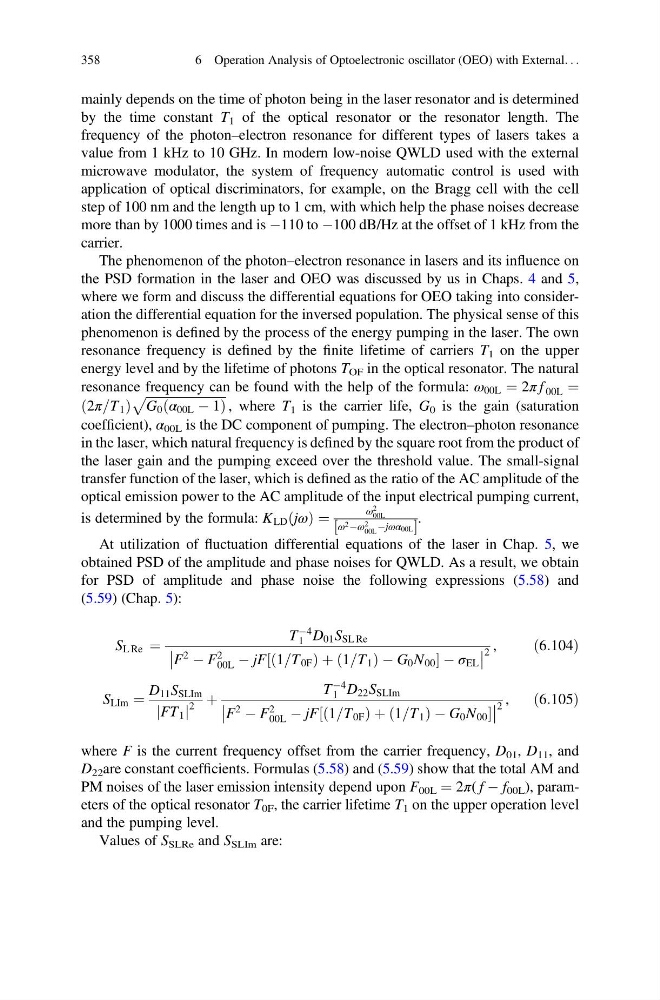
mainly depends on the time of photon being in the laser resonator and is determined
by the time constant T 1 of the optical resonator or the resonator length. The
frequency of the photon–electron resonance for different types of lasers takes a
value from 1 kHz to 10 GHz. In modern low-noise QWLD used with the external
microwave modulator, the system of frequency automatic control is used with
application of optical discriminators, for example, on the Bragg cell with the cell
step of 100 nm and the length up to 1 cm, with which help the phase noises decrease
more than by 1000 times and is À110 to À100 dB/Hz at the offset of 1 kHz from the
carrier.
The phenomenon of the photon–electron resonance in lasers and its influence on
the PSD formation in the laser and OEO was discussed by us in Chaps. 4 and 5,
where we form and discuss the differential equations for OEO taking into consideration the differential equation for the inversed population. The physical sense of this
phenomenon is defined by the process of the energy pumping in the laser. The own
resonance frequency is defined by the finite lifetime of carriers T 1 on the upper
energy level and by the lifetime of photons T OF in the optical resonator. The natural
resonance frequency can be found with the help of the formula: ω 00L ¼ 2π f 00L ¼
2π=T 1
ð
Þ
ffiffiffiffiffiffiffiffiffiffiffiffiffiffiffiffiffiffiffiffiffiffiffiffiffiffi
G 0 α 00L À 1
ð
Þ
p
, where T 1 is the carrier life, G 0 is the gain (saturation
coefficient), α 00L is the DC component of pumping. The electron–photon resonance
in the laser, which natural frequency is defined by the square root from the product of
the laser gain and the pumping exceed over the threshold value. The small-signal
transfer function of the laser, which is defined as the ratio of the AC amplitude of the
optical emission power to the AC amplitude of the input electrical pumping current,
is determined by the formula: K LD jω
ð Þ ¼
ω
2
00L
ω 2 Àω 2
00L
Àjωα 00L
½
.
At utilization of fluctuation differential equations of the laser in Chap. 5, we
obtained PSD of the amplitude and phase noises for QWLD. As a result, we obtain
for PSD of amplitude and phase noise the following expressions (5.58) and
(5.59) (Chap. 5):
S L Re ¼
T
À4
1 D 01 S SL Re
F
2
À F
2
00L À jF 1=T 0F
ð
Þþ 1=T 1
ð
ÞÀG 0 N 00
½
À σ EL
2 ,
ð6:104Þ
S LIm ¼
D 11 S SLIm
FT 1
j
j
2
þ
T
À4
1 D 22 S SLIm
F
2
À F
2
00L À jF 1=T 0F
ð
Þþ 1=T 1
ð
ÞÀ G 0 N 00
½
2 ,
ð6:105Þ
where F is the current frequency offset from the carrier frequency, D 01 , D 11 , and
D 22 are constant coefficients. Formulas (5.58) and (5.59) show that the total АМ and
PM noises of the laser emission intensity depend upon F 00L ¼ 2π( f À f 00L ), parameters of the optical resonator T 0F , the carrier lifetime T 1 on the upper operation level
and the pumping level.
Values of S SLRe and S SLIm are:
358
6 Operation Analysis of Optoelectronic oscillator (OEO) with External. . .
by the time constant T 1 of the optical resonator or the resonator length. The
frequency of the photon–electron resonance for different types of lasers takes a
value from 1 kHz to 10 GHz. In modern low-noise QWLD used with the external
microwave modulator, the system of frequency automatic control is used with
application of optical discriminators, for example, on the Bragg cell with the cell
step of 100 nm and the length up to 1 cm, with which help the phase noises decrease
more than by 1000 times and is À110 to À100 dB/Hz at the offset of 1 kHz from the
carrier.
The phenomenon of the photon–electron resonance in lasers and its influence on
the PSD formation in the laser and OEO was discussed by us in Chaps. 4 and 5,
where we form and discuss the differential equations for OEO taking into consideration the differential equation for the inversed population. The physical sense of this
phenomenon is defined by the process of the energy pumping in the laser. The own
resonance frequency is defined by the finite lifetime of carriers T 1 on the upper
energy level and by the lifetime of photons T OF in the optical resonator. The natural
resonance frequency can be found with the help of the formula: ω 00L ¼ 2π f 00L ¼
2π=T 1
ð
Þ
ffiffiffiffiffiffiffiffiffiffiffiffiffiffiffiffiffiffiffiffiffiffiffiffiffiffi
G 0 α 00L À 1
ð
Þ
p
, where T 1 is the carrier life, G 0 is the gain (saturation
coefficient), α 00L is the DC component of pumping. The electron–photon resonance
in the laser, which natural frequency is defined by the square root from the product of
the laser gain and the pumping exceed over the threshold value. The small-signal
transfer function of the laser, which is defined as the ratio of the AC amplitude of the
optical emission power to the AC amplitude of the input electrical pumping current,
is determined by the formula: K LD jω
ð Þ ¼
ω
2
00L
ω 2 Àω 2
00L
Àjωα 00L
½
.
At utilization of fluctuation differential equations of the laser in Chap. 5, we
obtained PSD of the amplitude and phase noises for QWLD. As a result, we obtain
for PSD of amplitude and phase noise the following expressions (5.58) and
(5.59) (Chap. 5):
S L Re ¼
T
À4
1 D 01 S SL Re
F
2
À F
2
00L À jF 1=T 0F
ð
Þþ 1=T 1
ð
ÞÀG 0 N 00
½
À σ EL
2 ,
ð6:104Þ
S LIm ¼
D 11 S SLIm
FT 1
j
j
2
þ
T
À4
1 D 22 S SLIm
F
2
À F
2
00L À jF 1=T 0F
ð
Þþ 1=T 1
ð
ÞÀ G 0 N 00
½
2 ,
ð6:105Þ
where F is the current frequency offset from the carrier frequency, D 01 , D 11 , and
D 22 are constant coefficients. Formulas (5.58) and (5.59) show that the total АМ and
PM noises of the laser emission intensity depend upon F 00L ¼ 2π( f À f 00L ), parameters of the optical resonator T 0F , the carrier lifetime T 1 on the upper operation level
and the pumping level.
Values of S SLRe and S SLIm are:
358
6 Operation Analysis of Optoelectronic oscillator (OEO) with External. . .